

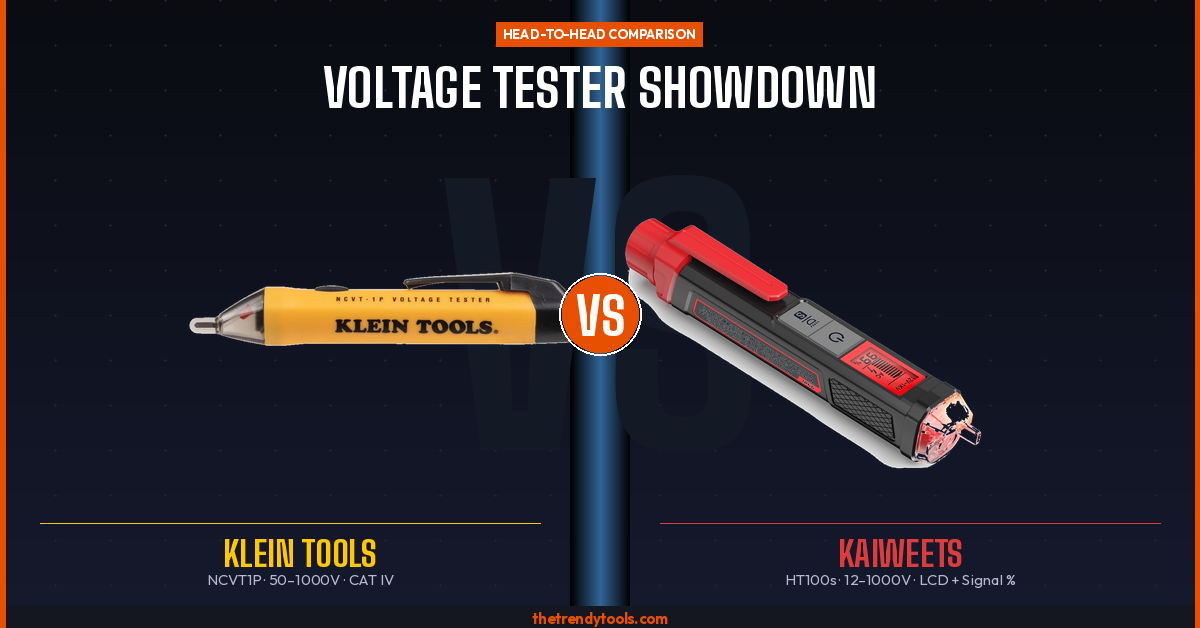
Quick Verdict: Both the KAIWEETS HT100s and the Klein Tools NCVT1P are solid non-contact voltage testers — but they serve slightly different users. The KAIWEETS HT100s is a feature-rich, tech-forward tester packed with dual range, LCD display, signal percentage, and breakpoint detection. The Klein Tools NCVT1P is a battle-tested, no-fuss workhorse designed for fast, reliable detection with maximum simplicity. Choosing between them comes down to whether you want more data or more speed.
Introduction: Why Choosing the Right Voltage Tester Matters
A non-contact voltage tester (NCV) is one of the most essential safety tools any electrician, DIYer, or homeowner can own. Unlike a traditional multimeter, an NCV tester lets you detect live voltage without touching any bare wires — just hold it near a wire, outlet, or switch, and it tells you whether voltage is present. Fast, simple, and potentially life-saving.
The challenge is that not all voltage testers are created equal. Some are bare-bones beepers that just tell you “yes” or “no.” Others are loaded with features like dual sensitivity ranges, LCD displays, signal strength indicators, and wire breakpoint detection. Each approach has its merits depending on who’s using the tool and how.
Today we’re putting two popular models head-to-head: the KAIWEETS HT100s and the Klein Tools NCVT1P. Both are pen-style, non-contact voltage testers in a similar price bracket — but they take meaningfully different approaches to the job. Let’s dig in.
Product Overview
KAIWEETS HT100s Voltage Tester
The KAIWEETS HT100s is a dual-range non-contact voltage tester from KAIWEETS, a brand that has quickly earned a strong reputation for delivering feature-packed electrical testing tools at competitive prices. The HT100s is their compact flagship NCV pen, designed to give users more diagnostic information than a typical pass/fail tester.
It features a bright LCD screen showing real-time signal percentage and bar graph, dual sensitivity ranges (12–70V and 70–1000V AC), live/null wire detection, breakpoint finding capability, and multi-mode alarm indicators. In short, it tries to do more than just beep — it tries to tell you how much voltage is present and where it’s coming from.
Model Number: HT100s ASIN: B0C2CNC624 First Available: April 2023 Safety Rating: IEC CAT III 1000V / CAT IV 600V Batteries: 2 AAA (included) Weight: 86g / 3.03 oz Dimensions: 6.1″ x 0.9″ x 1.1″
Klein Tools NCVT1P Voltage Tester
Klein Tools needs little introduction in the professional trades. Founded in 1857, Klein is one of the most trusted names in hand tools and electrical testing equipment in North America. The NCVT1P is their entry-level non-contact voltage tester pen — a clean, no-nonsense tool that prioritizes reliability and ease of use above all else.
There’s no LCD, no signal percentage, no sensitivity adjustment. What you get is a simple, durable pen that lights up green when powered on, flashes red and beeps when it detects voltage, and is rated for a 6.6-foot (2 meter) drop. It detects AC voltage from 50V to 1000V with a CAT IV 1000V safety rating — the highest category available for a tool like this.
Safety Rating: CAT IV 1000V Voltage Range: 50V–1000V AC Drop Protection: 6.6 ft (2 m) Design: Compact pen with pocket clip Batteries: AAA (auto power-off included)
Feature-by-Feature Comparison
1. Voltage Detection Range
KAIWEETS HT100s: Dual range — Low (12V–70V AC) and High (70V–1000V AC)
Klein Tools NCVT1P: Single range — 50V–1000V AC
This is one of the most significant practical differences between the two tools. The KAIWEETS HT100s can detect voltages as low as 12V AC, making it useful for low-voltage applications like doorbells, thermostats, irrigation system wiring, landscape lighting, and HVAC controls. By pressing the S button, you can switch between sensitivity modes to pick up these weaker signals that the Klein simply cannot detect.
The Klein NCVT1P starts at 50V AC, which covers standard household current (120V/240V) and commercial electrical systems perfectly well — but it won’t help you troubleshoot your doorbell or low-voltage thermostat wiring.
Winner: KAIWEETS HT100s — the dual range gives it significantly broader application.
2. Display & Signal Information
KAIWEETS HT100s: Backlit LCD screen with bar graph, signal percentage (0–100%), and color-coded indicators (red = live/high voltage, green = low voltage/neutral)
Klein Tools NCVT1P: No display. LED indicator only — green = power on, red flashing = voltage detected
This is where the two tools diverge most dramatically in philosophy. The KAIWEETS HT100s gives you a live readout of signal strength as a percentage, so you can see whether you’re getting a weak bleed-over from an adjacent wire or a strong, direct detection from a live conductor. This distinction matters more than it might seem — especially when tracing wires through walls or checking for phantom voltage.
The Klein NCVT1P gives you a binary answer: voltage or no voltage. Red flash = yes. No flash = no. For quick outlet checks or simple circuit verification, that’s all most people need. But for more nuanced diagnostic work, the lack of signal information can be limiting.
Winner: KAIWEETS HT100s — more information equals better diagnostics in complex situations.
3. Safety Rating
KAIWEETS HT100s: IEC CAT III 1000V / CAT IV 600V, CE certified, double insulated
Klein Tools NCVT1P: CAT IV 1000V
Both tools are rated for professional electrical work, but there’s a subtle difference worth noting. The Klein NCVT1P carries a CAT IV 1000V rating — the highest category, covering outdoor and utility-level applications including service entrance panels and outdoor transmission lines. The KAIWEETS is rated CAT III 1000V / CAT IV 600V, which covers most indoor industrial and commercial environments.
In practice, for the vast majority of residential and commercial electrical work, both ratings are more than adequate. CAT IV 1000V gives the Klein a slight edge in professional utility work, but it’s unlikely to matter for most users.
Winner: Klein Tools NCVT1P — marginally, for the highest-risk utility environments.
4. Alarm System & Indicators
KAIWEETS HT100s: Multi-mode alarm — LED tip glows red when voltage detected, beep frequency increases with voltage proximity/strength, screen turns red (high voltage) or green (low voltage/neutral), percentage display shows signal intensity
Klein Tools NCVT1P: Audible beep + red LED flash when voltage detected; green LED confirms tester is powered on
The KAIWEETS HT100s alarm system is notably more informative. The variable beep frequency — which speeds up as you move closer to a voltage source — helps you zero in on the exact location of a wire or fault. The color-coded screen (red vs. green) adds a layer of immediate visual clarity about whether you’re looking at a live or neutral conductor.
The Klein’s alarm is effective but fixed — it beeps and flashes red regardless of signal strength. You won’t get any information about proximity or intensity from the audible/visual indicators alone.
Winner: KAIWEETS HT100s — the variable frequency alarm and dual-color screen provide significantly more diagnostic value.
5. Breakpoint Detection
KAIWEETS HT100s: Yes — the variable signal percentage and proximity-based beeping allow you to trace wire paths and locate breaks or faults
Klein Tools NCVT1P: Limited — the binary detection makes wire tracing difficult beyond basic proximity
Wire breakpoint detection is the ability to trace a live wire through a wall and identify where the signal disappears — indicating a break, loose connection, or fault. The KAIWEETS HT100s is genuinely useful for this task because its signal percentage drops gradually as you move away from the wire and disappears at the break point.
The Klein NCVT1P can give you a rough idea of wire location, but the lack of signal strength data makes precise breakpoint identification much harder.
Winner: KAIWEETS HT100s — not even close for this specific application.
6. Build Quality & Durability
KAIWEETS HT100s: Compact pen design, pocket hook, reinforced tip, double insulated housing. Weight: 86g.
Klein Tools NCVT1P: Compact pen with pocket clip, 6.6-foot (2 meter) drop protection, lightweight and durable housing.
Klein Tools has over 160 years of experience building tools for professional tradespeople, and that heritage shows. The NCVT1P is explicitly rated for 6.6-foot drop protection — a spec that reflects the reality that tools get dropped on job sites, often from ladders or scaffolding. The Klein’s build quality is battle-tested and trusted by professionals who depend on their tools daily.
The KAIWEETS HT100s feels solid and well-made for its price point, but it doesn’t carry an explicit drop rating. Given that it has more internal components (LCD, additional circuitry), it’s potentially more vulnerable to impact damage.
Winner: Klein Tools NCVT1P — the explicit drop rating and brand reputation for durability give it the edge here.
7. Ease of Use
KAIWEETS HT100s: Slightly more involved — one button (S) for sensitivity switching, LCD screen to read and interpret, multiple alarm modes to understand
Klein Tools NCVT1P: Power on, point at wire, read LED. That’s it.
Simplicity is the Klein’s greatest strength and its only real competitive advantage over the KAIWEETS in terms of features. If you hand the NCVT1P to someone who has never used a voltage tester before, they’ll figure it out in about 10 seconds. If you hand them the HT100s, they might need a few minutes to understand what the screen and sensitivity modes mean.
For professional electricians who know exactly what they’re doing and want minimal distraction, the Klein’s simplicity is genuinely appealing. For homeowners or less experienced users who want more guidance from their tool, the KAIWEETS’s color-coded display is actually helpful.
Winner: Klein Tools NCVT1P — for pure ease of use and speed in familiar applications.
8. Additional Features
KAIWEETS HT100s:
- Built-in LED flashlight for working in dark spaces
- Low power indicator (triggers below 2.5V battery voltage)
- Auto power-off after 5 minutes of inactivity
- 36-month warranty / after-sale service
Klein Tools NCVT1P:
- Auto power-off to conserve batteries
- Pocket clip
- Not recommended for tamper-resistant outlets (per Klein’s own advisory)
The KAIWEETS HT100s has a slight accessory edge with the built-in flashlight and low-battery warning. The flashlight is a small but genuinely useful addition when you’re working in an electrical panel or tight crawl space. The 36-month warranty also outpaces what most competitors offer.
Winner: KAIWEETS HT100s — the flashlight and longer warranty add real value.
Side-by-Side Specifications Table
| Feature | KAIWEETS HT100s | Klein Tools NCVT1P |
|---|---|---|
| Voltage Range | 12–70V / 70–1000V AC | 50–1000V AC |
| Display | Backlit LCD + Bar Graph | LED Only |
| Signal Percentage | Yes (0–100%) | No |
| Sensitivity Adjustment | Yes (S button) | No |
| Safety Rating | CAT III 1000V / CAT IV 600V | CAT IV 1000V |
| Color Alarm | Red (live) / Green (neutral) | Red flash / Green standby |
| Breakpoint Detection | Yes | Limited |
| LED Flashlight | Yes | No |
| Drop Protection | Not rated | 6.6 ft (2 m) |
| Auto Power-Off | Yes (5 min) | Yes |
| Low Battery Indicator | Yes (below 2.5V) | No |
| Batteries | 2 AAA (included) | AAA |
| Weight | 3.03 oz / 86g | Not specified |
| Dimensions | 6.1″ x 0.9″ x 1.1″ | Compact pen |
| Warranty | 36 months | Standard Klein warranty |
| Best For | Diagnostics & low-voltage work | Quick checks & job site durability |
Who Should Buy the KAIWEETS HT100s?
The KAIWEETS HT100s is the better choice if:
You work with low-voltage systems. Doorbells, thermostats, irrigation controllers, landscape lighting, and HVAC wiring all operate below 50V — completely invisible to the Klein NCVT1P. If any of these are part of your regular work, the KAIWEETS is the only option between these two.
You need to trace wires or find breakpoints. The signal percentage and variable-frequency alarm make the HT100s a genuinely capable wire-tracing tool. For anyone doing renovation work, troubleshooting old wiring, or locating faults in hidden cables, this matters enormously.
You want more information from your tester. The LCD display, signal bar, and color-coded screen give you more data to work with. If you’re newer to electrical work or simply want a tool that provides more context, the KAIWEETS is more informative and arguably safer for less experienced users.
You’re a homeowner or DIYer doing varied electrical tasks. The KAIWEETS handles a wider range of scenarios without needing multiple tools.
Who Should Buy the Klein Tools NCVT1P?
The Klein Tools NCVT1P is the better choice if:
You’re a professional electrician doing primarily standard voltage work. For fast outlet checks, panel verification, and circuit testing in the 50–1000V range, the Klein’s speed and simplicity are genuine advantages on a busy job site.
Durability is your top priority. The 6.6-foot drop rating and Klein’s legendary build reputation make this the more rugged option. If you routinely drop tools or work in harsh environments, the Klein is more likely to survive the abuse.
You want a trusted brand with a long track record. Klein Tools has been building electrical tools since 1857. Their products are used by professional electricians throughout North America, and the NCVT1P’s reliability is well-documented through years of professional use.
You want the simplest possible tool. Sometimes simple is better. If you just need to know “is this wire live or not?” without reading a display or interpreting percentages, the Klein delivers that answer faster than any other tool on this list.
Final Verdict: Which One Wins?
There’s no universal winner here — it genuinely depends on what you need from a voltage tester.
Choose the KAIWEETS HT100s if you want a versatile, feature-rich tester that handles low voltage, provides signal strength data, includes breakpoint detection, and offers more diagnostic capability for the money. It’s the better tool for homeowners, DIYers, HVAC technicians, and electricians who deal with a wide variety of voltage levels.
Choose the Klein Tools NCVT1P if you’re a professional electrician who wants a dead-simple, ultra-durable, trusted tool for standard voltage detection work. No screen to read, no buttons to press — just fast, reliable detection you can trust job after job.
If you can only own one voltage tester and you deal with a wide variety of electrical tasks, the KAIWEETS HT100s offers more versatility for most users. But if you’re equipping a professional toolkit and already have a multimeter for the nuanced work, the Klein NCVT1P’s simplicity and durability make it the perfect quick-check companion.
Either way, both tools will keep you safer than working without one — and that’s ultimately what a voltage tester is all about.
Looking for more in-depth tool reviews and buying guides? Explore the latest at thetrendytools.com for expert comparisons, hands-on tests, and the best tool deals.