

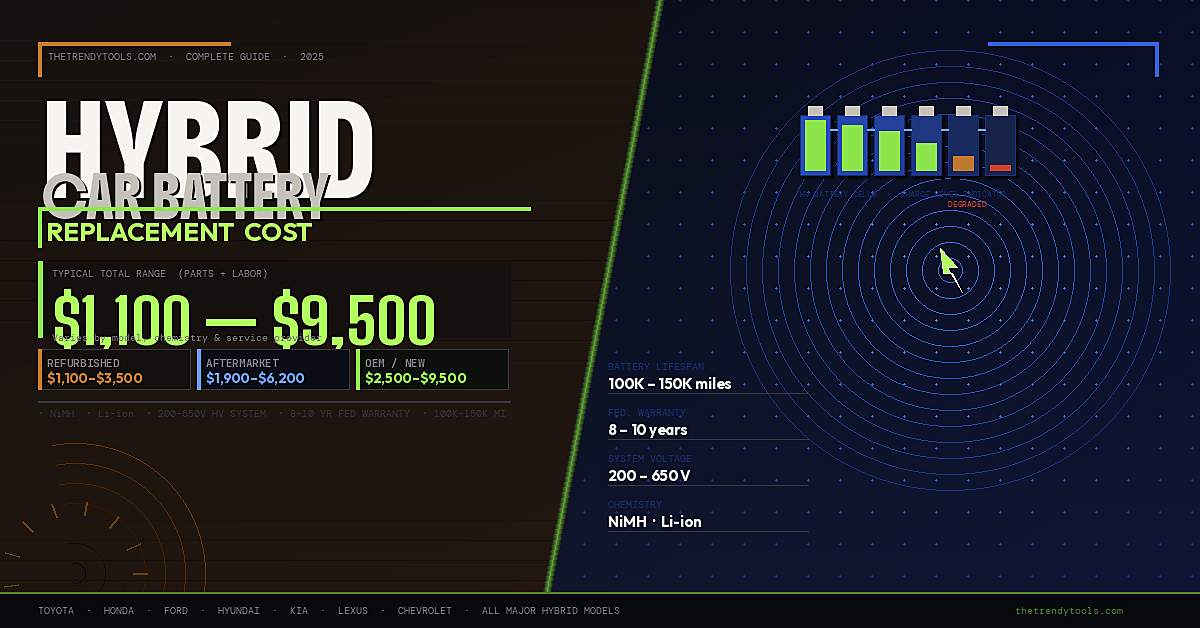
Owning a hybrid car is one of the smartest financial and environmental decisions a driver can make — until the day you face the dreaded hybrid battery replacement. The cost can catch many owners completely off guard, and without the right information, you could easily overpay by hundreds or even thousands of dollars.
In this comprehensive guide, we’ll cover everything you need to know about hybrid car battery replacement cost in 2025 — from average prices by make and model, to what factors drive costs up or down, whether refurbished batteries are worth it, and how to make the smartest financial decision for your situation.
What Is a Hybrid Battery and Why Does It Need Replacing?
Unlike a standard 12V car battery, a hybrid vehicle uses a high-voltage battery pack — typically a nickel-metal hydride (NiMH) or lithium-ion (Li-ion) pack — that powers the electric motor working alongside the gasoline engine. This battery pack is the heart of the hybrid system, enabling regenerative braking, electric-only driving at low speeds, and improved fuel economy.
Over time, these battery packs degrade. The individual cells within the pack lose capacity, which translates into reduced fuel economy, more frequent engine cycling, and eventually a dashboard warning light. Most hybrid batteries last between 8 and 15 years, or roughly 100,000 to 150,000 miles, depending on climate, driving habits, and how well the vehicle was maintained.
When the battery reaches end-of-life, replacement is usually the only viable path to restoring full hybrid performance — and the cost is significantly higher than a conventional car battery swap.
Average Hybrid Car Battery Replacement Cost
Hybrid battery replacement is one of the more expensive automotive repairs you’ll encounter. Here’s a general cost overview:
| Replacement Type | Battery Cost | Labor Cost | Total Estimated Cost |
|---|---|---|---|
| New OEM Battery (Dealership) | $2,000 – $8,000 | $500 – $1,500 | $2,500 – $9,500 |
| New Aftermarket Battery | $1,500 – $5,000 | $400 – $1,200 | $1,900 – $6,200 |
| Refurbished / Reconditioned Battery | $700 – $2,500 | $400 – $1,000 | $1,100 – $3,500 |
| DIY (Battery Only, No Labor) | $700 – $4,500 | $0 | $700 – $4,500 |
| Individual Cell Replacement | $200 – $600 | $300 – $800 | $500 – $1,400 |
These are ballpark figures — the actual cost varies dramatically depending on the make, model, year, and which service provider you choose. Let’s break it down further by popular hybrid model.
Hybrid Battery Replacement Cost by Car Model
Different hybrid vehicles use very different battery packs, and the price gap between models can be enormous. Here’s what owners of the most popular hybrids typically pay in 2025:
Toyota Prius (All Generations)
The Toyota Prius is the world’s best-selling hybrid and has one of the most well-documented battery replacement histories. Replacement cost varies by generation:
- 2001–2003 (1st Gen): $1,500 – $3,000 (NiMH, refurbs widely available)
- 2004–2009 (2nd Gen): $2,000 – $4,000 (OEM or quality aftermarket)
- 2010–2015 (3rd Gen): $2,500 – $4,500
- 2016–2022 (4th Gen): $3,000 – $5,500
- 2023+ (5th Gen): $3,500 – $6,000+ (Li-ion, less aftermarket availability)
The Prius benefits enormously from a mature aftermarket — more refurbished and third-party battery options exist for Prius than virtually any other hybrid, which helps keep costs competitive.
Toyota Camry Hybrid
The Camry Hybrid uses a robust NiMH battery in older generations and a lithium-ion pack in newer models. Typical replacement cost ranges from $3,000 to $6,500 for a new battery, with refurbished options available from $1,500 to $3,000. Labor at a shop typically adds $600–$1,200.
Toyota RAV4 Hybrid
The RAV4 Hybrid, one of the best-selling hybrid SUVs on the market, carries a higher battery replacement bill due to its larger pack. Expect to pay $4,000 to $7,000 for a new OEM battery, plus $800–$1,500 in labor. Aftermarket alternatives run $2,500–$5,000.
Honda Accord Hybrid
Honda’s two-motor hybrid system uses a lithium-ion battery pack in modern Accord Hybrids. Replacement cost typically falls between $3,500 and $7,000 for a new battery, with labor adding $700–$1,300. The Honda Accord Hybrid’s battery is more complex to replace than older NiMH systems, which tends to push labor costs higher.
Honda CR-V Hybrid
Similar to the Accord Hybrid in architecture, the CR-V Hybrid battery replacement runs approximately $3,800 to $7,500 including parts and labor. Aftermarket availability is still developing, so fewer budget options exist compared to the Prius ecosystem.
Ford Escape Hybrid / Fusion Hybrid
Ford hybrid battery packs are generally in the mid-range price tier. Expect $3,000 to $6,000 all-in for most Ford hybrid models, with older Escape Hybrids (2005–2012) having the benefit of a more established aftermarket — some refurbished packs are available for as low as $1,200–$2,000 for these older models.
Chevrolet Volt (PHEV)
The Volt’s larger plug-in hybrid battery (16–18.4 kWh depending on year) makes it one of the pricier replacements. A new battery assembly can cost $5,000 to $9,000, though the used/refurbished market has become robust for this discontinued model, with options available between $2,000 and $4,500.
Hyundai Sonata / Ioniq Hybrid
Hyundai hybrid battery replacement costs range from $3,000 to $6,500 for most models. One significant advantage: Hyundai and Kia offer an industry-leading 10-year / 100,000-mile warranty on hybrid batteries in most states — meaning many owners never pay for this replacement at all if the battery fails within warranty.
Lexus ES 300h / RX 450h
As premium Toyota-based hybrids, Lexus battery packs command premium prices. A Lexus hybrid battery replacement typically runs $4,500 to $8,500 for OEM parts, with luxury dealership labor pushing the total toward $6,000–$10,000 in some markets.
Key Factors That Affect Hybrid Battery Replacement Cost
Understanding why costs vary so widely helps you make smarter decisions when the time comes.
1. Battery Chemistry: NiMH vs. Lithium-Ion
Older hybrids (most pre-2015 models) use nickel-metal hydride (NiMH) batteries. These are well-understood, and the aftermarket for refurbished NiMH packs is mature and competitive. Newer hybrids increasingly use lithium-ion (Li-ion) technology, which offers better energy density and performance but is more expensive to replace — and has less aftermarket availability for older pack recovery.
2. Battery Pack Size
A mild hybrid or standard HEV (hybrid electric vehicle) uses a smaller battery pack primarily for fuel efficiency assistance — these cost less to replace. A plug-in hybrid electric vehicle (PHEV) carries a much larger battery designed for significant all-electric range, which commands a substantially higher replacement price. For example, replacing a Toyota Prius standard hybrid battery is far less expensive than replacing the larger pack in a Chevrolet Volt or Toyota Prius Prime.
3. New vs. Refurbished vs. Reconditioned
This is one of the most impactful decisions you’ll make:
- New OEM battery: Maximum reliability and warranty coverage. Most expensive option. Best for newer vehicles still in primary use.
- New aftermarket battery: Often 20–40% cheaper than OEM. Quality varies by brand — research carefully. Reputable brands like Dorman and A1 Hybrid offer solid options.
- Refurbished/reconditioned battery: Used packs that have been tested, weak cells replaced, and brought back to functional spec. Cost savings are substantial (40–60% off new), but quality and warranty depend heavily on the rebuilder. Best for older, high-mileage vehicles where investing in a new pack may not make financial sense.
- Individual cell replacement: A specialist replaces only the failed cells within your existing pack. Most affordable option when only a portion of the pack has degraded. Requires a skilled hybrid battery specialist.
4. Dealership vs. Independent Shop vs. Hybrid Specialist
Where you take your car matters enormously for both cost and quality:
- Dealership: Highest labor rates, OEM parts, factory-trained technicians. Best for vehicles still under warranty. Expect to pay a premium of 30–50% over independent shops.
- Independent mechanic: Lower labor rates, but not all independents are experienced with high-voltage hybrid systems. Always verify hybrid experience before committing.
- Hybrid battery specialist: The sweet spot for most owners. These shops (such as Bumblebee Batteries, Greentec Auto, or local hybrid specialists) focus exclusively on hybrid batteries, often offer refurbished options, and have competitive pricing with knowledgeable technicians.
5. Geographic Location
Labor rates vary significantly by region. Metropolitan areas in California, New York, and the Pacific Northwest typically have the highest labor rates — sometimes 40–60% above the national average. Rural areas and southern states generally offer more competitive pricing.
6. Warranty Coverage
This may be the most important factor of all. In the United States, federal law requires automakers to warrant hybrid battery packs for at least 8 years or 100,000 miles in all 50 states. In California (and the 14 states that follow California emissions standards), that warranty extends to 10 years or 150,000 miles.
Some manufacturers — notably Hyundai and Kia — have voluntarily extended their hybrid battery warranty to 10 years / 100,000 miles nationwide. Always check your remaining warranty coverage before paying out of pocket for any hybrid battery work.
Is a Hybrid Battery Replacement Worth It?
This is the central question most hybrid owners face, and the answer depends on several variables. Here’s a practical framework:
When Battery Replacement IS Worth It
- The vehicle is still in good mechanical condition with low to moderate mileage on the engine and other components
- You’re within warranty coverage (in which case, replacement is effectively free)
- The vehicle has been well maintained and has strong resale value
- A refurbished battery option significantly reduces the cost to replace
- You depend on the vehicle for daily transportation and a reliable replacement car is not readily available
When Battery Replacement May NOT Be Worth It
- The vehicle has very high mileage (150,000+) and other major components (transmission, engine) are also showing age
- The total repair cost exceeds the vehicle’s current market value
- Other significant repairs are also needed simultaneously
- You were already planning to upgrade to a newer, more efficient hybrid or EV
A good rule of thumb used by many mechanics: if the battery replacement cost exceeds 50% of the vehicle’s current market value, it’s time to seriously evaluate whether replacement or moving on to a new vehicle makes more financial sense.
Signs Your Hybrid Battery Is Failing
Catching a degrading hybrid battery early can give you more time to plan and budget for the replacement. Watch for these warning signs:
- Reduced fuel economy: A noticeable drop in miles per gallon — especially if your MPG has been declining gradually — is often the first sign of battery degradation.
- Hybrid battery warning light: The triangle with an exclamation point, or a specific “Ready” light that won’t illuminate on a Toyota Prius, indicates a battery system fault.
- Frequent engine cycling: If your gasoline engine is running more often than usual at speeds where the car should be in electric mode, the battery may no longer hold sufficient charge.
- State of charge fluctuations: Erratic or rapid changes in the battery state-of-charge display suggest failing cells within the pack.
- Reduced electric-only driving range: For PHEVs especially, a significant drop in all-electric range is a clear indicator of capacity loss.
- Increased cabin heat from battery area: Thermal runaway or abnormal heat generation near the battery pack location (often under rear seats or in the trunk) warrants immediate inspection.
- Multiple error codes: A scan with an OBD-II reader may reveal codes pointing specifically to battery module failures.
How to Save Money on Hybrid Battery Replacement
The good news: you have more options than most people realize when it comes to reducing the cost of hybrid battery replacement.
1. Check Your Warranty First — Always
Before spending a single dollar, verify your warranty status. Check with your automaker directly using your VIN. Many owners replace batteries out of pocket when they were actually still under the federal emissions warranty — don’t make this mistake.
2. Get Multiple Quotes
Don’t accept the first quote you receive. Get at least three estimates — one from a dealership, one from an independent shop experienced with hybrids, and one from a hybrid battery specialist. The price difference can be $1,000–$3,000 for the same service.
3. Consider a Reputable Refurbished Battery
For older vehicles especially, a quality refurbished battery from a reputable rebuilder can be a smart choice. Companies like Greentec Auto, Bumblebee Batteries, and Hybrid Automotive offer reconditioned packs with warranties ranging from 12 months to 3 years. Always ask about the warranty and the testing process used before purchasing.
4. Explore Individual Cell Replacement
If only a portion of your battery pack has degraded, individual cell replacement by a specialist can restore performance at a fraction of the cost of a full pack replacement. Not all shops offer this service, but hybrid battery specialists typically do. This is most viable for NiMH packs (Toyota, Honda, Ford older models).
5. Ask About Core Return Discounts
Many battery suppliers offer a core charge discount — meaning they’ll reduce the price of your new or refurbished battery if you return your old pack (which has valuable materials that can be recycled and reconditioned). This can save $200–$500 in some cases.
6. Shop Around for Labor
While hybrid battery work does require specialized training due to high-voltage safety requirements, labor rates vary widely. A specialist shop may offer significantly lower labor rates than a dealership while providing comparable — or in some cases superior — expertise on hybrid-specific repairs.
7. Check for Extended Warranty Programs
Several automakers have issued technical service bulletins (TSBs) or customer satisfaction programs that extend battery coverage beyond the standard warranty for specific model years experiencing higher-than-expected failure rates. Toyota and Honda in particular have occasionally issued such goodwill coverage programs. Check with your dealer and search the NHTSA database for your specific model.
DIY Hybrid Battery Replacement: Is It Realistic?
Unlike a standard 12V car battery, hybrid battery packs involve high-voltage systems (typically 200–650 volts) that pose a genuine risk of serious injury or death if handled improperly. This is not hyperbole — hybrid battery packs carry enough voltage to be lethal without proper training and equipment.
That said, experienced and technically inclined owners with proper safety equipment (high-voltage insulated gloves, safety goggles, and a thorough understanding of the specific vehicle’s hybrid system) have successfully replaced hybrid batteries themselves, saving $500–$1,500 in labor costs. For most people, however, this is not the right approach.
If you’re determined to go the DIY route, we strongly recommend:
- Completing a hybrid safety training course before touching any high-voltage components
- Acquiring proper high-voltage personal protective equipment
- Following the manufacturer’s service manual precisely, particularly for disabling the high-voltage system via the service plug or maintenance disconnect
- Having a second person present for safety when working with the high-voltage pack
- Never rushing or skipping safety steps under any circumstances
How Long Does Hybrid Battery Replacement Take?
At a dealership or experienced shop, a hybrid battery replacement typically takes 2 to 5 hours of labor time, meaning you can often have your vehicle back the same day it’s dropped off. More complex vehicles, or cases where additional diagnostic work is needed, may require an overnight stay.
After installation, the shop should perform a battery conditioning cycle and verify that all hybrid system codes are clear before returning the vehicle. Don’t be afraid to ask specifically what post-installation testing and verification procedures they follow.
Hybrid Battery Replacement Warranty: What to Expect
Warranty coverage on replacement batteries varies significantly:
- New OEM dealership battery: Typically 12 months / 12,000 miles, though some manufacturers offer longer coverage on replacement parts.
- New aftermarket battery: Usually 1–2 years depending on the brand.
- Refurbished battery from a reputable specialist: Commonly 1–3 years, sometimes with mileage limits.
- Individual cell replacement: Warranty varies by shop, typically 6–12 months on the work performed.
Always get the warranty terms in writing before authorizing any hybrid battery work, and understand what is and is not covered (e.g., whether labor is included in warranty repairs).
Hybrid Battery Replacement Cost: Quick Reference Summary
| Vehicle | Battery Type | Estimated Total Cost (Parts + Labor) |
|---|---|---|
| Toyota Prius (2nd/3rd Gen) | NiMH | $2,000 – $4,500 |
| Toyota Prius (4th/5th Gen) | Li-ion | $3,500 – $6,500 |
| Toyota Camry Hybrid | NiMH / Li-ion | $2,500 – $6,500 |
| Toyota RAV4 Hybrid | NiMH / Li-ion | $4,000 – $8,000 |
| Honda Accord Hybrid | Li-ion | $3,500 – $7,500 |
| Honda CR-V Hybrid | Li-ion | $3,800 – $7,500 |
| Ford Escape / Fusion Hybrid | NiMH | $2,500 – $6,000 |
| Chevrolet Volt (PHEV) | Li-ion | $4,000 – $9,000 |
| Hyundai Sonata / Ioniq Hybrid | Li-ion | $3,000 – $6,500 |
| Lexus ES 300h / RX 450h | NiMH | $4,500 – $10,000 |
Final Thoughts
Hybrid battery replacement is one of the most significant maintenance expenses a hybrid car owner will face — but it doesn’t have to be a financial disaster. By understanding your warranty coverage, exploring all replacement options (new OEM, aftermarket, and refurbished), getting competitive quotes from multiple sources, and assessing the overall condition of your vehicle, you can make a well-informed decision that makes sense for your specific situation.
For most hybrid owners, the vehicle’s overall reliability and fuel savings still make financial sense even after accounting for a battery replacement — especially when a quality refurbished battery significantly reduces the out-of-pocket cost. For others, a failing hybrid battery becomes the catalyst for upgrading to a newer, more capable hybrid or fully electric vehicle.
Whatever route you choose, go in prepared, get everything in writing, and never skip checking your warranty coverage first. That single step alone could save you several thousand dollars.
Have you replaced the hybrid battery in your vehicle? Share your experience, what you paid, and which service provider you used in the comments below — your insights are invaluable to other hybrid owners facing the same decision!