

One of the most common concerns among hybrid vehicle owners — and people shopping for one — is the cost of eventually replacing the high-voltage battery. It’s a legitimate worry. Unlike a standard 12V battery that you swap out for $100, a hybrid battery replacement is a significant expense. But with the right information, you won’t be caught off guard.
In this guide, we break down the real hybrid battery replacement cost in 2025 — by hybrid type, by brand, by replacement option — along with warranty facts, money-saving strategies, warning signs, and the honest answer to whether replacement is actually worth it.
What Does a Hybrid Battery Replacement Cost in 2025?
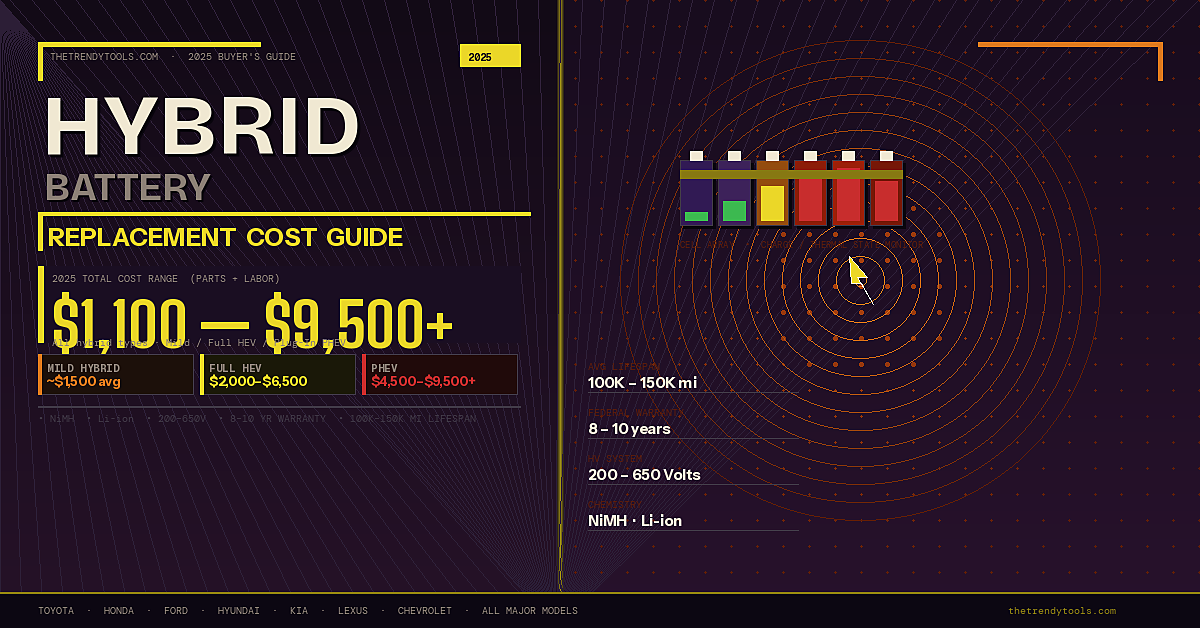
The short answer: total hybrid battery replacement costs typically range from $1,100 to over $9,500 in 2025, depending on your vehicle, battery type, and who does the work. That’s a wide range, but it exists for good reason — there are dramatically different types of hybrid systems on the road today, each with very different price tags.
Here’s the broad picture before we get into specifics:
| Replacement Option | Battery (Parts) | Labor | Total Cost |
|---|---|---|---|
| New OEM Battery (Dealership) | $2,500 – $8,000 | $500 – $1,500 | $3,000 – $9,500+ |
| New Aftermarket Battery | $1,500 – $5,000 | $400 – $1,200 | $1,900 – $6,200 |
| Remanufactured / Refurbished | $700 – $2,500 | $400 – $1,000 | $1,100 – $3,500 |
| Individual Cell Replacement | $200 – $600 | $300 – $800 | $500 – $1,400 |
Now let’s get more specific — because the type of hybrid you drive matters enormously.
Cost by Hybrid Type: Mild, Full, and Plug-In
Mild Hybrid (MHEV) Battery Replacement Cost
Mild hybrids use a smaller battery that assists the engine rather than powering the wheels directly. They’re the most affordable to repair. As of mid-2025, the average cost of a replacement mild hybrid battery in the U.S. sits around $1,500, though the range is broad depending on make and model. Some examples of current MHEV battery prices:
- Volvo XC60 mild hybrid: ~$1,159
- BMW M340i mild hybrid: ~$1,200+
- Mazda CX-70 hybrid: ~$1,980
- Mercedes C-Class mild hybrid: ~$2,116
- Audi RS Q8 mild hybrid: $2,000+
Add $400–$800 in labor and you’re typically looking at $1,600–$3,000 total for a mild hybrid battery replacement.
Full Hybrid (HEV) Battery Replacement Cost
This is the most common type of hybrid — think Toyota Prius, Honda Accord Hybrid, Ford Escape Hybrid. Full hybrids use a larger battery that can power the wheels at low speeds independently. Expect to pay $2,000–$6,500 all-in for most popular models, with remanufactured options bringing that down meaningfully. Here are real-world 2025 prices:
- Toyota Prius (2010–2015): $1,299 remanufactured / $2,249 new (plus labor)
- Honda Civic Hybrid (2012–2015): $1,395 remanufactured / $1,749 new (plus labor)
- Toyota Camry Hybrid: $2,500–$6,000 total (parts + labor)
- Honda Accord Hybrid: $3,000–$7,000 total
- Toyota RAV4 Hybrid: $4,000–$8,000 total
Plug-In Hybrid (PHEV) Battery Replacement Cost
PHEVs carry the largest and most expensive battery packs because they’re designed to drive significant distances on electricity alone. A Chevrolet Volt (16–18.4 kWh battery) or Toyota RAV4 Prime will cost considerably more to replace than a standard hybrid. Budget $4,500–$9,500+ for PHEV battery replacement, including labor. The used/refurbished PHEV battery market is growing but still limited compared to full hybrids.
Hybrid Battery Replacement Cost by Brand and Model
Let’s look at what owners of the most popular hybrid vehicles are actually paying in 2025:
Toyota Hybrid Battery Replacement Cost
Toyota is the most established hybrid brand in the world, and their battery ecosystem has the most developed aftermarket. Costs by model:
- Toyota Prius (2nd Gen, 2004–2009): $2,000–$3,500 total
- Toyota Prius (3rd Gen, 2010–2015): $2,000–$4,000 total
- Toyota Prius (4th Gen, 2016–2022): $3,000–$5,500 total
- Toyota Prius (5th Gen, 2023+): $3,500–$6,500+ total (Li-ion, limited aftermarket)
- Toyota Camry Hybrid: $3,000–$6,500 total
- Toyota RAV4 Hybrid: $4,500–$8,000 total
- Toyota Highlander Hybrid: $4,000–$8,000+ total
Toyota hybrids benefit from decades of real-world data and a mature third-party battery market. An owner of a 2007 Camry Hybrid reported in 2017 that dealer replacement cost $6,500 — and prices have increased since, making dealership OEM replacement more expensive, while the refurbished market has matured and become more competitive.
Honda Hybrid Battery Replacement Cost
- Honda Civic Hybrid (2003–2015): $1,395–$2,500 total (very mature aftermarket)
- Honda Accord Hybrid: $3,500–$7,500 total
- Honda CR-V Hybrid: $3,800–$7,500 total
- Honda Insight: $2,000–$4,500 total
An important note on older Honda hybrids: Honda no longer manufactures replacement batteries for the original 1999–2006 Insight. Third-party packs are available for about $1,749, but availability can’t be guaranteed long-term. This is a useful reminder that parts availability over the long haul should factor into any hybrid purchase decision.
Hyundai & Kia Hybrid Battery Replacement Cost
Hyundai and Kia offer one of the best hybrid battery warranties in the industry: 10 years / 100,000 miles on most new hybrid models, which means many owners never pay out of pocket for replacement at all. When replacement is needed out of warranty:
- Hyundai Sonata Hybrid: $2,500–$5,000 for OEM battery + $500–$1,000 labor
- Hyundai Ioniq Hybrid: $2,500–$5,500 total
- Kia Niro Hybrid: $2,800–$5,500 total
Some Kia models even have a pre-set replacement interval of 10 years or 150,000 miles built into the service schedule — making battery replacement a planned, predictable cost rather than a surprise.
Ford Hybrid Battery Replacement Cost
- Ford Escape Hybrid (2005–2012): $2,000–$4,500 total (mature aftermarket, NiMH)
- Ford Fusion Hybrid: $2,500–$5,500 total
- Ford F-150 Hybrid / Maverick Hybrid: $3,500–$7,000+ total
Lexus Hybrid Battery Replacement Cost
As luxury Toyota-platform vehicles, Lexus hybrids command premium pricing across the board:
- Lexus ES 300h / RX 450h: $4,500–$8,500 for battery + $800–$1,500 labor = $5,500–$10,000 total
- Lexus NX 350h: $5,000–$9,500 total
Chevrolet / GM Hybrid Battery Replacement Cost
- Chevrolet Volt (PHEV): $4,000–$9,000 total (larger pack, but used/refurb market has grown significantly for this discontinued model)
- Chevy Malibu Hybrid / Silverado Mild Hybrid: $1,500–$4,000 total
What Factors Affect the Cost Most?
1. Battery Chemistry: NiMH vs. Lithium-Ion
Older hybrids (mostly pre-2015) use nickel-metal hydride (NiMH) technology. These packs are well-understood, widely available in the aftermarket, and less expensive to replace. Newer hybrids increasingly use lithium-ion (Li-ion) — higher energy density, better performance, but costlier and with a smaller used/refurbished market for most models.
Battery chemistry also affects which replacement options are realistic. NiMH packs have a strong remanufactured market. For newer Li-ion systems, OEM or quality new aftermarket is often the most reliable choice — refurb availability is catching up but not yet as mature.
2. Pack Size (kWh)
A mild hybrid battery storing 0.45 kWh costs a fraction of a PHEV battery storing 16 kWh. Battery capacity is the single biggest driver of raw parts cost. For context: a 2018 Honda Accord Hybrid has a 1.3 kWh battery pack; the Chevrolet Volt tops out at 18.4 kWh — and the price difference is enormous.
3. New OEM vs. Aftermarket vs. Remanufactured
This decision has the most dramatic impact on your out-of-pocket cost:
- New OEM: Maximum reliability and warranty protection. Best for newer vehicles still worth the investment. Most expensive.
- New aftermarket: Typically 20–35% cheaper than OEM. Quality varies by brand — research warranties and reputation carefully. Reputable options include Dorman and A1 Hybrid.
- Remanufactured: Used packs fully inspected, weak cells replaced, and brought to spec. Best cost savings — 40–60% off new OEM. Best suited for older, high-mileage vehicles. Greentec Auto is a well-known specialist in this space.
- Individual cell replacement: Only replaces failed cells within your existing pack. Lowest cost option when just a portion of the pack has degraded. Requires a hybrid specialist — not all shops offer this.
4. Where You Take It
- Dealership: OEM parts, trained technicians, highest labor rates. Best for warranty work or very new vehicles.
- Independent hybrid specialist: Often the best value — deep expertise, more flexible on parts options, competitive labor rates. Specialists like Bumblebee Batteries, Greentec Auto, and local hybrid-focused shops are worth seeking out.
- General independent mechanic: Lower rates, but make sure they have documented hybrid high-voltage experience before trusting them with a 200–650V battery system.
5. Your Location
Labor rates in major coastal metro areas can run 40–60% higher than the national average. Getting quotes from multiple shops — including ones slightly outside your immediate area — can save hundreds of dollars on labor alone.
6. Warranty Coverage
Before spending any money, check your warranty status. Federal law in the U.S. requires all automakers to cover hybrid battery packs for a minimum of 8 years or 100,000 miles. In California and the 14 states that follow California emissions standards, that extends to 10 years or 150,000 miles. Hyundai and Kia voluntarily offer 10-year/100,000-mile coverage nationwide — one of the best warranty programs in the industry.
Many owners have replaced batteries out of pocket when they were actually still under coverage. Always verify your warranty status with your manufacturer using your VIN before authorizing any paid repair.
Is Hybrid Battery Replacement Worth It in 2025?
This is the question that matters most. And in most cases — yes, it’s worth it. Here’s why:
Even with rising costs across the board in 2025, buying a replacement vehicle is dramatically more expensive than a battery repair. A quality used hybrid starts at $20,000–$25,000+. A remanufactured battery replacement for a well-maintained vehicle can cost under $2,000 all-in — and give you another 5–10 years of reliable driving with no monthly payments, lower insurance, and no depreciation hit.
The math becomes less favorable when:
- The vehicle has very high mileage and multiple other components are also near end-of-life
- The total cost of the battery replacement exceeds 50% of the vehicle’s current market value
- Major additional repairs are needed at the same time
- You were already planning to upgrade to a newer EV or hybrid
For most well-maintained hybrids with 100,000–150,000 miles and no other major issues, battery replacement remains the smarter financial decision over vehicle replacement.
Warning Signs Your Hybrid Battery Is Failing
Catching a deteriorating battery early gives you time to plan, budget, and avoid being stranded. Watch for:
- Declining fuel economy: The most common early sign. If your MPG has been creeping down over months, your hybrid battery is likely no longer holding adequate charge.
- Battery warning light: The triangle with an exclamation mark, or on a Prius, a “Ready” light that won’t illuminate, signals a system fault requiring immediate attention.
- State-of-charge swings: A battery indicator that jumps rapidly from full to empty — or vice versa — points to degraded cells that can no longer hold stable charge.
- More engine cycling: If the gas engine runs constantly at speeds where the car should be gliding in electric-only mode, the battery isn’t delivering enough power.
- Reduced EV range (PHEVs): A noticeable drop in all-electric range is the clearest sign of Li-ion capacity loss in a plug-in hybrid.
- Cooling fan running loudly or constantly: The hybrid battery cooling fan shouldn’t be audible during normal driving. If it’s loud or running at idle, the battery may be running hotter than normal — a sign of stress or cell failure.
- Multiple error codes: An OBD-II scan revealing codes related to battery modules, voltage imbalances, or temperature sensors often precedes full failure.
How to Save Money on Hybrid Battery Replacement
Always Check Warranty First
It’s worth repeating: verify your warranty status before spending a dollar. Check directly with the manufacturer using your VIN at their official website or by calling the customer support line.
Get Three Quotes Minimum
Prices vary dramatically between dealerships, independent shops, and specialists. Getting three quotes — ideally one from each type of service provider — regularly saves owners $1,000 or more. Don’t let urgency force you into the first quote you receive.
Consider a Remanufactured Battery
For vehicles 5+ years old, a quality remanufactured pack from a reputable specialist typically offers 40–60% savings over a new OEM battery, and most come with 1–3 year warranties. For a well-maintained Prius or Civic Hybrid, this is often the smartest choice financially.
Ask About Individual Cell Replacement
If diagnostics show only certain cells within the pack have failed, a hybrid specialist may be able to replace just those cells rather than the entire pack — at a fraction of the full replacement cost. This is most viable for NiMH systems in older Toyota and Honda hybrids.
Ask About Core Return Discounts
Many battery suppliers offer a $200–$500 discount when you return your old pack (the “core charge”). The old pack has valuable recoverable materials. Always ask about core return programs before purchasing.
Check for Technical Service Bulletins
Manufacturers occasionally issue Technical Service Bulletins (TSBs) or customer satisfaction programs that extend battery coverage beyond standard warranty for specific model years with higher-than-expected failure rates. Search the NHTSA database by your VIN or ask a dealer to check for open campaigns on your vehicle before paying for any battery work.
How Long Does Hybrid Battery Replacement Take?
At an experienced shop, hybrid battery replacement typically takes 2–5 hours, meaning same-day turnaround is common. More complex vehicles, or jobs requiring additional diagnostic work, may take an extra day. After installation, the shop should run a battery conditioning cycle and clear all error codes before returning the vehicle. Don’t be shy about asking what post-installation testing they perform.
DIY Hybrid Battery Replacement: Honest Advice
Hybrid battery packs operate at 200–650 volts — enough to cause serious injury or death if mishandled. This is not a weekend project for the average home mechanic.
That said, technically skilled owners with proper high-voltage safety equipment (insulated gloves rated for 1000V, safety glasses, and thorough knowledge of the specific vehicle’s service procedure) have successfully completed these replacements and saved $500–$1,500 in labor. If you go this route, the non-negotiables are:
- Study the manufacturer’s service manual thoroughly — especially the high-voltage system disabling procedure via the service plug
- Use rated high-voltage PPE, not regular work gloves
- Never work alone — have someone present who can respond in an emergency
- Allow the capacitors to discharge for the time specified in the service manual before touching any HV components
For most people, the $400–$1,000 labor cost is money very well spent for safety alone.
Hybrid Battery Replacement Warranties: What to Expect
| Battery Type | Typical Warranty |
|---|---|
| New OEM (dealership) | 12 months / 12,000 miles (some manufacturers offer more) |
| New aftermarket | 1–2 years depending on brand |
| Remanufactured (reputable specialist) | 1–3 years, sometimes with mileage limits |
| Individual cell replacement | 6–12 months on work performed |
Always get warranty terms in writing, and confirm whether labor is included in any warranty claim — some cover parts only.
2025 Quick-Reference: Hybrid Battery Replacement Cost by Model
| Vehicle | Battery Type | Total Cost (Parts + Labor) |
|---|---|---|
| Toyota Prius (Gen 2–3) | NiMH | $2,000 – $4,000 |
| Toyota Prius (Gen 4–5) | Li-ion | $3,500 – $6,500 |
| Toyota Camry Hybrid | NiMH / Li-ion | $3,000 – $6,500 |
| Toyota RAV4 Hybrid | Li-ion | $4,500 – $8,000 |
| Toyota Highlander Hybrid | NiMH / Li-ion | $4,000 – $8,000+ |
| Honda Civic Hybrid | NiMH | $1,400 – $2,500 |
| Honda Accord Hybrid | Li-ion | $3,500 – $7,500 |
| Honda CR-V Hybrid | Li-ion | $3,800 – $7,500 |
| Ford Escape / Fusion Hybrid | NiMH | $2,500 – $5,500 |
| Chevrolet Volt (PHEV) | Li-ion | $4,000 – $9,000 |
| Hyundai Sonata / Ioniq Hybrid | Li-ion | $3,000 – $6,500 |
| Lexus ES 300h / RX 450h | NiMH | $5,500 – $10,000 |
| Mild Hybrids (avg. MHEV) | Li-ion (small) | $1,600 – $3,000 |
Final Thoughts
Hybrid battery replacement is one of the most expensive single repairs you’ll face as a hybrid owner — but it’s also one of the most manageable when you approach it with the right information. The key takeaways for 2025:
- Always check your warranty first. Federal law mandates 8-year/100,000-mile coverage minimum. Many owners pay out of pocket when they didn’t need to.
- Get multiple quotes. Price differences between a dealership and a hybrid specialist for the same job can easily exceed $1,500.
- Consider remanufactured for older vehicles. The quality of the remanufactured hybrid battery market has improved significantly — reputable specialists offer solid warranties and real-world savings of 40–60%.
- Replacement usually beats replacement car. Unless your vehicle has major additional issues, replacing the battery is almost always more economical than buying a different hybrid or EV.
- Mild hybrids are the most affordable — averaging around $1,500 for the battery itself as of mid-2025 — making them a low-risk hybrid entry point from a long-term maintenance perspective.
Armed with these numbers and strategies, you’re well-positioned to make a smart, informed decision — whether you’re facing an imminent replacement, planning ahead, or deciding whether a used hybrid is worth buying.
Have you replaced the hybrid battery in your vehicle recently? Share your model, what you paid, and whether you went OEM, aftermarket, or remanufactured in the comments below — your experience helps other drivers make better decisions!