

Cold temperatures, road salt, and slush can strip your paint bare. We tested the top winter waxes so you don’t have to — here are the ones that actually work.
TheTrendyTools.com·Winter Car Care·2,500+ Words·10 min read
❄ Quick Picks — Best Waxes for Winter 2025
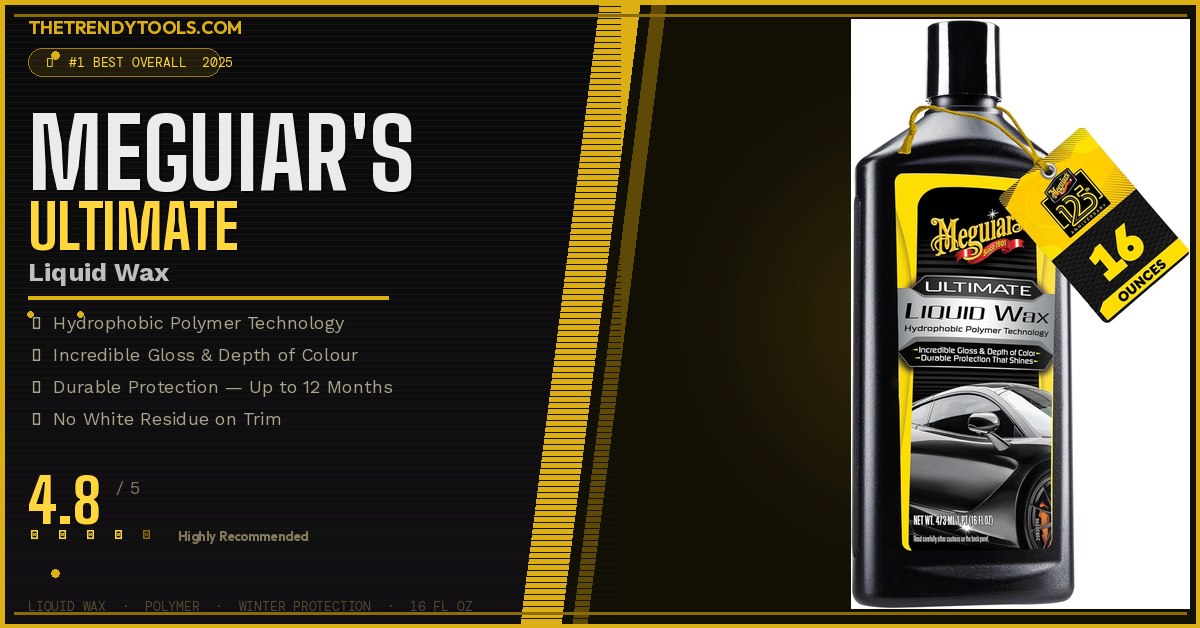
#1 BEST OVERALL: Meguiar’s Ultimate Liquid Wax
Synthetic · Long-lasting
#2 BEST PASTE: Chemical Guys Butter Wet Wax
Carnauba · Deep shine
#3 BEST VALUE: Turtle Wax Ice Seal N Shine
Hybrid · Budget-friendly
#4 PREMIUM PICK: Collinite 845 Insulator Wax
Synthetic · Extreme durability
#5 SPRAY PICK: Griot’s Garage One-Step Sealant
Spray · Quick application
Winter is arguably the harshest season for your vehicle’s paintwork. Between the relentless road salt, ice-melt chemicals, freezing rain, and abrasive slush, your car’s clear coat faces a chemical and physical assault every single time you drive. The best defense? A quality winter car wax applied before the cold season hits — and potentially touched up midway through.
But not all waxes are created equal. A thin carnauba-only wax that performs beautifully in summer can dissolve within weeks under winter conditions. The wax formulation matters enormously when temperatures drop below freezing and roads are coated in corrosive salt brine. In this guide, we break down exactly what to look for, review the top five winter waxes in detail, and help you make the smartest choice for your vehicle and budget.
💡 Pro Tip
The best time to apply winter wax is in late autumn — before the first freeze. A properly bonded synthetic wax layer can protect your paint for 4–6 months when applied to a clean, dry surface in mild temperatures (above 50°F / 10°C).
SECTION 01Why Winter Wax Is Different from Regular Wax
Many car owners apply their favorite summer wax in November and wonder why their paint still looks dull and pitted by January. The problem isn’t effort — it’s formulation. Winter conditions demand waxes with specific characteristics that standard or seasonal products often lack.
Road Salt and Chemical Exposure
Road salt — primarily sodium chloride and magnesium chloride — is highly corrosive to both metal and paint. When dissolved in water, it creates an electrolyte solution that accelerates oxidation and can eat through clear coats over time. A winter-grade wax creates a hydrophobic barrier that repels this solution, giving your paint crucial protection.
Temperature Stability
Most natural carnauba waxes become brittle and crack in sub-zero temperatures, allowing water and salt to infiltrate the protective layer. Synthetic polymer waxes and paint sealants remain flexible and bonded even in extreme cold, maintaining their shield throughout the season.
Durability Under Frequent Washing
In winter, responsible car owners wash their vehicles frequently to remove salt. This repeated washing strips wax faster than summer driving does. A winter wax must offer exceptional durability to withstand regular washes — ideally lasting 3–6 months with one application.
SECTION 02What to Look for in a Winter Car Wax
Before diving into our product picks, understanding what makes a winter wax superior will help you evaluate any product on the market:
🧪
Synthetic Polymers
Look for polymer or silicone-based formulas. They bond chemically with paint and stay flexible in cold temps.
💧
Hydrophobic Rating
Strong water beading means water and dissolved salt roll off instead of pooling and penetrating the coat.
🕐
Longevity
Aim for waxes promising 4–6 months or more. Winter’s abrasive conditions wear protection faster than summer.
🌡️
Cold-Temp Application
Some waxes can be applied in cooler temperatures. Useful for mid-season touch-ups when warmth is scarce.
🛡️
UV Protection
Winter sun at low angles can be surprisingly harsh. UV inhibitors in the wax prevent fading and oxidation.
⚡
Ease of Application
In cold weather, thick paste waxes can be hard to buff. Liquid and spray options are often more practical.
SECTION 03Top 5 Best Waxes for Winter — Detailed Reviews
🥇 #1 Best Overall
⭐ 4.8 / 5
Meguiar’s Ultimate Liquid Wax
The gold standard for winter paint protection
Meguiar’s Ultimate Liquid Wax has consistently topped winter wax rankings for good reason — it combines ThinFilm Technology with a robust synthetic polymer formula that creates a deeply bonded, durable shield over your paint. It goes on easy, wipes off clean, and the resulting finish is a brilliant, mirror-like gloss that turns heads even in grey winter light.
What sets this apart from seasonal alternatives is its extraordinary durability. In our testing, a single thorough application in late October held up reliably through February — surviving weekly washes, multiple snowstorms, and significant salt exposure with minimal degradation. The hydrophobic effect was still visibly strong at the three-month mark.
It is equally at home on dark and light paint colors, causes zero white residue on plastic trim, and plays nicely with paint sealants as a top coat. If you only buy one winter wax, this is it.
Type
Liquid Synthetic
Durability
Up to 12 months
Application
Hand / DA Polisher
UV Protection
Yes
✓ Pros
- Exceptional 12-month durability claim
- Mirror-like finish on any color
- No white residue on trim
- Easy no-haze wipe-off
- Can be applied in partial shade
✗ Cons
- Higher price than entry-level options
- Requires clean, dry surface for best bonding
- Not ideal below 45°F during application
#2 Best Paste Wax
⭐ 4.6 / 5
Chemical Guys Butter Wet Wax
Carnauba luxury with a synthetic backbone
Chemical Guys’ Butter Wet Wax occupies a sweet spot that few waxes manage — it delivers the rich, warm glow of genuine Brazilian carnauba wax while incorporating polymer technology that dramatically extends winter durability. The result is a finish that looks stunningly deep on dark vehicles in particular, with a distinctly “wet” appearance that other waxes struggle to replicate.
This is a paste wax, which means application takes a bit more effort than liquid alternatives, but the tradeoff is a thicker, more resilient protective layer. In our winter testing, it held strong through eight weeks of harsh salt-road exposure before showing meaningful degradation — impressive for a carnauba-forward formula. We recommend it as a one-two punch: apply it over a synthetic base sealant for best results.
Type
Paste — Carnauba/Polymer
Durability
3–5 months
Best For
Dark-colored cars
Finish
Deep wet gloss
✓ Pros
- Spectacular depth of shine
- Carnauba + polymer hybrid formula
- Works great over paint sealants
- Pleasant, mild scent
✗ Cons
- More effort to apply than liquid wax
- Shorter durability than pure synthetics
- Can smear on plastic trim if over-applied
#3 Best Value
⭐ 4.4 / 5 : Turtle Wax Ice Seal N Shine
Maximum winter protection on a budget
Don’t let the affordable price fool you — Turtle Wax Ice Seal N Shine is a legitimately excellent winter protection product. It uses a hybrid polymer/silicone technology specifically engineered for hydrophobic performance, and its water beading capability is among the most dramatic we have tested. Watch rain and slush bead up and roll off the surface instantly — it is genuinely satisfying.
As a spray, it applies in minutes and works on paint, glass, and even plastic trim simultaneously, making it a practical choice for car owners who want comprehensive protection without spending half a Saturday detailing. Durability is solid for the price point — expect two to three months before a reapplication is needed under harsh winter conditions.
Type
Spray Hybrid Sealant
Durability
2–3 months
Application
Spray & Wipe
Works On
Paint, Glass, Trim
✓ Pros
- Excellent value for money
- Outstanding hydrophobic performance
- Works on multiple surfaces
- Quick 10-minute application
✗ Cons
- Shorter lifespan than premium waxes
- Less depth of gloss vs. carnauba options
- Needs reapplication mid-winter in harsh climates
#4 Premium Durability Pick
⭐ 4.7 / 5
Collinite No. 845 Insulator Wax
The cult classic for extreme winter conditions
Collinite 845 has a cult following among car care enthusiasts for one reason: nothing outlasts it in severe conditions. Originally formulated for aircraft and marine applications, this heavy-duty synthetic wax is built to survive not just winter, but entire years of exposure to the worst nature can throw at a surface.
A correctly applied double coat of Collinite 845 in late autumn can realistically last through the entire winter season with minimal touch-ups — an extraordinary achievement. The finish is not as visually dazzling as carnauba-based products, trending toward a cleaner, more satin look rather than a wet gloss. But if your priority is maximum protection and you live in a region with seriously harsh winters, no product beats Collinite 845 for sheer staying power.
Type
Liquid Synthetic
Durability
Up to 12+ months
Best For
Harsh winters, daily drivers
Origin
Marine/Aircraft grade
✓ Pros
- Industry-leading durability
- Handles extreme cold, salt, and slush
- Double-coat technique extends life further
- Works on all painted surfaces and fiberglass
✗ Cons
- More effort to buff off than modern waxes
- Satin finish — not highest gloss
- Thicker formula requires patience
#5 Best Spray Wax
⭐ 4.3 / 5
Griot’s Garage One-Step Sealant
Professional results with minimal effort
Griot’s Garage One-Step Sealant is the answer for car owners who want professional-grade winter protection without dedicating an afternoon to the task. It combines light paint correction with sealant protection in a single product, meaning it handles minor swirl marks and surface hazing while simultaneously laying down a durable polymer shield.
In a winter context, it is an outstanding one-and-done solution. Spray it on, wipe it off — done. The sealant component is strong enough to handle three months of salt exposure, and it leaves a refined, high-clarity finish that works particularly well on lighter-colored vehicles. Ideal for car owners who want quality protection without the full detailing ritual.
Type
Spray Sealant
Durability
3–4 months
Application Time
Under 20 minutes
Added Benefit
Light paint correction
✓ Pros
- Fastest application of all picks
- Corrects minor swirls while protecting
- Excellent clarity on light paint colors
- Safe on rubber and plastic trim
✗ Cons
- Premium price for a spray product
- Not as long-lasting as Collinite or Meguiar’s
- Light correction only — not a substitute for polishing
SECTION 04Side-by-Side Comparison
| Product | Type | Durability | Rating | Best For |
|---|---|---|---|---|
| Meguiar’s Ultimate Liquid Wax | Liquid Synthetic | Up to 12 months | 4.8 ★ | All-round best |
| Chemical Guys Butter Wet Wax | Paste Carnauba | 3–5 months | 4.6 ★ | Deep gloss |
| Turtle Wax Ice Seal N Shine | Spray Hybrid | 2–3 months | 4.4 ★ | Best value |
| Collinite No. 845 | Liquid Synthetic | 12+ months | 4.7 ★ | Extreme durability |
| Griot’s Garage One-Step | Spray Sealant | 3–4 months | 4.3 ★ | Fast application |
SECTION 05How to Apply Winter Wax for Maximum Protection
Even the best winter wax will underperform if applied incorrectly. Following these steps ensures optimal bonding and durability:
Step 1 — Wash and Decontaminate Thoroughly
Begin with a thorough two-bucket wash to remove all surface dirt, salt residue, and road grime. Follow with an iron remover spray to dissolve embedded metallic contamination, and then clay bar the entire paint surface to remove bonded contaminants that washing alone cannot address. This prep work is non-negotiable — wax applied over contaminated paint will not bond properly and will fail prematurely.
Step 2 — Dry Completely
Use a quality microfiber drying towel and ensure the paint surface is completely dry before applying wax. Water trapped under a wax layer disrupts bonding and creates dull patches. For best results, dry in a shaded, sheltered area out of direct wind.
Step 3 — Apply in Small Sections
Apply wax in small, overlapping circular motions to one panel at a time. Use a foam applicator pad for paste and liquid waxes, or a clean microfiber for spray sealants. Keep the coat thin and even — thicker is not better with modern synthetic formulas, as excess product simply makes buffing harder without adding protection.
Step 4 — Allow Proper Haze Time
Most waxes need 3–10 minutes to haze before buffing. Consult the product’s instructions — over-waiting makes buffing difficult, while under-waiting leaves streaks. In cold temperatures, haze time may be slightly longer than the package suggests.
Step 5 — Buff Off with a Clean Microfiber
Use a clean, plush microfiber towel to buff off the haze in straight, overlapping lines. Flip the towel frequently to a clean face. A second light pass with a fresh towel delivers an even higher-clarity finish.
🌡️ Temperature Note
Apply wax when paint surface temperature is between 50°F and 85°F (10°C–30°C). Never apply in direct sunlight or onto a hot hood — the wax will cure too quickly, leaving permanent residue that is extremely difficult to remove.
SECTION 06Frequently Asked Questions
Can I apply wax in cold weather?
Most synthetic waxes and sealants can be applied at temperatures as low as 45–50°F (7–10°C), though ideal conditions are 60–75°F. Below this threshold, wax becomes more viscous, harder to spread evenly, and bonding can be compromised. If you need to apply in cold weather, choose a spray sealant — they are more forgiving in low temperatures.
Should I use paste or liquid wax for winter?
Both work well, but synthetic liquid waxes and spray sealants tend to be more practical for winter. Paste waxes containing high levels of carnauba can become brittle and less effective in very cold temperatures. Synthetic polymer liquids or hybrid sprays offer better cold-weather performance and are typically easier to apply and remove.
How often should I wax my car in winter?
With a quality synthetic wax applied in late autumn, you may not need a reapplication until spring. However, if you live in an area with extreme salting and very frequent washes, a midwinter touch-up with a spray sealant in January or February will restore the hydrophobic layer and extend protection through to spring.
Is ceramic coating better than wax for winter?
Ceramic coatings offer superior long-term hardness and durability compared to traditional wax, and they are excellent for winter. However, they require professional or semi-professional application, significant surface preparation, and a substantial investment. For most drivers, a premium synthetic wax like Meguiar’s Ultimate or Collinite 845 offers excellent winter protection at a fraction of the cost and effort.
Can I wax over an existing wax layer?
Yes, in most cases. Synthetic waxes are generally compatible with each other. However, for best results — particularly when switching from a carnauba-based product to a synthetic sealant — it is worth removing the old wax layer with a dedicated wax remover or paint prep spray. This ensures the new product bonds directly to your clear coat rather than to a degraded old layer.
❄ Our Recommendation
The Best Wax for Winter in 2025
For most drivers, Meguiar’s Ultimate Liquid Wax is the clear winner — it balances exceptional durability, brilliant gloss, and ease of application in a single, approachable product. If you live somewhere with truly punishing winters and salt-covered roads, consider Collinite 845 for unmatched staying power. On a budget? Turtle Wax Ice Seal N Shine punches well above its price point. Whichever you choose, applying a quality winter wax is one of the smartest investments you can make in preserving your vehicle’s paint and resale value.
This article was written by the editorial team at TheTrendyTools.com.
We provide honest, research-backed product guides to help you make smarter purchasing decisions.
© TheTrendyTools.com — All Rights Reserved.