

If you’ve ever tried changing your car’s oil without proper ramps, you already know the struggle — limited clearance, awkward angles, and the constant worry that a floor jack might slip. A quality pair of vehicle ramps solves all of that. They’re stable, quick to deploy, and make under-car access genuinely comfortable.
Two of the most popular options on the market today come from the same family: the FloTool 11909ABMI RhinoRamp and the RhinoGear 11912ABMI RhinoRamps Pro. They look similar at first glance, share some DNA, and are both widely trusted by DIY mechanics. But there are meaningful differences between them — and picking the wrong one for your needs could cost you time, money, or worse, safety.
In this detailed comparison, we’ll break down both products across every important category: build quality, weight capacity, design features, safety, ease of use, storage, and value. By the end, you’ll know exactly which ramp deserves a spot in your garage.
Quick Overview: FloTool RhinoRamp vs RhinoGear RhinoRamps Pro
Before we dive into the details, here’s a side-by-side snapshot of both products:
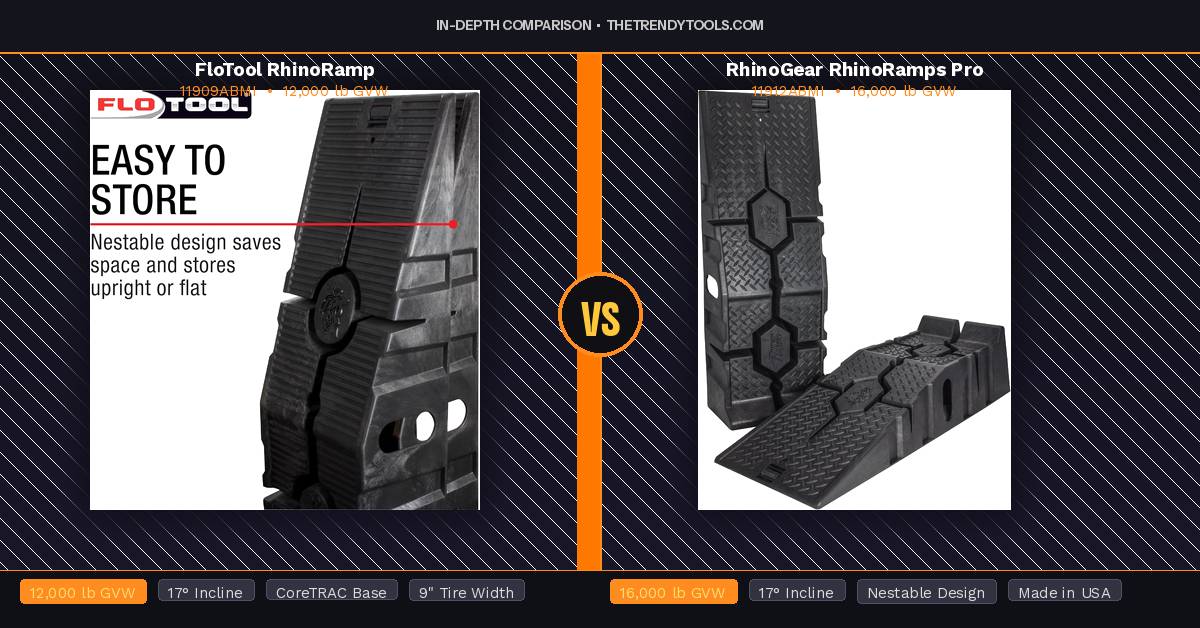
| Feature | FloTool RhinoRamp (11909ABMI) | RhinoGear RhinoRamps Pro (11912ABMI) |
|---|---|---|
| GVW Capacity | 12,000 lbs | 16,000 lbs |
| Incline Angle | 17 degrees | 17 degrees |
| Non-Skid Base | CoreTRAC | CoreTRAC |
| Tire Width Compatibility | Up to 9 inches | Widest on the market |
| Storage Design | Portable | Nestable / Stackable |
| Construction | Structural polymer | Patented resin / “Strong as Steel” |
| Made in USA | Not specified | Yes |
| Best For | Standard cars, light trucks | Cars, SUVs, pickups, vans, heavier vehicles |
Build Quality and Construction
FloTool RhinoRamp (11909ABMI)
The FloTool RhinoRamp is built with a rugged structural polymer design that strikes a solid balance between durability and portability. The construction is engineered to handle significant loads without flexing or cracking under pressure. While it’s not marketed as “strong as steel,” the internal structure distributes weight effectively across the ramp’s surface, which is critical when you’re parking thousands of pounds of vehicle on top of it.
The material choice also makes it weather-resistant, so if you’re using these ramps in an outdoor driveway setting, rain, UV exposure, and temperature swings won’t degrade them quickly. The overall finish feels solid and doesn’t have the cheap hollow feel that some budget ramps exhibit.
RhinoGear RhinoRamps Pro (11912ABMI)
The RhinoGear Pro steps up the construction game considerably. It features a patented polymer internal support system — often described by the brand as “Strong as Steel.” This isn’t just marketing language. The patented structural design uses an engineered internal lattice that allows the ramps to support an impressive 16,000 lbs GVW while remaining lightweight enough to move by hand.
The durable resin construction is also designed to resist cracking under extreme cold and warping under intense heat — important for people who store their ramps in unheated garages or work in variable climates. The “made in USA” designation also signals that the manufacturing quality controls are more closely managed.
Winner: RhinoGear RhinoRamps Pro — The patented internal structure and American manufacturing give it the edge in raw build quality.
Weight Capacity: A Critical Difference
This is arguably the most important spec when choosing vehicle ramps, and it’s where the two products diverge most significantly.
The FloTool RhinoRamp supports up to 12,000 lbs GVW (gross vehicle weight). For most passenger cars, sedans, and smaller crossovers, this is more than adequate. The average car weighs between 3,000 and 4,500 lbs, so the FloTool provides a comfortable safety margin for typical daily drivers.
The RhinoGear RhinoRamps Pro bumps that up to 16,000 lbs GVW — a 33% increase over the FloTool. This makes a meaningful difference if you own a full-size truck, a loaded SUV, a van, or any vehicle that sits toward the heavier end of the passenger vehicle spectrum. A Ford F-250, for instance, can weigh over 7,000 lbs — well within the RhinoGear’s capacity but closer to the FloTool’s limit than many owners realize.
It’s also worth noting that GVW ratings are total vehicle weights including cargo. If you regularly carry heavy loads in your truck bed or SUV, those extra pounds add up. Choosing a ramp with more headroom in its weight rating is simply the safer practice.
Winner: RhinoGear RhinoRamps Pro — The higher capacity opens the door to more vehicle types and safer margins for heavier loads.
Incline and Low Clearance Performance
Both ramps share the same 17-degree incline angle, which is a carefully chosen specification. Too steep and low-clearance vehicles will scrape their front spoilers or bumpers on the way up. Too shallow and the ramps take up far too much driveway space and require a longer run-up.
At 17 degrees, both ramps hit a sweet spot that works well for most vehicles with standard ground clearance. Sports cars, lowered vehicles, and aggressive body kits may still require caution, but for the vast majority of everyday vehicles — from compact sedans to full-size pickups — this incline makes driving onto the ramps a smooth, non-stressful process.
The gentle slope also means you don’t need to build up speed to climb the ramp, reducing the risk of overshooting and driving off the back end — a real concern with steeper aftermarket ramps.
Winner: Tie — Both perform identically on this spec.
Width and Vehicle Compatibility
Tire width compatibility is a practical concern that’s easy to overlook until your tires are sitting half on, half off the ramp surface. The FloTool RhinoRamp accommodates tires up to 9 inches wide, which covers the majority of passenger car tires. Standard car tires range from roughly 155mm to 275mm wide — the wider end of that range (about 10.8 inches) would exceed the FloTool’s stated capacity.
The RhinoGear RhinoRamps Pro claims to be the widest ramps on the market, though the brand doesn’t publish a specific inch measurement. In practice, users with wide-tire trucks and SUVs report that the Pro handles their tires without issue where narrower ramps have struggled. The extra width also provides better lateral stability during the drive-up phase, which is a confidence boost when you’re lining up the vehicle alone.
Winner: RhinoGear RhinoRamps Pro — Broader compatibility, particularly for trucks and SUVs with wider factory tires.
Safety Features: CoreTRAC and Beyond
Both ramps use the CoreTRAC non-skid base system, which is one of the standout features of the entire RhinoRamp/RhinoRamps product line. CoreTRAC is a textured, grippy base pattern designed to bite into concrete, asphalt, and most garage floor surfaces to prevent the ramps from sliding forward as you drive onto them.
Ramp slippage is one of the most common causes of garage accidents. When a ramp shifts under a slowly rolling vehicle, the consequences can be catastrophic. CoreTRAC directly addresses this by maximizing friction at the ramp-to-floor contact point.
The RhinoGear Pro adds an additional layer of security through its treaded driving surface. The textured top surface helps prevent tire spin and provides grip as you’re driving up — especially useful on humid days or if the ramp surface has any dust or debris on it.
Both ramps also benefit from their wide-stance designs, which lower the center of gravity and reduce the chance of a vehicle tipping or rocking while elevated. The structural rigidity of both products means there’s no disconcerting flex when you walk under a vehicle that’s resting on them.
Winner: RhinoGear RhinoRamps Pro — The treaded driving surface adds an extra safety dimension on top of the shared CoreTRAC base.
Ease of Use and Practical Experience
Setting up either ramp is a quick and straightforward process. You place them on a flat, stable surface in front of the drive wheels (front for FWD, rear for RWD, or both pairs for an even lift), line up your tires, and drive slowly forward until the tires settle onto the flat platform at the top of the ramp. No tools, no jacking, no mess.
The FloTool RhinoRamp is lighter and slightly more compact, which makes it easy to pull out of a garage corner and position quickly. For solo mechanics doing routine oil changes on a single car, the FloTool’s simplicity is genuinely appealing. There’s no learning curve — grab, place, drive.
The RhinoGear Pro is a bit more substantial given its higher capacity and wider profile, but it’s still very manageable for a single person. The nestable design (more on this below) means they’re always together and ready to use as a unit, which eliminates the occasional frustration of hunting down a matching ramp that’s rolled to the back of the garage.
Both ramps are stable enough that most users feel comfortable working under the vehicle with standard safety precautions (wheel chocks, parking brake engaged). Neither product requires additional anchoring for typical use.
Winner: Tie — Both are easy to use. The FloTool is slightly lighter; the RhinoGear Pro is slightly more organized thanks to the nestable design.
Storage: Nestable Design vs Standard Portable
This is a feature that doesn’t sound exciting on paper but makes a real difference in day-to-day garage life.
The FloTool RhinoRamp is portable and reasonably compact, but the two ramps are separate pieces that need to be leaned against a wall, stacked manually, or stored in a bin. In a crowded garage, two loose ramps can end up in different corners and become a minor organizational nuisance.
The RhinoGear RhinoRamps Pro features a unique nestable design — the two ramps are shaped to stack directly on top of each other like nesting bowls. This cuts the storage footprint roughly in half and means the pair always stores as a single cohesive unit. For garages where space is at a premium, this design is a genuine quality-of-life improvement that you’ll appreciate every single time you put the ramps away.
Winner: RhinoGear RhinoRamps Pro — The nestable design is a practical innovation that the FloTool simply doesn’t offer.
Who Should Buy the FloTool RhinoRamp?
The FloTool 11909ABMI RhinoRamp is the right choice if:
- You drive a standard passenger car, compact SUV, or light crossover.
- Your vehicle’s GVW is well within the 12,000 lb limit.
- Budget is a primary concern and you don’t need the extra capacity or width of the Pro model.
- You perform occasional oil changes and basic under-car maintenance, not frequent or heavy-duty work.
- You have limited garage space and prefer a lighter, simpler ramp to move around.
The FloTool is a reliable, no-frills workhorse that gets the job done for the vast majority of everyday car owners. It’s the kind of tool you buy once and forget about — until the next oil change, when you’re glad it’s sitting in the corner of your garage.
Who Should Buy the RhinoGear RhinoRamps Pro?
The RhinoGear 11912ABMI RhinoRamps Pro is the better investment if:
- You own a full-size truck, large SUV, minivan, or any heavier passenger vehicle.
- You want a higher safety margin and peace of mind with a 16,000 lb GVW rating.
- You have wide tires and need maximum ramp width for full, stable tire support.
- Garage organization matters to you and you want a space-saving nestable design.
- You perform regular maintenance and want a premium product built to last longer.
- You value American-made manufacturing quality.
The RhinoGear Pro is the obvious upgrade choice. The extra investment buys you more capacity, smarter storage, better tire coverage, and a tougher build. For anyone who works on heavier vehicles or simply wants the most capable ramp available, the Pro is the clear pick.
Value for Money
The FloTool RhinoRamp comes in at a lower price point, making it an accessible entry into quality vehicle ramps. For car owners who need a basic, dependable solution for standard vehicles, it offers excellent value. You’re not overpaying for capacity or features you don’t need.
The RhinoGear RhinoRamps Pro costs more, but the premium is justified. The 33% increase in weight capacity, the wider ramp surface, the nestable storage design, the treaded surface, and the American-made build all contribute real, tangible value. For truck and SUV owners especially, the Pro is actually the better value because it matches the product to the vehicle’s actual demands.
Buying an underpowered ramp to save money, then using it near the edge of its capacity with a heavy truck, is false economy. The RhinoGear Pro protects both your vehicle and your safety.
Winner: Depends on your vehicle — The FloTool wins on price for light vehicles; the RhinoGear Pro wins on value for heavy vehicles.
Final Verdict: FloTool RhinoRamp vs RhinoGear RhinoRamps Pro
Both the FloTool RhinoRamp and the RhinoGear RhinoRamps Pro are well-engineered, reliable products that earn their place in the garage. They share the same fundamental approach to vehicle ramp design — gentle incline, non-skid base, structural polymer construction — and both will serve you well for years of routine maintenance.
But the RhinoGear RhinoRamps Pro is the stronger product overall. The higher 16,000 lb GVW capacity, the widest-in-class ramp surface, the patented internal support structure, the nestable storage design, and the made-in-USA quality all combine to make it the superior tool — especially for anyone who owns or services heavier vehicles.
The FloTool RhinoRamp remains a smart buy for drivers of standard passenger cars who want a straightforward, affordable, and reliable ramp without paying for features they’ll never use.
Our recommendation: Know your vehicle’s weight and tire width first. If you’re within the FloTool’s specs and on a budget, it’s a solid choice. If you have any doubt — or if you drive a truck, large SUV, or van — invest in the RhinoGear Pro. Your safety is worth it.
Frequently Asked Questions
Can I use these ramps on an inclined driveway?
Both ramps are designed for use on flat, stable surfaces. Using them on an inclined driveway is not recommended as it affects the stability and safety of the ramp setup. Always position ramps on level ground.
Do I need wheel chocks with these ramps?
Yes. Even though both ramps are stable platforms, it is best practice to use wheel chocks on the rear wheels when working on the front of the vehicle (and vice versa). This adds an extra layer of protection against accidental rolling.
Are these ramps safe for jack stands?
Vehicle ramps and jack stands serve different purposes. These ramps are designed to support the vehicle by its tires on an elevated platform — not as a base for jack stand placement. Always follow the manufacturer’s instructions for safe use.
What’s the difference between GVW and curb weight?
Curb weight is the weight of the vehicle alone. GVW (Gross Vehicle Weight) is the maximum total weight including passengers, cargo, and fuel. Always use GVW when assessing whether your vehicle is compatible with a ramp’s rated capacity.
Can the FloTool RhinoRamp be used for trucks?
It depends on the truck. Light trucks and compact pickups may fall within the 12,000 lb GVW limit, but full-size trucks — especially when loaded — can exceed this. Check your vehicle’s GVW before use, and consider the RhinoGear Pro for larger trucks.