

By thetrendytools.com | Last updated: March 2026 | 7 min read
5mm drill bit in inches6mm drill bit to fraction8mm to inches10mm drill bitmm to imperial
You’ve got a metric drill bit in your hand — say, a 6 mm — and you need to know its equivalent in inches so you can match it to a pilot hole chart, a tap size guide, or a standard US drill bit set. Or maybe you’re working from a metric blueprint and your drill press only has imperial-size bits. Whatever the scenario, the frustration is real, and hunting through scattered conversion tables online wastes time you’d rather spend on the project itself.
This guide solves that problem permanently. Below you’ll find the most complete metric to imperial drill bit conversion chart available — covering every common size from 1 mm to 25 mm — with decimal inches, fractional inches, and the nearest standard imperial drill bit for each metric size. We’ve also included a free downloadable PDF version you can print and keep at your workbench.
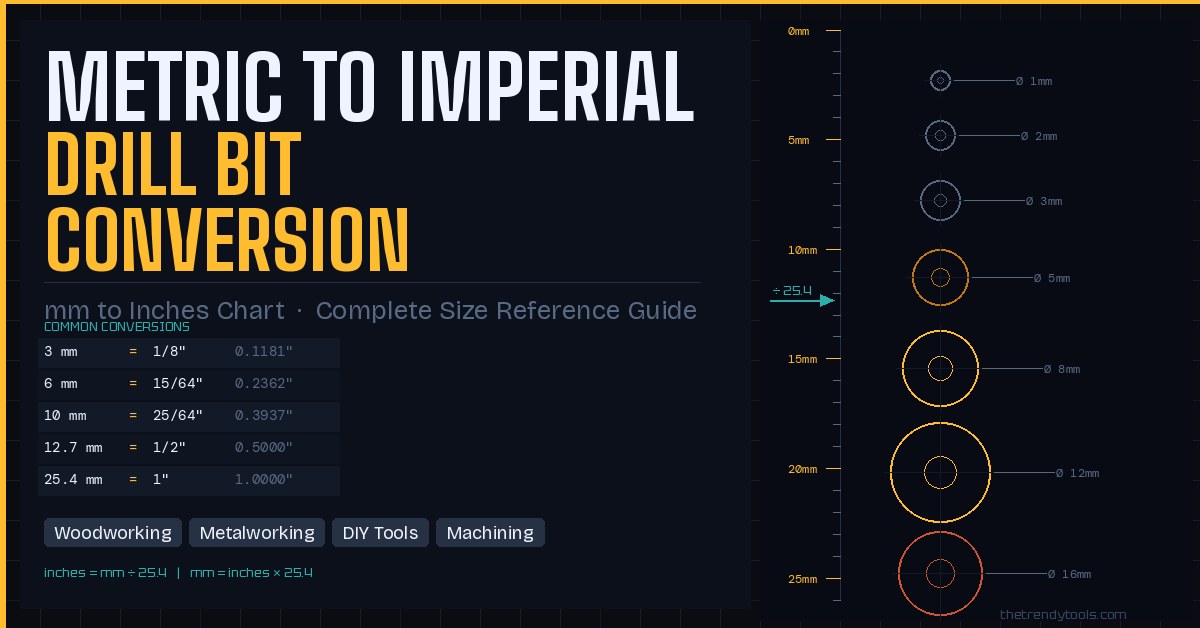
Quick formula: To convert mm to inches, divide by 25.4.
Example: 6 mm ÷ 25.4 = 0.2362″ (nearest standard fraction: 15/64″)
📄
Free Download: Printable Drill Bit Conversion Chart (PDF)
Get the full 1–25 mm conversion table as a clean, print-ready PDF. Perfect for the workbench, toolbox lid, or job site binder. No sign-up required. Download PDF
Full Metric to Imperial Drill Bit Conversion Table (1 mm – 25 mm)
The table below covers every common metric drill bit size in 0.5 mm increments. The Nearest Standard column (in red) shows the closest imperial fractional drill bit available in standard US drill bit sets — the one you’d actually reach for if you don’t have the exact metric size.
How to read this table: The Fraction column shows the mathematically exact conversion to the nearest 64th of an inch. The Nearest Standard column shows the most practical imperial drill bit to substitute — these are the sizes found in standard fractional drill bit sets sold at hardware stores.
| Metric Size | Decimal (inches) | Fraction (inches) | Nearest Standard |
|---|---|---|---|
| 1 mm | 0.0394″ | 3/64″ | 3/64″ |
| 1.5 mm | 0.0591″ | 1/16″ | 1/16″ |
| 2 mm | 0.0787″ | 5/64″ | 5/64″ |
| 2.5 mm | 0.0984″ | 3/32″ | 3/32″ |
| 3 mm | 0.1181″ | 1/8″ | 1/8″ |
| 3.5 mm | 0.1378″ | 9/64″ | 9/64″ |
| 4 mm | 0.1575″ | 5/32″ | 5/32″ |
| 4.5 mm | 0.1772″ | 11/64″ | 11/64″ |
| 5 mm | 0.1969″ | 13/64″ | 13/64″ |
| 5.5 mm | 0.2165″ | 7/32″ | 7/32″ |
| 6 mm | 0.2362″ | 15/64″ | 15/64″ |
| 6.5 mm | 0.2559″ | 1/4″ | 1/4″ |
| 7 mm | 0.2756″ | 9/32″ | 9/32″ |
| 7.5 mm | 0.2953″ | 19/64″ | 19/64″ |
| 8 mm | 0.3150″ | 5/16″ | 5/16″ |
| 8.5 mm | 0.3346″ | 21/64″ | 21/64″ |
| 9 mm | 0.3543″ | 23/64″ | 23/64″ |
| 9.5 mm | 0.3740″ | 3/8″ | 3/8″ |
| 10 mm | 0.3937″ | 25/64″ | 25/64″ |
| 10.5 mm | 0.4134″ | 13/32″ | 13/32″ |
| 11 mm | 0.4331″ | 7/16″ | 7/16″ |
| 11.5 mm | 0.4528″ | 29/64″ | 29/64″ |
| 12 mm | 0.4724″ | 15/32″ | 15/32″ |
| 12.5 mm | 0.4921″ | 31/64″ | 31/64″ |
| 13 mm | 0.5118″ | 33/64″ | 33/64″ |
| 13.5 mm | 0.5315″ | 17/32″ | 17/32″ |
| 14 mm | 0.5512″ | 35/64″ | 35/64″ |
| 14.5 mm | 0.5709″ | 37/64″ | 37/64″ |
| 15 mm | 0.5906″ | 19/32″ | 19/32″ |
| 15.5 mm | 0.6102″ | 39/64″ | 39/64″ |
| 16 mm | 0.6299″ | 5/8″ | 5/8″ |
| 17 mm | 0.6693″ | 43/64″ | 43/64″ |
| 18 mm | 0.7087″ | 45/64″ | 45/64″ |
| 19 mm | 0.7480″ | 3/4″ | 3/4″ |
| 20 mm | 0.7874″ | 25/32″ | 25/32″ |
| 21 mm | 0.8268″ | 53/64″ | 53/64″ |
| 22 mm | 0.8661″ | 55/64″ | 55/64″ |
| 23 mm | 0.9055″ | 29/32″ | 29/32″ |
| 24 mm | 0.9449″ | 15/16″ | 15/16″ |
| 25 mm | 0.9843″ | 63/64″ | 63/64″ |
🟠 Orange rows = most commonly searched sizes. Red values = nearest standard imperial drill bit. All conversions calculated using the exact standard: 1 inch = 25.4 mm (ISO 2848).
Quick Reference: Most Common Metric Drill Bit Conversions
These are the sizes people search for most. Bookmark this section or download the PDF for fast on-the-job reference.
3 mm = 1/8″ = 0.1181 inches
4 mm = 5/32″ =0.1575 inches
5 mm = 13/64″ =0.1969 inches
6 mm = 15/64″ = 0.2362 inches
6.5 mm = 1/4″ = 0.2559 inches
7 mm = 9/32″= 0.2756 inches
8 mm = 5/16″ =0.3150 inches
9 mm = 23/64″= 0.3543 inches
10 mm = 25/64″ =0.3937 inches
12 mm = 15/32″ = 0.4724 inches
16 mm = 5/8″ = 0.6299 inches
19 mm = 3/4″ = 0.7480 inches
Individual Size Conversions: In-Depth
5 mm Drill Bit to Inches
A 5 mm drill bit converts to 0.1969 inches, or approximately 13/64 inch. This is one of the most common metric sizes used in European power tools, furniture flat-pack hardware, and M5 bolt pilot holes. In a standard US fractional drill bit set, the 13/64″ bit is your closest equivalent. The difference between 5 mm (0.1969″) and 13/64″ (0.2031″) is just 0.016″ — generally acceptable for most woodworking and general metalworking applications.
5 mm to standard drill bit: Use a 13/64″ bit. For precision machining or M5 tap holes, use the exact 5 mm metric bit.
6 mm Drill Bit to Fraction / Inches
The 6 mm drill bit is one of the most searched metric conversions, and for good reason — it’s widely used for M6 bolt clearance holes, European cabinet hardware, and general metalworking. The exact conversion is 0.2362 inches, which falls closest to 15/64 inch in the standard fractional system. Note that 6.5 mm is even closer to the more commonly stocked 1/4″ (0.250″) bit, so if you need a slightly larger hole, stepping up to 6.5 mm or 1/4″ is practical.
6 mm to standard drill bit: Use 15/64″ for the closest imperial match. Use 1/4″ if you need a slightly looser fit (e.g., clearance for an M6 bolt).
8 mm Drill Bit to Inches
An 8 mm drill bit converts to exactly 0.3150 inches, which is almost perfectly equal to 5/16 inch (0.3125″). The difference is only 0.0025″ — less than three thousandths of an inch — making 8 mm and 5/16″ essentially interchangeable for most practical purposes. This is one of the best metric-to-imperial matches in the common size range.
8 mm to standard drill bit: Use 5/16″. It’s nearly identical — a difference of only 0.003″. This is one of the closest metric-to-imperial fits across the entire range.
10 mm Drill Bit to Inches / Fraction
A 10 mm drill bit is 0.3937 inches in decimal, which converts to 25/64 inch as a fraction. There is no standard imperial fraction that is an exact match for 10 mm — the nearest common sizes are 3/8″ (0.375″, which is 0.019″ smaller) and 13/32″ (0.406″, which is 0.012″ larger). If precision matters, stick with the metric 10 mm bit. For clearance holes or general work, either 3/8″ or 25/64″ will serve.
10 mm to standard drill bit: Use 25/64″ for the closest match. Use 3/8″ if you need a slightly smaller hole, or 13/32″ for a slightly larger clearance.
12 mm Drill Bit to Inches
A 12 mm drill bit equals 0.4724 inches or 15/32 inch. Half an inch (1/2″) is 0.028″ larger, which is a meaningful difference in precision work but acceptable for rough clearance holes. The 15/32″ bit is not always stocked in basic drill sets, so if you’re doing metric work regularly, keeping an actual 12 mm bit on hand is worthwhile rather than substituting.
3/16 Inch Drill Bit in mm
Working in reverse — a 3/16 inch drill bit (0.1875″) converts to 4.76 mm. The nearest metric size is 4.8 mm or most practically a 5 mm bit if you need to go slightly larger. For most pilot holes and general work, a 3/16″ and a 5 mm bit are close enough to be interchangeable.
1/4 Inch Drill Bit in mm
A 1/4 inch drill bit (0.250″) converts to 6.35 mm. The closest metric size is 6.5 mm (0.2559″). A standard 1/4″ bit drills a hole that is 0.35 mm smaller than a 6.5 mm hole — a difference that matters for tight tolerance fits but is negligible for most woodworking and structural applications.
How to Convert mm to Inches: The Formula
The conversion between millimeters and inches is based on a fixed, exact relationship established by international standards:
1 inch = 25.4 mm (exact, per ISO 2848 and ANSI/ASME)
To convert mm → inches: divide by 25.4
To convert inches → mm: multiply by 25.4
Example: 6 mm ÷ 25.4 = 0.23622… → round to 0.2362″
Once you have the decimal inch value, converting to a fraction is a matter of finding the nearest 64th. Multiply your decimal by 64, round to the nearest whole number, then simplify. For 6 mm: 0.2362 × 64 = 15.12 → round to 15 → 15/64″.
Why Metric and Imperial Drill Bits Don’t Line Up Perfectly
Metric and imperial measurement systems were developed independently — the metric system is based on powers of ten, while the imperial system evolved from historical units with no mathematical relationship to metric values. Because of this, a round metric number (like 6 mm) almost never converts to a round imperial fraction (like 1/4″).
The practical consequence is that even when you find the “nearest standard” imperial size, there will almost always be a small gap — typically between 0.001″ and 0.025″ — between the metric size and its imperial equivalent. For most woodworking, construction, and general metalworking applications, this gap is inconsequential. For precision machining, CNC operations, or tight-tolerance fits, you should always use the exact metric size rather than substituting an imperial equivalent.
Important for precision work: When drilling pilot holes for taps, or creating close-tolerance fits for bearings, bushings, or precision assemblies, always use the exact metric drill bit. The decimal inch values in the table above are for reference — they are not a substitute for the actual metric size in precision applications.
Practical Tips for Working with Metric Drill Bits in the US
- Buy a metric drill bit set. If you regularly work with metric hardware, a dedicated metric set (1–13 mm in 0.5 mm increments) is a smarter investment than constantly substituting imperial equivalents. Sets are widely available and inexpensive.
- Use digital calipers. A set of digital calipers that reads in both mm and inches lets you measure any drill bit or hole diameter directly. This is faster and more accurate than looking up conversion tables on the job.
- Keep this chart at your workbench. Download the free PDF below and tape it inside your toolbox lid — it’s the fastest way to answer conversion questions without reaching for your phone.
- For M-thread pilot holes, use the metric spec. When drilling pilot holes for M4, M5, M6, M8 or other metric thread taps, always use the drill size specified on your tap chart — don’t substitute an imperial equivalent. A 0.015″ error in a pilot hole diameter can cause taps to break or threads to strip.
- For wood screws and clearance holes, imperial substitutes are usually fine. If you’re drilling a clearance hole for a bolt or a pilot hole for a wood screw, the nearest imperial fraction within 0.01″ will work perfectly well in practice.
📄
Download the Full Chart as a PDF
Print-ready, landscape format. Covers every size from 1 mm to 25 mm with decimal, fraction, and nearest standard columns. Free — no sign-up needed.⬇ Download Free PDF Chart
Frequently Asked Questions
What is a 6mm drill bit in inches?
A 6 mm drill bit is 0.2362 inches in decimal, which is closest to 15/64 inch as a standard fraction. If you need a slightly larger hole, 6.5 mm is almost exactly 1/4 inch (0.2559″). For most general-purpose work, a 15/64″ bit is the best imperial substitute for a 6 mm drill bit.
What is 5mm in standard drill bit size?
5 mm converts to 0.1969 inches, making the nearest standard imperial drill bit size 13/64 inch. The difference between 5 mm and 13/64″ is about 0.006″ — small enough to be interchangeable for most woodworking and general metalworking. For M5 tap holes, always use the exact 5 mm size.
What is 8mm in inches as a drill bit fraction?
An 8 mm drill bit is 0.3150 inches, which is nearly identical to 5/16 inch (0.3125″). The difference is only 0.0025″ — less than three thousandths of an inch — making 8 mm and 5/16″ effectively interchangeable for the vast majority of applications. This is one of the closest metric-to-imperial matches in the common drill bit size range.
What is a 10mm drill bit in inches?
A 10 mm drill bit equals 0.3937 inches or 25/64 inch as a fraction. There is no exact imperial match — the nearest common sizes are 3/8″ (slightly smaller, by 0.019″) and 13/32″ (slightly larger, by 0.012″). For general work, use 25/64″. For precision applications like threading or close-tolerance fits, use the actual 10 mm metric bit.
What is a 12mm drill bit in inches?
A 12 mm drill bit is 0.4724 inches, closest to 15/32 inch. A 1/2″ bit (0.500″) is 0.028″ larger — meaningful for precision work, but acceptable for rough clearance holes or general woodworking applications.
How do I convert metric drill bits to imperial if I don’t have a chart?
Use the simple formula: mm ÷ 25.4 = inches. For example, 8 mm ÷ 25.4 = 0.315″. Then multiply by 64 and round to find the nearest 64th fraction: 0.315 × 64 = 20.2 → round to 20 → 20/64 = 5/16″. So 8 mm ≈ 5/16″. The simplest way is to bookmark this page or download the free PDF chart above for instant reference.
Is a 6.5mm drill bit the same as 1/4 inch?
Almost, but not exactly. A 6.5 mm bit is 0.2559″ while 1/4″ is 0.2500″ — a difference of 0.0059″ (about 0.15 mm). For most practical applications including clearance holes and wood pilot holes, they are interchangeable. For precision machining or when creating a snug fit, use the exact size specified in your plans.