

If you’ve ever stood at your workbench holding a metric drill bit while staring at a project that calls for fractional inch measurements — or the other way around — you’re not alone. Switching between millimeters and inches is one of the most common frustrations woodworkers, metalworkers, DIYers, and machinists face every day. Whether you’re drilling pilot holes for screws, matching a tap size, or working with imported hardware, knowing how to convert metric to imperial drill bit sizes (and back) is an essential shop skill.
This comprehensive guide gives you a complete metric to imperial drill bit conversion chart (mm to inches), explains how the two systems relate, and offers practical tips so you always grab the right bit — the first time.
Why Two Systems Still Exist
The United States primarily uses the imperial (inch-based) system for drill bits, while most of the rest of the world uses the metric (millimeter-based) system. In practice, however, both systems coexist in nearly every workshop because:
- Imported tools and hardware from Europe, Japan, and China are spec’d in metric.
- Fasteners, bolts, and machine screws can be either system depending on the manufacturer.
- Engineering drawings for global products often list both units.
- Inherited tool sets may contain a mix of both.
Rather than buying duplicate drill sets, a solid conversion chart lets you find the closest equivalent in whatever system you’re working in.
How Drill Bit Sizing Works
Imperial (Fractional Inch) Drill Bits
Imperial drill bits in the fractional inch system are sized in fractions of an inch — typically in 1/64″ increments for smaller bits. Common sizes range from 1/64″ up to 1″ or larger for spade and hole-saw bits. The most widely used fractional sizes in general woodworking and construction are 1/16″, 3/32″, 1/8″, 5/32″, 3/16″, 7/32″, 1/4″, 5/16″, 3/8″, 7/16″, and 1/2″.
Number and Letter Drill Bits (Wire Gauge)
Beyond fractional sizes, the imperial system also includes number drill bits (sized #1 through #80, with #80 being the smallest at 0.0135″) and letter drill bits (A through Z, with A being the smallest at 0.234″). These are common in machining, electronics, and precision metalwork where fractional increments are too coarse.
Metric Drill Bits
Metric drill bits are labeled by their diameter in millimeters. Standard metric sets typically start at 0.5 mm and step up in 0.5 mm or 1 mm increments, though precision sets may offer 0.1 mm steps. Large metric bits go up to 13 mm in most chuck-compatible sets, with larger sizes available for specialized use.
The Conversion Formula
The math is straightforward once you know the relationship:
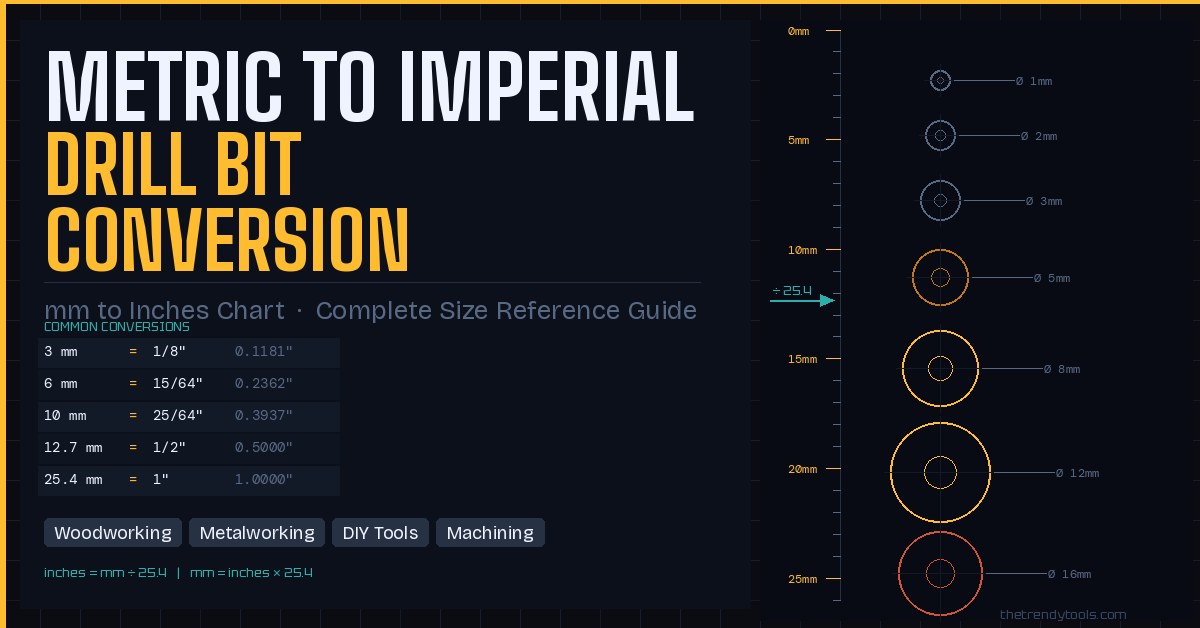
- mm to inches: divide by 25.4 → inches = mm ÷ 25.4
- inches to mm: multiply by 25.4 → mm = inches × 25.4
For example: a 6 mm drill bit = 6 ÷ 25.4 = 0.2362 inches, which is closest to 15/64″ (0.2344″).
Because metric and imperial don’t share common denominators, you’ll rarely find a perfect match. The goal is to find the closest available size — and know whether to go slightly larger or slightly smaller depending on the application.
Complete Metric to Imperial Drill Bit Conversion Chart (mm to Inches)
The table below covers the most common metric drill bit sizes from 0.5 mm to 25 mm and shows their decimal inch equivalent, the nearest fractional inch size, and the nearest number/letter drill size where applicable.
| Metric (mm) | Decimal Inches | Nearest Fractional Inch | Fractional Decimal | Difference (in) | Nearest #/Letter Size |
|---|---|---|---|---|---|
| 0.5 mm | 0.0197″ | — | — | — | #76 (0.0200″) |
| 0.8 mm | 0.0315″ | — | — | — | #68 (0.0310″) |
| 1.0 mm | 0.0394″ | — | — | — | #60 (0.0400″) |
| 1.2 mm | 0.0472″ | — | — | — | #56 (0.0465″) |
| 1.5 mm | 0.0591″ | 1/16″ | 0.0625″ | +0.0034 | #53 (0.0595″) |
| 2.0 mm | 0.0787″ | 5/64″ | 0.0781″ | −0.0006 | #47 (0.0785″) |
| 2.5 mm | 0.0984″ | 3/32″ | 0.0938″ | −0.0046 | #39 (0.0995″) |
| 3.0 mm | 0.1181″ | 7/64″ | 0.1094″ | −0.0087 | #33 (0.1130″) |
| 3.175 mm | 0.1250″ | 1/8″ | 0.1250″ | 0.0000 | — |
| 3.5 mm | 0.1378″ | 9/64″ | 0.1406″ | +0.0028 | #28 (0.1405″) |
| 4.0 mm | 0.1575″ | 5/32″ | 0.1563″ | −0.0012 | #21 (0.1590″) |
| 4.5 mm | 0.1772″ | 11/64″ | 0.1719″ | −0.0053 | #16 (0.1770″) |
| 4.7625 mm | 0.1875″ | 3/16″ | 0.1875″ | 0.0000 | — |
| 5.0 mm | 0.1969″ | 13/64″ | 0.2031″ | +0.0062 | #9 (0.1960″) |
| 5.5 mm | 0.2165″ | 7/32″ | 0.2188″ | +0.0023 | #3 (0.2130″) |
| 6.0 mm | 0.2362″ | 15/64″ | 0.2344″ | −0.0018 | B (0.2380″) |
| 6.35 mm | 0.2500″ | 1/4″ | 0.2500″ | 0.0000 | — |
| 6.5 mm | 0.2559″ | 17/64″ | 0.2656″ | +0.0097 | F (0.2570″) |
| 7.0 mm | 0.2756″ | 9/32″ | 0.2813″ | +0.0057 | J (0.2770″) |
| 7.5 mm | 0.2953″ | 19/64″ | 0.2969″ | +0.0016 | N (0.3020″) |
| 7.9375 mm | 0.3125″ | 5/16″ | 0.3125″ | 0.0000 | — |
| 8.0 mm | 0.3150″ | 5/16″ | 0.3125″ | −0.0025 | O (0.3160″) |
| 8.5 mm | 0.3346″ | 21/64″ | 0.3281″ | −0.0065 | Q (0.3320″) |
| 9.0 mm | 0.3543″ | 23/64″ | 0.3594″ | +0.0051 | T (0.3580″) |
| 9.5 mm | 0.3740″ | 3/8″ | 0.3750″ | +0.0010 | V (0.3770″) |
| 9.525 mm | 0.3750″ | 3/8″ | 0.3750″ | 0.0000 | — |
| 10.0 mm | 0.3937″ | 25/64″ | 0.3906″ | −0.0031 | X (0.3970″) |
| 10.5 mm | 0.4134″ | 13/32″ | 0.4063″ | −0.0071 | — |
| 11.1125 mm | 0.4375″ | 7/16″ | 0.4375″ | 0.0000 | — |
| 11.0 mm | 0.4331″ | 7/16″ | 0.4375″ | +0.0044 | — |
| 11.5 mm | 0.4528″ | 29/64″ | 0.4531″ | +0.0003 | — |
| 12.0 mm | 0.4724″ | 15/32″ | 0.4688″ | −0.0036 | — |
| 12.7 mm | 0.5000″ | 1/2″ | 0.5000″ | 0.0000 | — |
| 13.0 mm | 0.5118″ | 33/64″ | 0.5156″ | +0.0038 | — |
| 14.0 mm | 0.5512″ | 35/64″ | 0.5469″ | −0.0043 | — |
| 15.0 mm | 0.5906″ | 19/32″ | 0.5938″ | +0.0032 | — |
| 16.0 mm | 0.6299″ | 5/8″ | 0.6250″ | −0.0049 | — |
| 17.0 mm | 0.6693″ | 43/64″ | 0.6719″ | +0.0026 | — |
| 18.0 mm | 0.7087″ | 45/64″ | 0.7031″ | −0.0056 | — |
| 19.0 mm | 0.7480″ | 3/4″ | 0.7500″ | +0.0020 | — |
| 19.05 mm | 0.7500″ | 3/4″ | 0.7500″ | 0.0000 | — |
| 20.0 mm | 0.7874″ | 25/32″ | 0.7813″ | −0.0061 | — |
| 21.0 mm | 0.8268″ | 53/64″ | 0.8281″ | +0.0013 | — |
| 22.0 mm | 0.8661″ | 55/64″ | 0.8594″ | −0.0067 | — |
| 23.0 mm | 0.9055″ | 29/32″ | 0.9063″ | +0.0008 | — |
| 24.0 mm | 0.9449″ | 61/64″ | 0.9531″ | +0.0082 | — |
| 25.0 mm | 0.9843″ | 63/64″ | 0.9844″ | +0.0001 | — |
| 25.4 mm | 1.0000″ | 1″ | 1.0000″ | 0.0000 | — |
* Highlighted rows (yellow) indicate sizes where a metric drill bit has an exact or near-exact imperial equivalent. These are the easiest substitutions.
📌 Pro Tip: When a perfect match doesn’t exist, choose whether to go slightly under or slightly over based on your application. For clearance holes (where a bolt must pass through freely), go slightly larger. For pilot holes (where a screw threads into wood or metal), go slightly smaller.
Quick-Reference: Most Common Drill Bit Substitutions
Here are the substitutions DIYers and tradespeople reach for most often:
| Metric Size | Best Imperial Substitute | Common Use Case |
|---|---|---|
| 2 mm | 5/64″ or #47 | Small pilot holes, electronics |
| 3 mm | 1/8″ (slightly larger) | Wood pilot holes, drywall anchors |
| 4 mm | 5/32″ | M4 bolt clearance, wood joinery |
| 5 mm | 13/64″ or #9 | Shelf pin holes, M5 clearance |
| 6 mm | 15/64″ or B | M6 bolt clearance, cabinet hardware |
| 6.35 mm | 1/4″ (exact) | Router bit shanks, dowels |
| 8 mm | 5/16″ | Dowel holes, Confirmat screws |
| 10 mm | 25/64″ or X | M10 clearance, plumbing |
| 12 mm | 15/32″ | Hinge cups, large fasteners |
| 13 mm | 1/2″ (close) | Standard drill chuck capacity |
Choosing the Right Size: Clearance vs. Pilot Holes
One of the most important decisions when substituting drill bit sizes is understanding hole function. Two major categories dominate shop work:
Clearance Holes
A clearance hole is drilled so a bolt or screw can pass through freely without engaging the threads. The hole must be at least as large as the fastener’s outer thread diameter. When substituting, always round up to the nearest available size. For instance, if you need a 6 mm clearance hole and only have fractional bits, use 1/4″ (6.35 mm) rather than 15/64″ (5.95 mm).
Pilot Holes
Pilot holes guide a screw into wood or metal and should be slightly smaller than the screw’s thread diameter to allow the threads to bite. Here you round down. A 3 mm pilot hole for a 3.5 mm wood screw? Use 7/64″ (2.78 mm) rather than 1/8″ (3.18 mm).
Tap Drill Holes
When tapping threads into metal, the drill size is critical. Refer to a dedicated tap drill chart since the required drill diameter depends on both the thread pitch and the desired thread engagement percentage (typically 75%). Metric and imperial tap sizes do not overlap, so always use the correct tap drill for your specific thread.
Number and Letter Drill Bit Sizes in mm
Number and letter drill bits fill the gaps that fractional sizes miss. Here’s a reference for the most useful sizes, with their metric equivalents:
| Drill #/Letter | Inches | mm Equivalent | Common Use |
|---|---|---|---|
| #80 | 0.0135″ | 0.343 mm | Jewelry, micro-electronics |
| #60 | 0.0400″ | 1.016 mm | Small watch screws |
| #53 | 0.0595″ | 1.511 mm | #4-40 tap drill |
| #43 | 0.0890″ | 2.261 mm | #4 sheet metal screw |
| #36 | 0.1065″ | 2.705 mm | #6-32 tap drill |
| #29 | 0.1360″ | 3.454 mm | #8-32 tap drill |
| #25 | 0.1495″ | 3.797 mm | #10-24 tap drill |
| #21 | 0.1590″ | 4.039 mm | #10-32 tap drill |
| #7 | 0.2010″ | 5.105 mm | 1/4-20 tap drill |
| F | 0.2570″ | 6.528 mm | 1/4-28 tap drill |
| I | 0.2720″ | 6.909 mm | 5/16-18 tap drill |
| Q | 0.3320″ | 8.433 mm | 3/8-16 tap drill |
| W | 0.3860″ | 9.804 mm | 7/16-14 tap drill |
| Z | 0.4130″ | 10.490 mm | 1/2-13 tap drill (close) |
Tips for Working Between Metric and Imperial Systems
1. Keep a Conversion Card at Your Bench
Print or laminate a pocket-sized version of the chart above and keep it near your drill press or workbench. When you’re mid-project, you don’t want to be hunting for your phone to look up a conversion.
2. Use a Digital Caliper to Measure Unknown Bits
Drill bits lose their markings over time. A quality digital caliper reads in both mm and inches, letting you measure any bit directly and find the right match in the conversion chart.
3. Invest in a Combination Metric/Imperial Drill Index
Rather than buying two separate sets, several manufacturers offer combo drill indexes that include both fractional inch and metric sizes in a single case. This eliminates most substitution guesswork on the spot.
4. Understand “Close Enough” vs. Precision Applications
For rough woodworking (hanging pictures, driving deck screws, assembling furniture), a difference of 0.005″ to 0.010″ between the ideal and actual drill size rarely matters. For metalworking, precision joinery, or tapping threads, that same gap can mean a loose fit, a broken tap, or a failed assembly. Know when precision counts.
5. Step Drills Bridge Gaps Quickly
A step drill bit (also called a unibit) drills a range of hole sizes in thin sheet metal or wood without swapping bits. Many step bits include both metric and imperial graduations on the steps, making them a versatile shop tool when you’re bridging systems.
✅ Workshop Tip: When in doubt about whether to go slightly larger or smaller, test your substitution on a piece of scrap material first. A 30-second test hole can save a ruined workpiece.
Common Mistakes to Avoid
Confusing Drill Bit Diameter with Screw Size
A #8 wood screw and a #8 drill bit are completely different sizing systems. Screw sizes refer to a gauge number that represents the screw’s outer diameter, not a drill dimension. Always look up the recommended pilot hole size for a specific screw, not just match numbers.
Ignoring Material Differences
The same conversion chart applies to all materials, but the tolerance you can accept differs. Wood is forgiving — metal and plastic are not. In harder materials, closer tolerances become more important, and the “nearest fractional size” may not always be close enough.
Using Worn or Mislabeled Bits
Worn drill bits cut slightly undersized holes due to dulled cutting edges. If you’re doing precision work, always use sharp, clearly labeled bits — and verify size with a caliper if any doubt exists.
⚠️ Caution: Never force an oversized bit into a tight spot just because it’s “close enough.” Even a 0.5 mm difference can cause cracking in brittle materials or a sloppy fit in precision assemblies.
Online Conversion Tools vs. Printed Charts
While online calculators are convenient, there are three reasons to keep a printed chart handy:
- No connectivity needed — many shops and garages don’t have reliable Wi-Fi or phone signal.
- Faster at a glance — scanning a chart is quicker than typing into a calculator when you’re in the middle of a project.
- Seeing neighboring sizes — a chart lets you instantly compare a size with the next size up and down, helping you make a better substitution decision.
That said, online tools are invaluable for unusual sizes outside a standard chart’s range, or for tap drill calculations that require pitch information.
Frequently Asked Questions
Is a 3 mm drill bit the same as 1/8 inch?
Not exactly. A 3 mm bit is 0.1181 inches, while 1/8″ is 0.1250 inches — a difference of about 0.007″. For most woodworking applications, 1/8″ is a perfectly acceptable substitute for 3 mm, but in precision metalwork the difference may matter.
What is 6 mm in inches for a drill bit?
6 mm converts to 0.2362 inches. The nearest fractional inch size is 15/64″ (0.2344″), which is slightly smaller. The nearest letter drill is B (0.2380″), which is slightly larger. For clearance holes, use B or 15/64″ depending on whether you need the hole slightly larger or smaller.
What is the closest imperial drill bit to 10 mm?
10 mm equals 0.3937 inches. The closest fractional size is 25/64″ (0.3906″), which is just under. The nearest letter drill is X (0.3970″), which is just over. For most applications, 25/64″ is the most common substitute.
Can I use a metric bit in an imperial drill chuck?
Yes, absolutely. Drill chucks grip the shank of any bit within their capacity range, regardless of whether the bit is metric or imperial. The chuck doesn’t care about the system — only the shank diameter matters for fitting into the chuck.
What is the most common drill bit size?
In the imperial system, 1/8″ (3.175 mm) and 1/4″ (6.35 mm) are arguably the most universally used sizes across woodworking, metalworking, and DIY. In metric, 3 mm, 4 mm, 6 mm, and 8 mm are the workhorses of most metric drill sets.
Final Thoughts
Navigating between metric and imperial drill bit sizes doesn’t have to slow down your work. With the complete mm to inches conversion chart above bookmarked or printed, you’ll always know which bit to reach for — whether you’re matching a metric fastener with an imperial drill or substituting an inch-size bit for a metric spec on a foreign-built machine.
The key takeaways are simple: understand the 25.4 conversion factor, know whether your application needs you to go larger or smaller than the ideal, and when in doubt, test on scrap material first. With practice, reading across measurement systems becomes second nature — and your projects will be better for it.
Bookmark this page for your next drilling job, and feel free to share it with a fellow DIYer or machinist who’s always squinting at drill bit labels trying to figure out which one is which.