

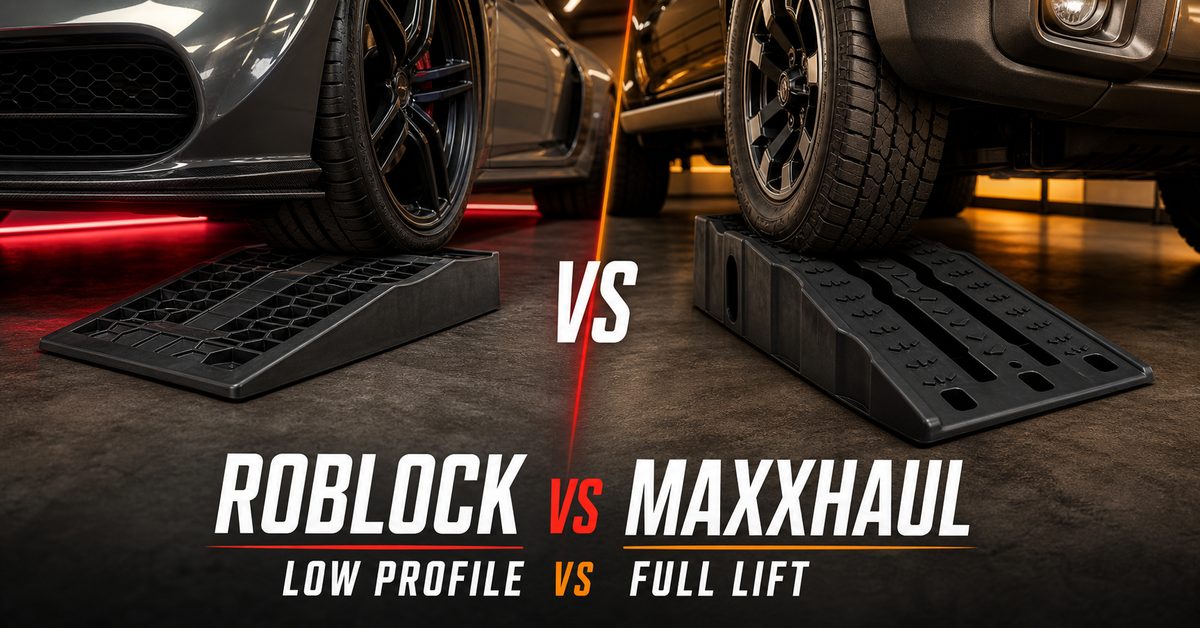
Vehicle ramps can make routine maintenance more convenient, but choosing the right set involves more than comparing maximum weight ratings. The ramp’s length, approach angle, usable width, lift height, traction, and compatibility with your vehicle are just as important.
That is particularly true when comparing the ROBLOCK Low-Profile Car Ramps with the MaxxHaul 50947 Stackable Vehicle Ramps.
The ROBLOCK ramps are compact, lightweight approach ramps designed primarily for lowered and low-clearance vehicles. They raise the tires approximately 2.6 inches, which may provide enough additional clearance to position a floor jack or perform a limited inspection.
The MaxxHaul 50947 ramps are full-size service ramps. They elevate the vehicle by approximately 6.7 inches and provide considerably more room beneath the chassis for compatible maintenance tasks. Their longer design creates a more substantial structure but also requires more garage and storage space.
Both products are made from polypropylene and are sold as pairs. Beyond those similarities, they serve different needs.
If you own a sports car, tuned vehicle, or lowered sedan that cannot reach a normal floor-jack point, the compact ROBLOCK ramps may be more practical. If you need greater working clearance under a compatible standard-height vehicle, the MaxxHaul ramps are the stronger overall choice.
Quick Verdict
Choose the ROBLOCK Low-Profile Car Ramps if you need a small 2.6-inch initial lift for a low-clearance or modified vehicle. Their short 17.5-inch length leaves more room for positioning a floor jack beneath the chassis, while their 10-inch width accommodates many wider tires.
Choose the MaxxHaul 50947 Car Ramps if you want a more traditional service ramp with substantially greater elevation. Their 6.7-inch lift height provides more useful under-vehicle space for jobs such as certain oil changes, inspections, and access to splash shields.
The main differences are:
- ROBLOCK provides a 2.6-inch lift.
- MaxxHaul provides a 6.7-inch lift.
- ROBLOCK is better suited to low-clearance access.
- MaxxHaul provides more working room.
- ROBLOCK is shorter, lighter, and easier to store.
- MaxxHaul has a wider 12-inch tread.
- ROBLOCK lists a 20,000-pound GVW figure.
- MaxxHaul is rated at 6,500 pounds per pair.
- MaxxHaul has a longer and more gradual climb.
- ROBLOCK may be more useful as a first-stage lift before placing a jack.
ROBLOCK vs MaxxHaul Specifications
| Feature | ROBLOCK Low-Profile Ramps | MaxxHaul 50947 Ramps |
|---|---|---|
| Product type | Compact low-profile approach ramps | Full-size vehicle service ramps |
| Quantity | Two ramps | Two ramps |
| Material | Impact-resistant polypropylene | Rugged polypropylene |
| Length | 17.5 inches | 35.63 inches |
| Width | 10 inches | 12 inches |
| Overall height | 3.14 inches | 8.5 inches |
| Effective lift height | 2.6 inches | 6.7 inches |
| Approach angle | Approximately 17 degrees | Not specified |
| Stated capacity | 20,000 lbs. GVW | 6,500 lbs. per pair |
| Stated per-ramp capacity | Not specified | 3,250 lbs. |
| Pair weight | Approximately 5.3 lbs. | Not specified |
| Traction design | Honeycomb surface and non-slip pads | Ribbed platform |
| Tire-retention feature | Curved resting area | Raised service platform |
| Drainage design | Yes | Not specified |
| Storage | Compact and lightweight | Stackable |
| Carrying feature | Lightweight construction | Built-in side handles |
| Best for | Low cars and jack access | Greater undercarriage clearance |
Understanding the Different Ramp Designs
The ROBLOCK and MaxxHaul ramps should not be considered identical products with different dimensions. Their designs reflect two different maintenance strategies.
ROBLOCK ramps provide a small preliminary increase in ride height. Raising a vehicle by 2.6 inches may create enough room to slide a low-profile floor jack farther beneath the chassis or reach a recessed lifting point. The ramps may also help with basic visual inspections when only a small amount of extra clearance is needed.
MaxxHaul ramps are intended to create a more useful working space directly beneath the raised end of a vehicle. A 6.7-inch lift is considerably more noticeable and may provide enough room for maintenance that would be impractical with the ROBLOCK set alone.
That difference makes lift height one of the most important factors in this comparison. The ROBLOCK model focuses on accessibility for low cars, while MaxxHaul focuses on under-vehicle working clearance.
ROBLOCK Low-Profile Car Ramps Overview
Each ROBLOCK ramp measures 17.5 inches long, 10 inches wide, and 3.14 inches tall. The usable tire-resting area raises the vehicle by approximately 2.6 inches.
The ramps use impact-resistant polypropylene with a honeycomb-style structure. This construction is intended to provide strength without making the ramps difficult to transport.
The pair reportedly weighs approximately 5.3 pounds, making it easy to carry between a garage, trailer, workshop, or track-day equipment box.
A curved upper section helps locate the tire and reduce the possibility of it rolling too far forward. The ramp surface incorporates texture to improve traction, while drainage channels help prevent water from collecting beneath the tire.
Non-slip pads on the bottom are intended to reduce movement as the vehicle climbs.
The manufacturer lists a 20,000-pound GVW figure. As with every ramp rating, buyers should confirm exactly how the rating is defined and whether their vehicle’s tire load, axle load, width, and weight distribution meet the instructions.
ROBLOCK Key Features
- Two-piece low-profile ramp set
- 2.6-inch effective lift
- 17.5-inch compact length
- 10-inch width
- Approximately 17-degree slope
- Polypropylene construction
- Honeycomb traction pattern
- Curved tire-resting area
- Surface drainage channels
- Bottom non-slip pads
- Approximately 5.3 pounds per pair
- Stated 20,000-pound GVW rating
MaxxHaul 50947 Car Ramps Overview
The MaxxHaul 50947 is a pair of full-size polypropylene car ramps. Each ramp measures approximately 35.63 inches long, 12 inches wide, and 8.5 inches tall.
The effective lift height is approximately 6.7 inches. This provides over four additional inches of elevation compared with the ROBLOCK ramps.
Each MaxxHaul ramp is rated at 3,250 pounds, producing a total stated capacity of 6,500 pounds per pair. The ramps should still be selected according to the load carried by the supported axle rather than vehicle weight alone.
A ribbed platform helps the tires maintain traction during loading. The patented stackable design allows one ramp to nest with the other, reducing the space required for storage.
Built-in side handles make the ramps easier to carry despite their larger dimensions.
MaxxHaul 50947 Key Features
- Two full-size service ramps
- 6.7-inch effective lift
- 35.63-inch length
- 12-inch width
- 8.5-inch overall height
- Polypropylene construction
- 3,250-pound capacity per ramp
- 6,500-pound capacity per pair
- Ribbed traction surface
- Stackable storage design
- Built-in carrying handles
- Patented structure
Lift Height and Working Clearance
MaxxHaul is the clear winner when the goal is to create usable space beneath a vehicle.
Its 6.7-inch lift raises the supported end more than twice as high as the ROBLOCK set. That difference can determine whether you can comfortably reach an oil-drain plug, inspect an exhaust component, or remove an underbody panel.
ROBLOCK’s 2.6-inch lift should be viewed more realistically. It may improve access, but it will not create the same working environment as a full-height service ramp.
For some low-profile cars, 2.6 inches may be exactly what is needed to position a floor jack. For other maintenance jobs, it may offer too little additional space to work comfortably.
Before choosing, measure your vehicle’s existing ground clearance and add the advertised lift. Remember that the entire vehicle does not rise by exactly that amount in a perfectly level position. Only one end is elevated, so the chassis will sit at an angle.
Winner for working clearance: MaxxHaul 50947
Low-Profile Vehicle Compatibility
ROBLOCK is designed specifically for low-chassis vehicles, sports cars, tuners, and modified cars.
Its compact dimensions allow it to fit into garages with limited working space. More importantly, the short body leaves space behind the ramp for positioning tools beneath the vehicle.
However, the stated 17-degree slope may still be too steep for some extremely low vehicles. A long front overhang, splitter, air dam, side skirt, exhaust component, or underbody panel could contact the ramp before the tire begins climbing.
Do not assume that a product labeled “low profile” will automatically fit every lowered car. Measure:
- Front bumper clearance
- Splitter clearance
- Distance from the tire to the lowest forward body component
- Side-skirt clearance
- Tire width
- Jack-point location
- Required jack placement area
MaxxHaul’s longer 35.63-inch body may create a more gradual overall climb, but its taller final platform requires the vehicle to travel farther and higher. The larger structure may also interfere with jack placement if the intended lifting point is close behind the tire.
ROBLOCK is generally the better option when the primary problem is reaching the jack point on a lowered vehicle.
Winner for low-clearance access: ROBLOCK
Tire Width and Ramp Surface
MaxxHaul offers a 12-inch-wide platform, while ROBLOCK measures 10 inches wide.
The additional two inches make MaxxHaul more accommodating for wider tires, but the usable tread width may be less than the product’s total exterior width. Always compare the actual tire-contact area with the manufacturer’s measurements.
ROBLOCK’s 10-inch width is broader than many compact low-profile ramps, but modified vehicles sometimes use tires that exceed this measurement. A tire hanging over the edge can reduce stability and concentrate the load incorrectly.
Before purchasing either set:
- Measure the tire’s section width.
- Determine the approximate contact-patch width.
- Confirm the ramp’s usable tread area.
- Check whether the manufacturer permits any overhang.
- Select another ramp if the fit is uncertain.
The tire should remain centered during the entire climb and while resting on the platform.
Winner for accommodating wider tires: MaxxHaul 50947
Weight Capacity
ROBLOCK lists an impressive 20,000-pound GVW figure, while MaxxHaul specifies 6,500 pounds per pair and 3,250 pounds per ramp.
The ROBLOCK number is higher, but capacity figures should be interpreted carefully. GVW, per-ramp capacity, supported-axle load, and static-test strength are not automatically interchangeable.
MaxxHaul’s information provides a clearer per-ramp figure. This makes it easier to compare each tire load with the stated limit.
A vehicle’s total weight is not distributed equally across all four tires. Engine placement, cargo, passengers, accessories, and towing equipment can significantly increase the load over one axle.
Before using either product:
- Check the vehicle’s current loaded weight.
- Identify the gross axle weight ratings.
- Account for cargo and modifications.
- Confirm the capacity of each individual ramp.
- Follow the ramp manufacturer’s loading instructions.
- Never assume that a high advertised number eliminates compatibility concerns.
ROBLOCK has the higher stated GVW rating, but MaxxHaul provides more specific per-ramp capacity information in the supplied specifications.
Higher advertised rating: ROBLOCK
Clearer capacity breakdown: MaxxHaul
Traction and Tire Retention
ROBLOCK uses several features to improve stability.
Its honeycomb pattern increases surface texture, while drainage channels help prevent water from collecting beneath the tire. A curved upper section cradles the tire after it reaches the resting position. Non-slip pads underneath help reduce forward movement during loading.
MaxxHaul uses a ribbed platform surface to provide tire traction. Its taller service-platform design gives the tire a defined resting area once it reaches the top.
The effectiveness of either traction system depends on the surrounding conditions. Dust, sand, oil, water, ice, tire dressing, and loose debris can make a ramp slide or reduce tire grip.
Both the ramp surface and the floor should be clean and dry whenever possible. Smooth sealed concrete may require more attention than a naturally textured floor.
Neither design should be considered completely slip-proof.
Portability
ROBLOCK wins for pure portability.
At approximately 5.3 pounds per pair, the ramps should be easy for most users to carry. Their compact 17.5-inch length also makes them suitable for smaller garages, trunks, trailers, or track-day equipment storage.
MaxxHaul ramps are almost twice as long and substantially taller. Built-in handles make them easier to move, but they remain full-size automotive ramps.
For a permanent home garage, MaxxHaul’s size may not be a major disadvantage. For mobile mechanics, motorsport enthusiasts, or drivers carrying ramps in a vehicle, ROBLOCK is more convenient.
Winner for portability: ROBLOCK
Storage
ROBLOCK’s small size makes it easy to place the pair on a shelf or against a garage wall. The ramps do not require a special nesting system because each one is already compact.
MaxxHaul addresses its larger size through a stackable design. One ramp can nest with the other, reducing the amount of floor or shelf space required.
The best design depends on your storage area. ROBLOCK occupies less space overall, while MaxxHaul uses its larger dimensions efficiently.
Winner for minimum storage footprint: ROBLOCK
Best full-size storage design: MaxxHaul
Using the Ramps With a Floor Jack
ROBLOCK’s short length is specifically intended to leave more room for positioning a floor jack or other equipment beneath the chassis.
A common use case is:
- Drive the vehicle onto the ROBLOCK ramps.
- Gain approximately 2.6 inches of initial clearance.
- Position a compatible floor jack at the manufacturer-approved lifting point.
- Lift the vehicle according to the service procedure.
- Support it with correctly rated jack stands at approved support points.
This does not mean the ramps and jack can be used in any improvised combination. Vehicle lifting points, ramp placement, jack position, and support procedures vary by model.
Never rely on a hydraulic floor jack alone while working beneath a vehicle. A jack lifts the vehicle; appropriately rated support equipment holds it.
MaxxHaul can also be used as part of a maintenance setup, but its longer body may occupy more of the floor area where a jack needs to operate. Its advantage is that some jobs may be performed with the tires remaining on the ramps, without lifting the vehicle farther.
Suitable Maintenance Tasks
ROBLOCK Ramps May Help With:
- Reaching recessed jacking points
- Creating clearance for a low-profile floor jack
- Limited undercarriage inspection
- Accessing some low body fasteners
- Loading certain vehicles onto trailers
- Minor clearance-related garage tasks
The 2.6-inch lift may not be enough for comfortable under-vehicle work by itself.
MaxxHaul Ramps May Help With:
- Certain oil changes
- Visual undercarriage inspections
- Accessing some splash shields
- Examining exhaust components
- Checking for leaks
- Performing compatible maintenance with the tires installed
Vehicle ramps are not suitable for jobs requiring removal of the wheels resting on them. This generally excludes brake work and tire rotation on the supported axle.
Some fluid services require the vehicle to remain level. Always consult the vehicle’s maintenance instructions before working on an incline.
Safety Considerations
The ROBLOCK description suggests the ramps can support a vehicle for extended periods and provide more security than using a jack alone. Regardless of marketing language, users should never improvise with vehicle-support equipment.
Follow these precautions with either ramp set:
- Read all manufacturer instructions.
- Confirm vehicle and axle compatibility.
- Inspect every ramp before use.
- Do not use ramps with cracks, deformation, missing pads, or structural damage.
- Work on solid, level ground.
- Clean oil, sand, water, and debris from the surface.
- Align the ramps directly with the tires.
- Drive up slowly and smoothly.
- Use a spotter if visibility is limited.
- Keep people away from the vehicle during loading.
- Apply the parking brake after positioning.
- Place the transmission in Park or the manufacturer-recommended gear.
- Chock the wheels remaining on the ground.
- Turn off the engine and remove the key.
- Confirm stability before approaching the underside.
- Never exceed the applicable load rating.
- Never stack ramps unless the manufacturer specifically designed them for height stacking.
- Never place wood, bricks, blocks, or loose material beneath the ramps.
The MaxxHaul ramps are described as stackable for storage. That does not necessarily mean they can be stacked under a vehicle to increase lift height.
ROBLOCK Pros and Cons
Pros
- Designed for low-clearance vehicles
- Compact 17.5-inch length
- Leaves room for floor-jack positioning
- Lightweight at approximately 5.3 pounds per pair
- 10-inch width suits many performance tires
- Honeycomb traction pattern
- Curved tire-resting area
- Drainage channels reduce moisture accumulation
- Non-slip bottom pads
- High stated GVW rating
- Easy to transport and store
Cons
- Only provides 2.6 inches of lift
- May not create enough room for undercarriage work
- Ten-inch width may not fit very wide tires
- The 17-degree slope may still contact extremely low bodywork
- Per-ramp capacity is not specified in the supplied information
- Small size demands precise tire alignment
- May require additional lifting equipment for many repairs
MaxxHaul 50947 Pros and Cons
Pros
- Provides 6.7 inches of lift
- Offers substantially more working clearance
- Wide 12-inch ramp body
- Rated at 3,250 pounds per ramp
- 6,500-pound capacity per pair
- Rugged polypropylene construction
- Ribbed surface improves traction
- Stackable storage design
- Built-in carrying handles
- Suitable for a wide range of compatible vehicles
Cons
- Much larger than ROBLOCK
- Requires more approach and storage space
- Less convenient to transport
- Longer body may obstruct some jack positions
- May not fit extremely low vehicles
- Lower advertised pair capacity than ROBLOCK
- Taller lift creates a more noticeable vehicle incline
Who Should Buy ROBLOCK Car Ramps?
ROBLOCK is the better choice if:
- You own a lowered car or sports car.
- Your floor jack cannot reach the proper lifting point.
- You need only a small initial increase in clearance.
- You frequently transport ramps.
- Garage storage space is limited.
- Your tires fit safely within the usable ramp width.
- You want compact ramps for track or workshop use.
These ramps are best understood as low-profile access tools rather than replacements for full-size service ramps.
Who Should Buy MaxxHaul Car Ramps?
MaxxHaul is the better choice if:
- You want meaningful undercarriage clearance.
- Your vehicle can safely climb a full-height service ramp.
- You perform compatible oil changes or inspections.
- You need a wider ramp surface.
- Per-ramp capacity information is important to you.
- You have room for 35.63-inch ramps.
- You prefer built-in handles and stackable storage.
For general home-garage maintenance, MaxxHaul is the more versatile option if the vehicle’s approach angle and weight are compatible.
Frequently Asked Questions
Which ramp is better for a lowered car?
ROBLOCK is generally better because it is designed for low-clearance vehicles and provides a modest 2.6-inch lift. Extremely low cars still require measurement before use.
Which ramp provides more space under the vehicle?
MaxxHaul. Its effective lift is approximately 6.7 inches, compared with 2.6 inches from ROBLOCK.
Can I change brakes while the car is on these ramps?
Not on the wheels resting on the ramps. The tires must remain installed to support the vehicle.
Can ROBLOCK ramps replace jack stands?
They perform a different function. ROBLOCK can provide initial clearance or support tires that remain on the ramps. If the vehicle is raised off the ramps with a jack, use appropriately rated support equipment according to the vehicle’s service procedure.
Is the MaxxHaul stackable design for increasing lift height?
The supplied information describes stackability as a storage feature. Do not stack the ramps beneath a vehicle unless the manufacturer explicitly authorizes that use.
Will a 10-inch-wide ROBLOCK ramp fit my tires?
Measure the tire and compare it with the ramp’s usable tread width. Do not assume the full external width is available for tire contact.
Can I use these ramps on asphalt?
Only if the manufacturer permits it and the surface is solid, level, stable, and capable of supporting the concentrated load. Hot or soft asphalt may deform.
Which ramp is easier to carry?
ROBLOCK. The pair weighs approximately 5.3 pounds and is much shorter than the MaxxHaul set.
Which has the higher capacity?
ROBLOCK lists the higher advertised GVW figure at 20,000 pounds. MaxxHaul provides a clearer rating of 3,250 pounds per ramp and 6,500 pounds per pair. Always confirm how each rating applies to the supported axle and tire loads.
Final Verdict
ROBLOCK and MaxxHaul have different strengths, so the best choice depends on why you need ramps.
The ROBLOCK Low-Profile Car Ramps are the better option for lowered cars, sports cars, tuners, and vehicles whose lifting points are difficult to reach. Their 2.6-inch lift, compact length, light weight, and open working area make them useful for gaining enough clearance to position a floor jack.
The MaxxHaul 50947 Car Ramps are the better option for general vehicle maintenance. Their 6.7-inch lift creates considerably more undercarriage space, while the 12-inch width, defined per-ramp capacity, ribbed platform, carrying handles, and stackable design make them practical for a home garage.
Choose ROBLOCK when access is the main problem. Choose MaxxHaul when working clearance is the main priority.
For most owners seeking traditional service ramps, MaxxHaul is the stronger overall choice. For owners of low-clearance vehicles who cannot position a jack or use conventional ramps, ROBLOCK solves the more specific—and often more frustrating—problem.