

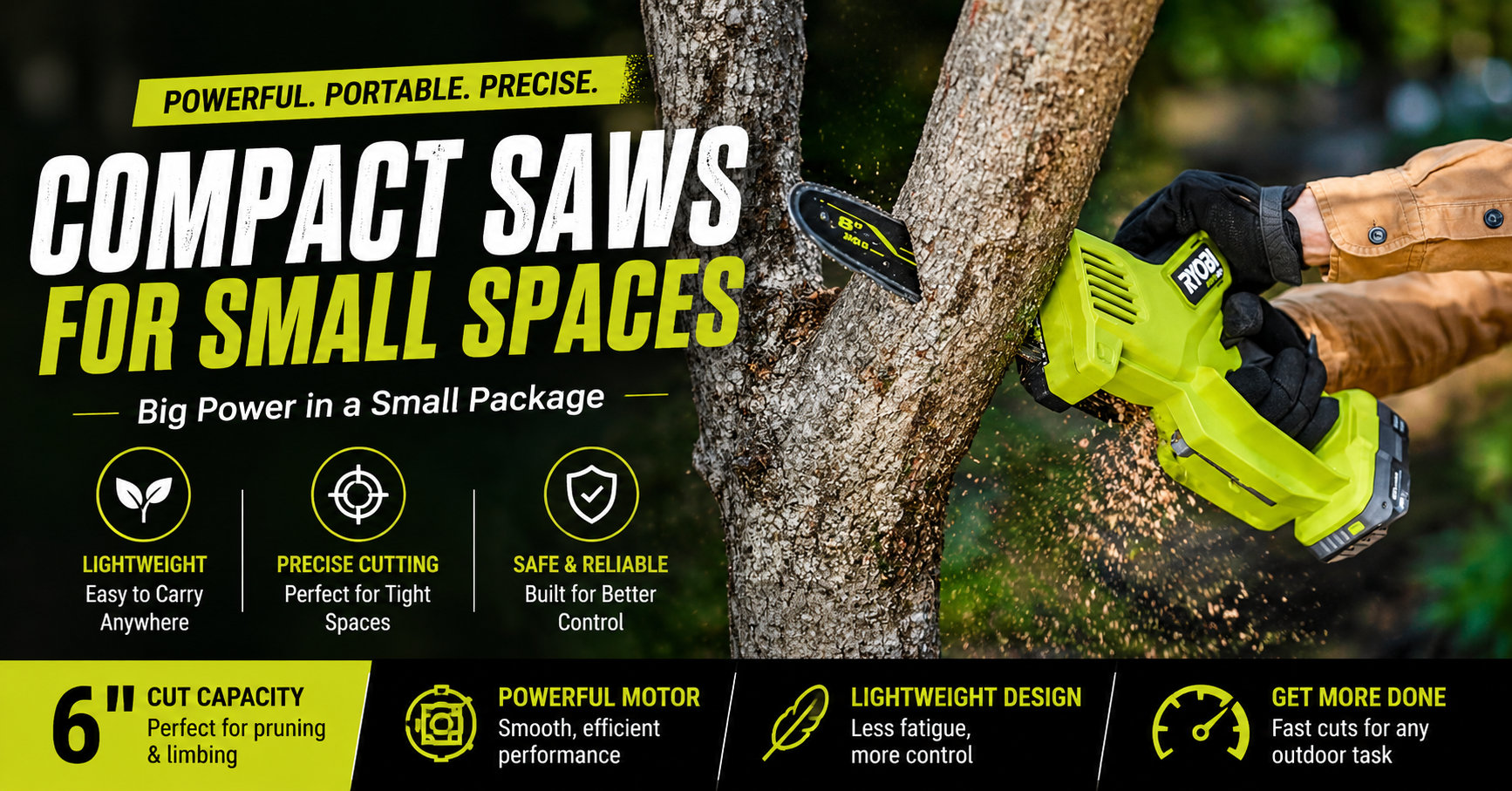
If you’ve searched for the “best compact saw for small spaces,” you’ve probably noticed a pattern: most roundups only cover one type of saw — usually a mini chainsaw or two — while completely ignoring compact circular saws and small-shop table saws, even though those are exactly what a lot of searchers are looking for. That’s a gap worth fixing.
This guide covers all four categories that actually belong under “compact saws for small spaces”: mini pruning chainsaws, compact reciprocating saws, compact circular saws, and small table saws for tight shops. Whether you’re trimming branches in a small backyard, cutting through wall studs in a cramped utility closet, or setting up a table saw in a one-car-garage workshop, there’s a pick below sized for the job.
Quick Comparison: Best Compact Saw by Category
| Category | Best For | Standout Feature | Approx. Price |
|---|---|---|---|
| Mini Chainsaw | Pruning & yard cleanup | Lightweight, one-handed use | $50–$110 |
| Compact Reciprocating Saw | Demolition in tight framing | Fits between wall studs | $70–$180 |
| Compact Circular Saw | Trim, flooring, small rips | Slim body, easy one-hand control | $70–$150 |
| Compact Table Saw | Small garage/basement shop | Full rip capacity, small footprint | $180–$600+ |
What to Look For in a Compact Saw for Small Spaces
Before jumping into specific picks, it helps to know what actually matters when a saw needs to work in a cramped space:
- Overall length and body shape. A saw that’s 3–4 inches shorter than average can be the difference between reaching a cut and not. Reciprocating saws in particular vary a lot in “nose-to-tail” length.
- Weight and balance. Under 3 lbs generally means genuine one-handed operation, which matters more indoors, overhead, or in awkward stances than raw power does.
- Power source. Cordless battery platforms (18V/20V/21V) offer maneuverability with no cord to snag on furniture or framing; corded models trade portability for unlimited runtime.
- Battery cross-compatibility. If you already own batteries from a major brand (Ryobi, DeWalt, Makita), a bare “tool-only” saw on the same platform is usually the better value than a full kit.
- Blade/chain size vs. cutting capacity. Smaller isn’t always a downgrade — an 8-¼” table saw blade, for example, spins faster than a 10″ blade and can still rip standard lumber, just with less headroom for very thick stock.
- Safety features. Look for chain/blade guards, lock-off switches, and — for table saws — a riving knife or blade-contact detection system if you’re working solo in a small space with less room to react.
Best Compact Chainsaws for Small-Space Pruning
Mini chainsaws are the easiest entry point for anyone dealing with overgrown branches, small trees, or firewood prep in a yard too small for a full-size gas saw.
Ryobi 18V Brushless 8″ Compact Pruning Chainsaw (PSBCW01)
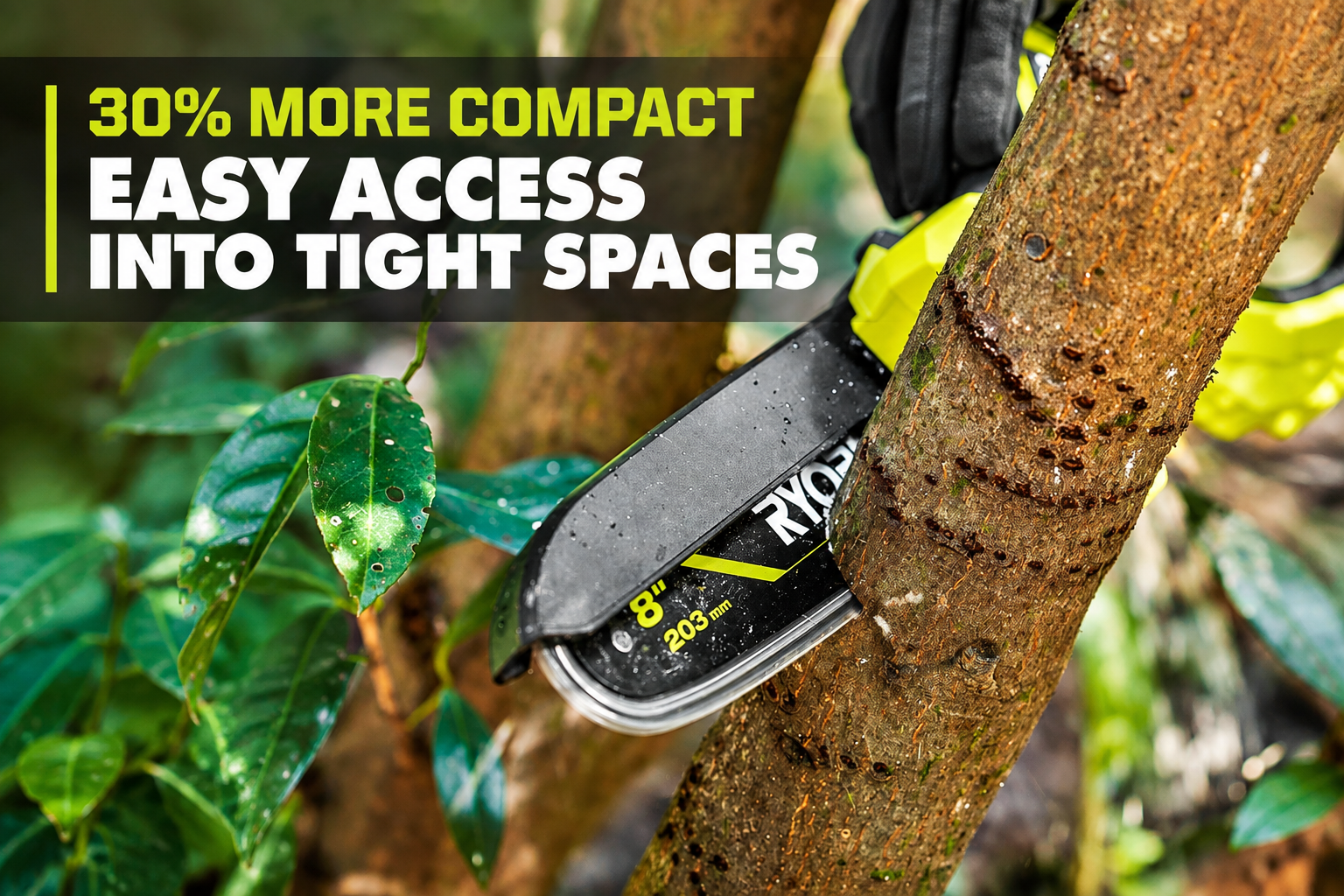
Best pick if you’re already on Ryobi’s 18V ONE+ battery system. It’s sold tool-only, so anyone with a compatible battery gets a low-cost add-on rather than a full kit purchase. The brushless HP motor and 8-inch bar handle branches up to 6 inches thick, and the frame runs about 30% smaller than a standard chainsaw, which matters when you’re working around fences, sheds, or raised beds. It’s rated for 65+ cuts per charge and skips the mess of manual bar-oil application. A stored combination wrench keeps chain-tension adjustments quick.
Pros: Battery cross-compatibility, oil-free design, compact 30% smaller frame
Cons: Tool-only — no battery or charger included, so it’s not a great first purchase outside the Ryobi ecosystem
Seesii 6″ Mini Chainsaw with Automatic Oiler
The strongest all-around pick if you don’t already own a battery platform. Its 900W motor and hardened chain cut through wood up to 15cm (about 6 inches) thick in roughly seven seconds, and at 2.9 lbs it’s built for one-handed control. The automatic chain lubrication system is the real differentiator here — a simple pump press keeps oil flowing evenly, avoiding the leaks and dry-chain wear that come with manual oiling. Two included 21V 2000mAh batteries give 80–100 minutes of combined runtime.
Pros: Auto-oiler, dual batteries included, complete kit with hard case
Cons: Bulkier hard case isn’t ideal if you need something ultra-portable
Imoumlive 6″ Mini Chainsaw Cordless
The lightest option here at 2.2 lbs, aimed squarely at beginners, and anyone who wants to minimize arm fatigue. The pure-copper motor is tuned to hold cutting speed through denser wood without stalling, and it’s compatible with the brand’s extension poles, so it can double as an overhead pole saw without buying a second tool.
Pros: Lightest option, extension-pole compatible, beginner-friendly
Cons: Single 21V 2.0Ah battery means shorter runtime than the dual-battery Seesii
Best Compact Reciprocating Saws for Tight Framing
Reciprocating saws are the go-to for demolition work — cutting through studs, pipes, and nail-embedded lumber — and length matters more here than with almost any other saw type, since you’re often working inside a wall cavity or crawlspace.
DeWalt 20V Max Compact Reciprocating Saw (DCS387B)
At just 14 inches long, this is built specifically to fit between wall studs where a full-size reciprocating saw can’t maneuver. The keyless, lever-action 4-position blade clamp lets you reorient the blade for flush cuts, and the variable-speed trigger delivers up to 2,900 strokes per minute. It’s a bare tool, so it’s the better buy if you’re already invested in the DeWalt 20V Max platform.
Pros: Genuinely compact 14″ body, 4-position blade clamp, trusted brand durability
Cons: Bare tool — battery and charger sold separately
Seesii Cordless Reciprocating Saw
The better pick if you don’t own a battery platform yet, since it ships as a complete kit: two 4.0Ah batteries, fast charger, six blades, storage box, and safety gear. The 200W brushless motor hits 0–3500 RPM with a 15mm stroke, and at 2 lbs it’s noticeably lighter than most reciprocating saws, which helps during overhead or extended cutting.
Pros: Complete out-of-box kit, dual batteries minimize downtime, tool-free blade changes
Cons: Newer brand with a shorter track record than DeWalt for long-term durability
Best Compact Circular Saws for Small Spaces (The Category Most Guides Skip)
Compact circular saws matter for anyone doing flooring cuts, trim work, or small rips where a full-size 7-¼” saw is overkill and hard to control one-handed.
DeWalt Atomic 20V Max 4-½” Compact Circular Saw
In independent lab testing across 11 compact circular saws, the DeWalt Atomic <cite index=”7-1″>stood out as the clear favorite for its balance of lightweight design, reliable cutting power, and thoughtful features like a dust port adapter and bevel adjustment.</cite> It won’t replace a full framing saw for heavy structural work, but for trim, small rips, and general small-space cutting, it’s widely regarded as the strongest all-around compact pick currently on the market.
Pros: Lab-tested top performer, dust port adapter, bevel adjustment
Cons: 4-½” blade means less depth of cut than a full-size saw — not built for thick structural lumber
WORX WX439L Compact Circular Saw
A budget-friendly, feature-rich option that regularly comes up as a top pick for DIYers who want adjustable cuts and reasonable accuracy without paying pro-tool prices. It’s a good fit for home projects that don’t demand all-day, job-site-grade durability.
Pros: Budget-friendly, adjustable cutting depth, laser guide on most versions
Cons: Less durable long-term than premium brand-name compacts
Best Compact Table Saws for Small Shops
This is the second category most “compact saw” articles ignore entirely, despite it being one of the most commonly searched terms in this space. If your shop is a corner of a garage or basement, these are built to reclaim floor space without giving up rip capacity.
DeWalt 8-¼” Compact Table Saw (DWE7485)
Frequently cited as the go-to “tiny table saw” for genuinely small shops — small enough to live on a shelf or under a bench, with a rack-and-pinion fence for fast, accurate adjustments. Because the blade is smaller than a standard 10-inch blade, it spins faster (around 5,800 RPM), which some reviewers note actually improves cut precision on thinner stock. A metal roll cage base adds jobsite durability, and a secondary dust port lets you hook up a vacuum for cleaner indoor cutting.
Pros: Smallest true footprint in this list, rack-and-pinion fence, dual dust ports
Cons: Smaller blade means less rip depth on thick hardwood compared to 10″ saws
SawStop Compact Table Saw (CTS)
The smallest saw in SawStop’s lineup, built for portability without dropping the brand’s signature safety system — <cite index=”15-1″>the blade immediately stops and retracts below the table if it detects contact with skin.</cite> For anyone working solo in a small shop where there’s less room to react to a slip, that safety margin is a meaningful trade-off for the higher price tag. It also includes a quick-tilt bevel with micro-adjustments operable with one hand.
Pros: Industry-leading blade-contact safety system, one-handed bevel adjustment, portable
Cons: Noticeably more expensive than other compact table saws on this list
Frequently Asked Questions
Are compact saws less powerful than full-size versions? Generally yes, but the gap is smaller than most people expect. Compact circular and table saws often spin smaller blades at higher speeds, which can partially offset the reduced cutting depth for everyday tasks like trim, flooring, and standard lumber.
Is a cordless or corded compact saw better for small spaces? Cordless is usually the better fit for small spaces specifically, since there’s no cord to manage around furniture, framing, or tight corners. Corded saws still win on unlimited runtime for longer, stationary jobs like a home table saw setup.
What’s the safest type of compact saw for a beginner working solo? For table saws, a blade-contact safety system like SawStop’s is the strongest safeguard for anyone working alone. For mini chainsaws and reciprocating saws, prioritize models with a lock-off trigger and full guard coverage, and never bypass the safety lock even for quick cuts.
Can a mini chainsaw handle anything beyond light pruning? Most 6–8 inch mini chainsaws are rated for branches up to about 6 inches in diameter. They’re built for pruning, yard cleanup, and small firewood prep — not for felling trees or heavy timber work.
Final Thoughts
The right “compact saw” really depends on which job you’re sizing down for. For yard work, the Seesii 6″ Mini Chainsaw and Ryobi PSBCW01 cover most pruning needs. For tight-framing demolition, the DeWalt DCS387B is the benchmark if you’re already on the 20V Max platform. For flooring and trim cuts, the DeWalt Atomic 20V Max Circular Saw is the best-tested compact option available right now. And if you’re setting up a small shop from scratch, the DeWalt 8-¼” DWE7485 gives you the smallest genuine footprint, while the SawStop CTS is worth the premium if solo safety is your top priority.