

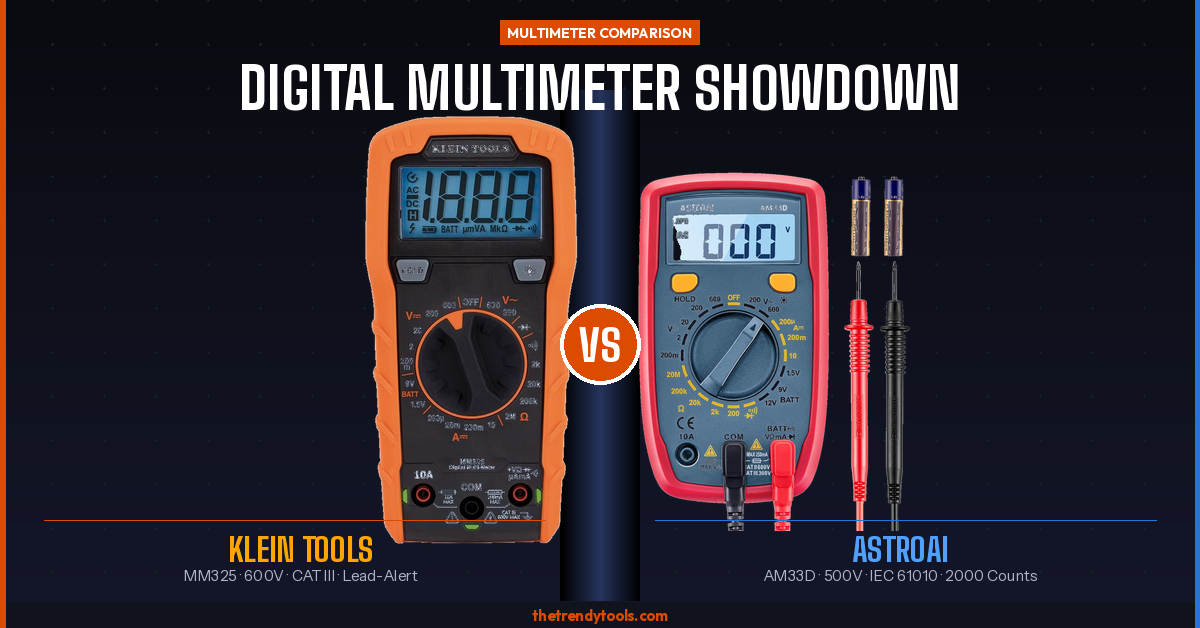
Quick Verdict: The AstroAI AM33D and Klein Tools MM325 are both capable entry-level to mid-range digital multimeters — but they’re built for different users. The AstroAI is a compact, beginner-friendly, budget-conscious multimeter ideal for homeowners, students, and casual DIYers. The Klein Tools MM325 is a more robust, job-site-ready tool with Lead-Alert protection, superior build quality, and broader measurement specs designed for tradespeople and serious DIY enthusiasts. Your budget, experience level, and how often you’ll use it should guide your choice.
Introduction: Why the Right Multimeter Matters
Whether you’re troubleshooting a tripped breaker, testing a car battery, checking continuity in a circuit board, or diagnosing an HVAC system, a digital multimeter is one of those tools that earns its keep every single time you pick it up. Unlike specialty instruments, a good multimeter serves across dozens of applications — electrical, automotive, HVAC, electronics, and more. It’s arguably the most versatile diagnostic tool a person can own.
But here’s the challenge: the multimeter market is enormous, and the options range from dirt-cheap units that will fail at the worst moment to professional-grade instruments that cost several hundred dollars. For most homeowners and hobbyists — and even many working professionals — the sweet spot lies somewhere in the middle: a reliable, accurate, feature-equipped multimeter that doesn’t require a second mortgage.
Today we’re comparing two popular options that occupy that middle ground: the AstroAI Digital Multimeter Tester AM33D and the Klein Tools MM325 Manual-Ranging Multimeter. Both are battery-powered, LCD-equipped, and built for everyday electrical testing. But as we’ll see, they take meaningfully different approaches to the job.
Let’s break them down — feature by feature, spec by spec — so you can make an informed buying decision.
Meet the Contenders
AstroAI AM33D Digital Multimeter
AstroAI has carved out a strong niche in the affordable test equipment market, offering feature-packed instruments at prices that make electrical testing accessible to everyone. The AM33D is their entry-level multimeter — compact, blue, and beginner-friendly, with a 2000-count display, protective silicone cover, and support for voltage, current, resistance, continuity, and diode testing.
It’s the kind of tool you keep in a kitchen drawer for household electrical checks, toss in a toolbox for basic automotive work, or buy as a first multimeter for a student just getting into electronics. At around $10–$15, it’s one of the most affordable multimeters on the market with any kind of feature set.
Key specs at a glance:
- Measurements: AC/DC Voltage, DC Current, Resistance, Diode, Continuity
- Display: 3½ digit backlit LCD, 2000 counts (1999 max reading)
- Max Voltage: 500V
- Sampling Speed: 2 times/second
- Safety: IEC 61010 certified
- Dimensions: 5.12″ x 2.87″ x 1.46″
- Weight: 5.3 oz / 0.15 kg
- Color: Blue
- ASIN: B01ISAMUA6 | Model: AM33D
Klein Tools MM325 Multimeter
Klein Tools is a name that needs no introduction in the professional trades. With over 160 years of manufacturing history, Klein produces tools that working electricians, HVAC technicians, and tradespeople depend on daily. The MM325 is their manual-ranging entry-level multimeter — built rugged, packed with practical features like Lead-Alert LED indicators, a built-in kickstand, test lead holders, and drop protection.
At a higher price point than the AstroAI, the MM325 targets users who need a multimeter that can survive a busy job site while delivering reliable, accurate readings. It measures AC/DC voltage up to 600V, DC current up to 10A, resistance up to 2MΩ, plus continuity, diode, and battery testing.
Key specs at a glance:
- Measurements: AC/DC Voltage, DC Current, Resistance, Continuity, Diode, Battery Test
- Display: Backlit LCD
- Max Voltage: 600V AC/DC
- Max Current: 10A DC
- Max Resistance: 2MΩ
- Measurement Accuracy: ±2%
- Safety Rating: CAT III 600V
- Drop Protection: 6.6 ft (2 m)
- Dimensions: 9.33″ x 5.08″ x 3.82″
- Weight: 13.92 oz
- Color: Orange/Black
- Model: MM325 | UPC: 092644693731
Feature-by-Feature Comparison
1. Measurement Range & Capabilities
This is where the two multimeters diverge most significantly in raw capability.
AstroAI AM33D: The AM33D covers AC/DC voltage, DC current, resistance, diode testing, and continuity. Its maximum voltage is capped at 500V, and it measures DC current (though note from the manufacturer that it cannot test all AC current or AC voltages below 100mV — worth keeping in mind for specific applications). The 2000-count display (1999 max) is adequate for most basic electrical measurements.
Klein Tools MM325: The MM325 pushes further across the board. It measures AC/DC voltage up to 600V, DC current up to 10A, and resistance up to 2MΩ. It adds a dedicated battery test mode that lets you check common household batteries without any manual range-setting. The CAT III 600V safety rating means it’s rated for use on distribution-level circuits, not just household outlets.
The 100V additional headroom and the expanded resistance range matter in practical applications. If you’re working on commercial electrical systems, industrial panels, or complex automotive circuits, that extra capacity is genuinely useful. Battery test mode is a small but handy addition for technicians who frequently test batteries as part of their diagnostic workflow.
Winner: Klein Tools MM325 — broader measurement range, higher voltage ceiling, battery test mode, and greater resistance capacity.
2. Display & Readability
AstroAI AM33D: The AM33D features a 3½ digit backlit LCD with a 2000-count resolution (displaying up to 1999). The 0.6″ digit height is readable in normal conditions, and the backlight helps in dim environments. The display shows polarity (positive and negative readings), which is important for DC measurements where reversing probes can cause confusion.
Sampling speed is 2 times per second — adequate for stable measurements but may feel slow if you’re chasing fluctuating readings or trying to nail down an intermittent fault.
Klein Tools MM325: The MM325 also features a backlit LCD for low-light visibility. While Klein doesn’t publish a specific count rating for this model, the display is notably larger physically — the meter itself is nearly twice the size of the AstroAI — making it easier to read at arm’s length or in awkward positions. The larger form factor also allows for clearer labeling of ranges and function positions on the rotary dial.
The MM325 includes a Data Hold function, allowing you to freeze a reading on the display — handy when you need to step away from a tight measurement location to read the result safely.
Winner: Tie — The AstroAI’s 2000-count display is slightly more precise for fine measurements; the Klein’s larger physical display is easier to read in job-site conditions. Both have backlights and data hold.
3. Safety Features & Ratings
Safety is not an area where you want to compromise when working with live electrical circuits. Here the two meters show a clear hierarchy.
AstroAI AM33D: The AM33D meets IEC 61010 standards, which is the baseline international safety standard for electrical test equipment. It features a double fuse design described as anti-burn, protecting the meter from overload damage. The silicone protective cover adds a layer of drop protection and insulation, and a low battery indicator warns you before the battery voltage drops low enough to affect accuracy.
These are solid safety features for a budget meter. The silicone cover in particular is more than just cosmetic — it provides meaningful protection against minor drops and reduces electrical shock risk from an accidental contact with a live probe tip.
Klein Tools MM325: The MM325 raises the bar significantly with its CAT III 600V safety rating and the unique Lead-Alert LED system. CAT III covers circuits in fixed installations — distribution boards, feeders, and lighting circuits in commercial buildings — making it suitable for a broader range of professional electrical work than a meter with no CAT rating or a lower one.
The Lead-Alert feature is genuinely innovative: LEDs on the meter body illuminate to indicate whether the test leads are plugged into the correct input jacks before you start measuring. Plugging a probe into the wrong jack — say, the current input when you mean to measure voltage — can blow the fuse, damage the meter, or create a dangerous short circuit. Lead-Alert actively reduces this risk by giving you a visual confirmation of correct lead placement.
Additionally, the MM325 includes CAT III/CAT IV safety caps on the included test leads, providing an extra layer of protection at the probe tips.
Winner: Klein Tools MM325 — the Lead-Alert system, CAT III 600V rating, and rated test lead safety caps represent a meaningfully higher level of electrical safety.
4. Build Quality & Durability
AstroAI AM33D: At 5.3 oz and measuring just over 5 inches long, the AstroAI AM33D is a compact, lightweight meter. The blue silicone overmold provides grip and impact resistance for minor drops, and the overall build quality is acceptable for its price point. It’s not designed for heavy professional use — treating it as a household tool rather than a job-site companion is the right mindset.
There’s no published drop-test rating, and the meter does not include a stand or holder for hands-free operation. You’ll be holding it or resting it on a surface during measurements.
Klein Tools MM325: The MM325 is built to Klein’s exacting professional standards. At nearly 14 oz and measuring over 9 inches tall, it’s a full-sized meter with a presence on the workbench. Most importantly, it carries a 6.6-foot (2 meter) drop protection rating — meaning it’s been tested to survive falls from head height onto hard surfaces, exactly the kind of thing that happens regularly on job sites.
Practical details that speak to professional design include test lead holders on the back of the meter (so leads don’t drag across surfaces when you set the meter down), a built-in kickstand for hands-free angled operation, and compatibility with optional magnetic hangers for mounting to metal panels during work. These aren’t luxury features — for a working electrician or HVAC tech, they’re genuine quality-of-life improvements that add up over hundreds of uses.
Winner: Klein Tools MM325 — the drop rating, kickstand, lead holders, and overall build robustness clearly target professional durability.
5. Ranging: Manual vs Auto
Both the AstroAI AM33D and the Klein Tools MM325 are manual-ranging multimeters, meaning you need to select the appropriate measurement range using the rotary dial before taking a reading. This contrasts with auto-ranging meters, which detect the appropriate range automatically.
For experienced users, manual ranging is often preferred — it’s faster once you know your ranges, and it gives you direct control over measurement sensitivity. For beginners, manual ranging has a learning curve: selecting the wrong range will either give you an over-range reading (“OL” or “1” on the display) or a less precise result.
Both meters are equal in this regard — neither offers auto-ranging, and both require the user to understand basic electrical measurement principles before use. The AstroAI’s user manual and the included tips about common incorrect operations are a nod to the reality that many of its buyers will be first-time multimeter users.
Winner: Tie — both are manual-ranging; neither has an advantage here.
6. Ease of Use
AstroAI AM33D: The AM33D’s compact size and simple layout make it approachable for beginners. The rotary switch covers all major functions clearly, and the backlit display is easy to read. AstroAI includes batteries, test leads, and a user manual in the box, so you’re ready to measure right out of the package.
The manufacturer does call out specific common mistakes — incorrect lead placement, wrong rotary switch position — which is useful guidance for new users. The California-based support team (responding within 24 hours) is a nice touch for a budget product, giving buyers some recourse if they have questions or issues.
The silicone body makes it comfortable to hold during extended use, and the compact dimensions mean it fits easily in a pocket or small toolbox compartment.
Klein Tools MM325: The MM325 has a slightly steeper learning curve simply because it’s a larger, more feature-rich meter — but Klein designs for professional usability, and everything about the MM325’s layout is logical and well-labeled. The Lead-Alert system actively prevents one of the most common user errors (wrong lead placement), making it arguably safer and more beginner-friendly than it might initially appear.
The kickstand and lead holders make hands-free operation genuinely practical — you can set the meter up on a panel door, take your reading, and work with both hands free. For complex diagnostic tasks, this is a real workflow advantage.
The included test leads with safety caps are higher quality than those included with budget meters, providing better grip and durability for frequent use.
Winner: Klein Tools MM325 — the Lead-Alert feature and hands-free design options make it smarter in use, even if the initial learning curve is slightly steeper.
7. Automotive Use
Both multimeters are marketed for automotive applications, and both can handle the most common automotive electrical tasks: testing battery voltage, checking fuses, measuring circuit continuity, and diagnosing charging system output.
AstroAI AM33D: The AM33D’s 500V max voltage is more than sufficient for any automotive application — vehicle electrical systems top out around 12–48V for standard vehicles (and up to ~400V for EV battery packs, which neither meter should be used on). DC current measurement is available, continuity testing works well for checking grounds and harness integrity, and the diode test is useful for checking rectifier diodes in alternators.
The compact size is actually an advantage in automotive work, where you often need to squeeze the meter into tight spaces around an engine bay.
Klein Tools MM325: The MM325 covers all the same automotive bases with more headroom. The battery test mode is particularly useful for automotive technicians who regularly check 9V, AA, and AAA batteries used in key fobs, sensors, and diagnostic equipment alongside standard 12V vehicle battery tests. The 10A DC current range covers most automotive circuit testing needs.
The larger size is a minor disadvantage in tight engine bay work, but the kickstand and lead holders make bench-top battery and charging system testing more convenient.
Winner: Tie for basic automotive work — both handle standard vehicle electrical diagnostics well. The Klein edges ahead for technicians who do battery testing regularly.
8. Value for Money
This is where the conversation gets nuanced. “Value” isn’t just about price — it’s about what you get per dollar spent.
AstroAI AM33D: At roughly $10–$15, the AM33D is genuinely remarkable value for money at its price point. You get a functional, IEC-certified multimeter with backlit display, continuity buzzer, data hold, auto shutoff, double fuse protection, and a silicone cover — all included with batteries and test leads. For a homeowner who needs to check an outlet, test a car battery a few times a year, or verify continuity in a home repair, this is absolutely sufficient.
The trade-off is build longevity and measurement ceiling. A meter this inexpensive may not survive years of heavy use, and its 500V ceiling and basic safety rating limit its application scope.
Klein Tools MM325: At roughly $40–$55, the MM325 costs significantly more — typically 3–4x the price of the AstroAI. But it delivers proportionally more: CAT III 600V safety rating, Lead-Alert protection, 6.6-foot drop rating, battery test mode, kickstand, lead holders, and Klein’s legendary build quality backed by decades of professional trust.
For a working electrician, HVAC tech, or serious DIYer who will use a multimeter regularly and in demanding conditions, paying the premium for the MM325 is a sound investment. It will likely outlast multiple budget meters and reduce the risk of measurement errors or safety incidents.
Winner: Depends on the user. The AstroAI wins for budget-conscious casual users. The Klein wins for anyone who uses a multimeter regularly or professionally.
Side-by-Side Specifications Table
| Feature | AstroAI AM33D | Klein Tools MM325 |
|---|---|---|
| Max AC/DC Voltage | 500V | 600V |
| Max DC Current | Yes (limited) | 10A |
| Max Resistance | Not specified | 2MΩ |
| Display | 3½ digit, 2000-count LCD | Backlit LCD |
| Ranging | Manual | Manual |
| Safety Rating | IEC 61010 | CAT III 600V |
| Lead-Alert System | No | Yes |
| Battery Test Mode | No | Yes |
| Drop Protection | Not rated | 6.6 ft (2 m) |
| Data Hold | Yes | Yes |
| Auto Power-Off | Yes | Yes |
| Continuity Buzzer | Yes | Yes |
| Backlit Display | Yes | Yes |
| Kickstand | No | Yes |
| Lead Holders | No | Yes |
| Silicone Cover | Yes | No (built-in rubber) |
| Weight | 5.3 oz | 13.92 oz |
| Dimensions | 5.12″ x 2.87″ x 1.46″ | 9.33″ x 5.08″ x 3.82″ |
| Color | Blue | Orange/Black |
| Batteries Included | Yes | Yes (2 AAA) |
| Test Leads Included | Yes | Yes (with safety caps) |
| Accuracy | Not published | ±2% |
| Price Range | ~$10–$15 | ~$40–$55 |
| Best For | Beginners, homeowners | Professionals, serious DIYers |
Who Should Buy the AstroAI AM33D?
The AstroAI AM33D is the right choice for:
First-time multimeter buyers. If you’ve never used a multimeter before and want to learn without spending a lot of money, the AM33D is a low-risk entry point. It covers all the fundamentals and comes with enough documentation to get you started.
Homeowners with occasional needs. Testing an outlet, checking whether a circuit is live, verifying a battery, or measuring resistance in a simple repair — the AM33D handles all of this reliably for the few times a year most homeowners need a multimeter.
Students and hobbyists. Electronics hobbyists building circuits, students learning electrical theory, or makers working on Arduino and Raspberry Pi projects will find the AM33D entirely adequate for low-voltage bench work.
Budget-constrained buyers. At $10–$15, the AM33D is one of the most affordable multimeters with any kind of credible feature set. If budget is the primary constraint, it delivers genuine utility.
Backup or secondary meter. Professional users who already have a high-end meter often keep an inexpensive backup in the vehicle. The AM33D fills that role perfectly.
Who Should Buy the Klein Tools MM325?
The Klein Tools MM325 is the right choice for:
Working electricians and HVAC technicians. If you use a multimeter on the job every day, the MM325’s CAT III 600V rating, Lead-Alert protection, and job-site durability make it the professional choice between these two options.
Serious DIYers doing their own electrical work. If you’re doing your own panel work, running new circuits, or regularly troubleshooting complex electrical systems at home, the Klein’s safety features and broader measurement range are worth the investment.
Automotive technicians. The battery test mode, 10A DC current range, and robust build quality make the MM325 a strong performer in an automotive shop environment.
Anyone who values safety above price. The Lead-Alert system alone is worth the price premium for users who are prone to accidentally plugging leads into the wrong ports — which is more common than most people admit, especially under job-site pressure.
Users who need hands-free operation. The kickstand, lead holders, and optional magnetic hanger make the MM325 dramatically more practical for complex diagnostic tasks where you need both hands free.
Verdict: Which Multimeter Should You Choose?
After a thorough comparison, the verdict really comes down to one question: How often and in what context will you use this multimeter?
If you’re a homeowner, student, or casual DIYer who needs a multimeter for occasional use — checking outlets, testing batteries, verifying continuity in basic repairs — the AstroAI AM33D is an outstanding value. It does what it says, costs very little, and includes everything you need to get started. You’d have a hard time spending your first $15 on a more useful tool.
If you’re an electrician, HVAC technician, automotive professional, or serious DIYer who uses a multimeter regularly in demanding environments — the Klein Tools MM325 is the clear choice. The Lead-Alert safety system, CAT III 600V rating, 6.6-foot drop protection, battery test mode, and Klein’s legendary build quality justify the higher price many times over through safer operation, longer tool life, and greater measurement capability.
The Klein MM325 is not just a better multimeter — it’s a safer one. And when you’re working with live electrical circuits, that distinction matters more than any other spec on the list.
Bottom line: Buy the AstroAI if price is your primary concern. Buy the Klein if performance, safety, and durability are.
Frequently Asked Questions
Can the AstroAI AM33D measure AC current? No — according to the manufacturer, the AM33D cannot test all AC current or AC voltages below 100mV. It is primarily designed for DC current measurement. Always check the user manual before attempting any measurement outside standard voltage/resistance/continuity work.
Is the Klein Tools MM325 suitable for 240V household circuits? Yes. The MM325’s 600V AC/DC rating comfortably covers standard North American 120V and 240V household circuits, as well as most commercial single-phase applications up to 600V.
Which multimeter is better for automotive use? Both work for basic automotive electrical testing. The Klein MM325 has the edge for automotive shops due to its battery test mode, 10A current range, and sturdier build. The AstroAI AM33D is adequate for home mechanics doing basic diagnostics.
Do either of these multimeters auto-range? No — both the AstroAI AM33D and the Klein Tools MM325 are manual-ranging meters. You must select the correct measurement range using the rotary dial before taking a reading.
What does CAT III 600V mean on the Klein MM325? CAT III (Category III) is an IEC safety classification for electrical test equipment. It indicates the meter is safe for use on distribution-level circuits — fixed installations like distribution boards, feeders, and branch circuits in buildings up to 600V. It represents a higher level of transient overvoltage protection than an uncategorized meter.
Is the AstroAI AM33D good for beginners? Yes — it’s one of the most beginner-friendly multimeters available. The compact design, simple layout, included manual, and low price make it an excellent first meter. Just be aware of its limitations (no AC current testing, 500V max) before using it in unfamiliar situations.
Looking for more honest, expert tool comparisons and reviews? Browse the full collection at thetrendytools.com — your go-to resource for tools that actually work.