

A good ratcheting pipe cutter can turn an awkward plumbing job into a quick, controlled task. Instead of producing plastic dust and vibration like a saw, it gradually pushes a sharp blade through the pipe as you squeeze the handles.
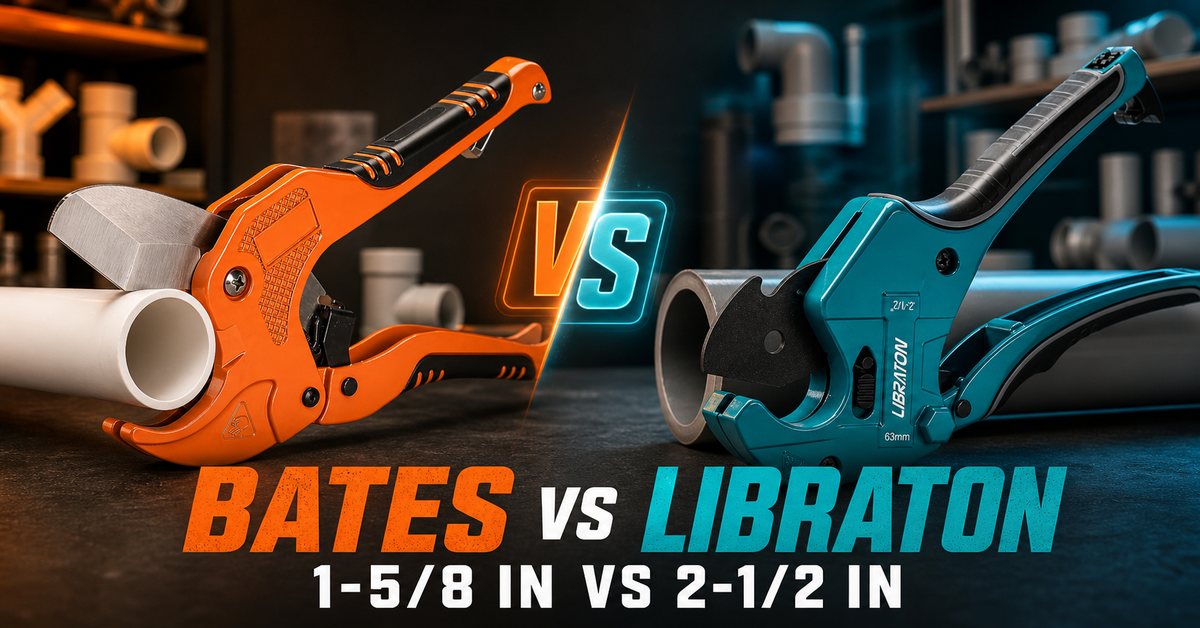
The Bates PVC Pipe Cutter and Libraton Heavy-Duty PVC Pipe Cutter both use this ratcheting approach, but they are designed for different types of users.
The Bates cutter is a compact, lightweight tool capable of cutting compatible plastic pipes with outside diameters up to 1-5/8 inches. Its manganese-steel construction, rubber-textured handle, and 9.9-ounce weight make it attractive for household plumbing, irrigation, electrical conduit, automotive hoses, and occasional repair work.
The Libraton cutter is larger and heavier. It accepts compatible plastic pipe with an outside diameter of up to 2-1/2 inches. Its aluminum-alloy body, 3 mm SK5 blade, Teflon coating, spring-loaded handle, and tool-free blade-changing system give it a more substantial feature set.
If you normally work with small PEX, CPVC, PVC, or flexible hose, the Bates cutter provides the better combination of portability and simplicity. If you need to cut larger pipe or want a replaceable blade, the Libraton is the more capable choice.
Quick Verdict
Choose the Bates PVC Pipe Cutter if you want an affordable, compact, lightweight cutter for pipes measuring up to 1-5/8 inches in outside diameter. It is easier to carry and should cover many common household PEX, CPVC, irrigation, and small PVC jobs.
Choose the Libraton PVC Pipe Cutter if you need a larger 2-1/2-inch cutting capacity, a thicker SK5 blade, an aluminum-alloy body, or a quick-change blade system. It is the more versatile option for users who regularly encounter different pipe sizes.
The short verdict is:
- Bates wins for portability.
- Libraton wins for cutting capacity.
- Bates is better for smaller, occasional jobs.
- Libraton offers the more substantial construction.
- Libraton has the more clearly specified blade.
- Libraton allows tool-free blade replacement.
- Bates is easier to fit inside a compact tool bag.
- Neither cutter is intended for metal pipe.
- Both require correct pipe positioning to produce straight cuts.
Bates vs Libraton at a Glance
| Feature | Bates PVC Pipe Cutter | Libraton PVC Pipe Cutter |
|---|---|---|
| Maximum stated capacity | 1-5/8 inches | 2-1/2 inches or 63 mm |
| Cutting mechanism | Ratcheting | Ratcheting |
| Body material | Manganese steel | Aluminum-alloy construction |
| Blade material | Not separately specified | 3 mm SK5 steel |
| Blade coating | Not specified | Teflon coating |
| Replaceable blade | Not specified | Tool-free quick-change system |
| Replacement blade included | Not specified | No |
| Handle | Rubber-textured, fish-shaped | Spring-loaded ergonomic handle |
| Safety lock | Stainless steel buckle | Bottom safety lock |
| Weight | 9.9 ounces | 1.23 pounds |
| Product dimensions | 3.94 × 3.94 × 3.94 inches | 10.83 × 1.38 × 4.53 inches |
| Compatible materials | PVC, CPVC, PP, PEX, PE and rubber hose | PVC, CPVC, PP-R, PEX, PE and rubber hose |
| Suitable for metal pipe | No | No |
| Best for | Small pipes and portable use | Larger pipes and broader capacity |
What Is the Bates PVC Pipe Cutter?
The Bates cutter is a compact ratcheting hand tool designed for compatible plastic pipes and hoses up to 1-5/8 inches in outside diameter.
Its body is made from manganese steel, a material chosen for its combination of hardness, toughness, and strength. The handles have a rubber-textured surface intended to improve comfort and reduce slipping.
A ratcheting mechanism advances the blade in small steps. Instead of forcing the blade through the pipe with one hard squeeze, the user repeatedly closes the handles until the cut is complete.
The blade area uses a triangular entry design to help position the pipe and begin the cut. The fish-shaped handle is intended to give the user a comfortable grip during repeated squeezing.
A stainless steel buckle at the bottom locks the handles together for storage. This reduces the tool’s footprint and keeps the blade from remaining unnecessarily exposed inside a toolbox.
Bates Technical Specifications
- Manufacturer: Bates Choice Pro
- Model: PIPC01B131
- Maximum stated capacity: 1-5/8 inches
- Product type: Ratcheting plastic-pipe cutter
- Body material: Manganese steel
- Handle: Rubber-textured
- Safety feature: Stainless steel locking buckle
- Weight: 9.9 ounces
- Product dimensions: 3.94 × 3.94 × 3.94 inches
- Color: Orange
- Package quantity: One
- Batteries required: No
What Is the Libraton PVC Pipe Cutter?
The Libraton cutter is a larger ratcheting tool designed for plastic pipe with an outside diameter of up to 2-1/2 inches, or approximately 63 mm.
Its construction combines an aluminum-alloy body with a 3 mm SK5 steel blade. SK5 is a high-carbon tool steel commonly used when hardness and edge retention are important.
The blade has a Teflon coating, which is intended to reduce friction and help it pass through compatible plastic more smoothly.
One of Libraton’s standout features is its tool-free quick-change blade system. The blade can reportedly be replaced in approximately 10 seconds without additional tools. A replacement blade is not included, so one must be purchased separately when the original blade becomes worn or damaged.
The tool also uses a spring-loaded handle. The spring reopens the handles after each squeeze, allowing the user to continue the ratcheting motion with less interruption.
A safety lock at the bottom keeps the cutter closed during storage.
Libraton Technical Specifications
- Manufacturer: Libraton
- Model: 900920
- Maximum stated capacity: 2-1/2 inches or 63 mm
- Product type: Heavy-duty ratcheting pipe cutter
- Body material: Aluminum alloy
- Blade: 3 mm SK5 steel
- Blade coating: Teflon
- Blade system: Tool-free quick change
- Replacement blade included: No
- Handle: Spring-loaded ergonomic design
- Safety feature: Bottom locking buckle
- Weight: 1.23 pounds
- Product dimensions: 10.83 × 1.38 × 4.53 inches
- Batteries required: No
Cutting Capacity
The most important difference is cutting capacity.
The Bates cutter accepts compatible pipe up to 1-5/8 inches in outside diameter. This is sufficient for many household tasks involving PEX, CPVC, irrigation tubing, conduit, and smaller PVC pipe.
The Libraton accepts pipe up to 2-1/2 inches in outside diameter. That additional capacity makes it more versatile for larger drains, pool plumbing, irrigation systems, workshop projects, and other applications involving wider plastic pipe.
The difference between 1-5/8 and 2-1/2 inches may look modest on paper, but it is substantial in actual pipe size. The Libraton’s larger jaw and longer handles are necessary to accommodate and cut the wider material.
Do not select a cutter based only on nominal pipe size. Manufacturers may list nominal pipe size and outside diameter differently. Measure the pipe’s actual outside diameter and compare it with the cutter’s stated capacity.
Bates specifically states that its cutter is not suitable for 2-inch PVC. Libraton’s larger jaw is the appropriate option between these two when working with pipe near that size.
Winner for cutting capacity: Libraton
Body Construction
Bates uses manganese steel for its cutter body. This gives the compact tool a sturdy feel while keeping its total weight below one pound.
Libraton uses an aluminum-alloy body. The larger cutter weighs 1.23 pounds, reflecting its bigger jaw, longer handle, and heavy-duty blade arrangement.
A heavier cutter is not automatically more durable, and a lighter one is not automatically less capable. The body must remain rigid enough to keep the blade aligned while force is applied.
Libraton’s larger frame should provide better leverage on wider pipe. Bates’ compact frame is more convenient in tight spaces and easier to carry for occasional jobs.
Best for compact strength: Bates
Best for substantial full-size construction: Libraton
Blade Quality
Libraton provides more detailed information about its blade.
The cutter uses a 3 mm SK5 steel blade with a Teflon coating. The thickness should help the blade resist flexing when working through larger plastic pipe, while the coating is intended to reduce friction.
Bates describes its cutter as having a durable cutting edge and triangular blade-entry design, but the supplied specifications do not identify a separate blade-steel grade or coating.
That does not mean the Bates blade performs poorly. It simply means Libraton provides clearer technical details.
Blade sharpness affects more than cutting effort. A dull blade is more likely to crush thin pipe, produce a slanted cut, leave a rough edge, or require excessive handle pressure.
Winner for documented blade construction: Libraton
Replaceable Blade System
Libraton has a major long-term advantage: a tool-free quick-change blade system.
The blade is a consumable component. Its useful life depends on the type of pipe, material hardness, wall thickness, frequency of use, storage, and whether the tool encounters dirt or incompatible materials.
Being able to replace the blade means the entire cutter does not necessarily need to be discarded once performance declines.
The replacement blade is not included, so buyers should consider its availability and cost. If the cutter will be used professionally or stored as part of an emergency kit, purchasing a spare blade in advance may be sensible.
The supplied Bates information does not identify a comparable quick-change system.
Winner for blade maintenance: Libraton
Ratcheting Performance
Both cutters use a ratcheting mechanism to multiply hand force.
After the pipe is placed in the jaw, each squeeze advances the blade farther. This allows the cutter to pass through material gradually rather than requiring one extremely forceful movement.
The Bates mechanism is designed around speed and simplicity. Its smaller capacity means it should require less handle travel on narrow pipe.
Libraton combines the ratchet with an arched jaw and spring-loaded handles. The spring reopens the tool between squeezes, which can improve the rhythm of repeated cutting.
Libraton claims compatible pipe can be cut in approximately five to 20 seconds. Actual time will depend on pipe material, size, wall thickness, temperature, blade condition, and the user’s grip.
For smaller pipe, both should be efficient. As the pipe approaches two inches in diameter, Libraton is the only suitable option of the two.
Cut Quality
A ratcheting cutter can produce a cleaner edge than a hacksaw or reciprocating saw because it slices through the plastic instead of grinding away material.
However, clean results are not guaranteed solely by the tool.
The pipe must sit square to the blade. If it enters at an angle, the cut can spiral or leave one side longer than the other.
Libraton specifically advises users to position the pipe perpendicular to the blade. This is good advice for both tools.
For thin-wall PVC, Libraton recommends rotating the pipe slightly after it is secured in the V-shaped jaw. Thin plastic may crack or flatten when a blade pushes directly through one point.
The ideal technique is:
- Mark the desired cut.
- Open the cutter fully.
- Place the pipe squarely against the jaw.
- Align the blade with the mark.
- Confirm the pipe is perpendicular.
- Begin with light, controlled squeezes.
- Rotate thin pipe slightly if recommended.
- Continue ratcheting without twisting the tool.
- Inspect and deburr the cut before assembly.
Ease of Use
Bates is likely the easier tool for a beginner working with small pipe.
Its compact size and 9.9-ounce weight make it less intimidating and easier to maneuver. The rubber-textured fish-shaped handle also provides a comfortable gripping area.
Libraton is larger but incorporates features that help control its extra capacity. The long, spring-loaded handles provide leverage, while the ratchet reduces the effort needed during each squeeze.
Users with small hands or limited grip strength may find the Libraton handles harder to span when fully open. On the other hand, trying to force an undersized cutter through large pipe is not safe or effective.
For small PEX or CPVC, Bates is more manageable. For large PVC or PPR, Libraton’s size becomes an advantage.
Winner for small-pipe ease of use: Bates
Winner for large-pipe leverage: Libraton
Handle Comfort
Bates uses a rubber-textured handle designed to remain comfortable and secure during use. The fish-shaped profile distributes the gripping force over a relatively broad area.
Libraton uses an ergonomic, spring-loaded handle. The spring reduces the need to pull the handles apart manually after every squeeze.
Comfort depends on the user’s hand size and workload. A lightweight tool may feel better during quick household repairs, while a longer tool can reduce the force required to cut thick pipe.
Gloves can improve grip and protect the hand from sharp pipe edges, but they should not be so bulky that they interfere with control.
Portability and Storage
Bates is the clear winner for portability.
At 9.9 ounces and approximately 3.94 inches in its listed dimensions, it takes up relatively little space. The locking buckle keeps the handles closed, making it easier to carry inside a small plumbing bag, electrical pouch, or vehicle toolbox.
Libraton measures 10.83 inches long and weighs 1.23 pounds. It is still portable, but it occupies considerably more space.
The larger dimensions are the tradeoff for its 2-1/2-inch capacity and longer handles.
Winner for portability: Bates
Material Compatibility
Both cutters are intended for several types of plastic pipe and flexible tubing.
Compatible materials listed across the two products include:
- PVC
- CPVC
- PEX
- PPR or PP-R
- PP
- PE
- Rubber hose
- Certain multilayer plastic tubing
Compatibility still depends on diameter, wall thickness, temperature, age, and condition.
Old plastic can become brittle. Very cold PVC may crack more easily than material at moderate temperature. Reinforced hose, wire-braided tubing, and multilayer pipe containing metal may require a different cutting tool.
Neither cutter is intended for metal pipe. Do not use them on copper, steel, iron, or aluminum tubing unless the manufacturer explicitly approves that material.
Performance on Thin Pipe
Thin pipe presents a different challenge from thick pipe. Rather than resisting the blade, it may deform or crack.
Libraton recommends rotating thin PVC slightly after the pipe has been held by the V-shaped jaw. This allows the blade to score more of the circumference before passing through the wall.
The same cautious principle applies when using Bates. Avoid clamping the pipe too aggressively at the start.
If the pipe begins to flatten, split, or move out of alignment, stop and reassess. A fresh blade and gradual pressure usually produce better results than forcing the cut.
Performance on Thick Pipe
Thick-wall pipe requires more blade force and frame rigidity.
Libraton’s larger body, long handles, 3 mm blade, and 2-1/2-inch capacity give it the advantage.
Bates can still perform well within its specified limit, particularly on PEX, CPVC, and smaller PVC. It should not be forced through a pipe that exceeds its rating.
Trying to use an undersized cutter may damage the ratchet, bend the blade, crush the pipe, or cause the tool to slip.
Winner for thick and large plastic pipe: Libraton
Maintenance
Both cutters require basic maintenance.
After use:
- Remove plastic shavings and dirt.
- Wipe moisture from the blade and mechanism.
- Check the blade for chips, bends, or dull areas.
- Inspect the ratchet for smooth engagement.
- Apply only an appropriate light lubricant where recommended.
- Lock the handles before storage.
- Keep the tool away from children.
- Store it in a dry location.
Do not place fingers inside the jaw while operating or inspecting the ratchet. The blade can advance suddenly when the handles are squeezed.
Libraton’s replaceable blade gives it an advantage when wear becomes noticeable. Bates may remain suitable for occasional use, but the replacement process is not specified in the supplied information.
Customer Feedback Considerations
The provided customer feedback for both tools is generally positive, but reviews should be treated as individual experiences rather than controlled testing.
The Bates reviewer praised its solid feel, comfortable grip, clean cutting, and ease of use across several PVC sizes. The comments suggest that the tool may be particularly satisfying for routine DIY plumbing.
The Libraton reviewer reported clean cuts on one-inch and 1-1/2-inch pipe and preferred it to cheaper ratchet cutters. The reviewer also appreciated that the tool avoided the vibration created by a saw when removing installed, leaking pipe sections.
That same review raised a reasonable limitation: the blade is a consumable item, and very high-volume professional users may eventually want a more industrial tool.
These experiences align with the general product positioning. Bates is a compact DIY cutter, while Libraton offers more capacity without necessarily being a premium commercial-grade cutter for nonstop daily use.
Bates PVC Pipe Cutter Pros and Cons
Pros
- Compact and lightweight
- Suitable for common small plastic pipes
- Manganese-steel construction
- Rubber-textured grip
- Comfortable fish-shaped handle
- Ratcheting mechanism reduces hand effort
- Stainless steel storage lock
- Easy to carry in a small tool bag
- Beginner-friendly design
- No batteries required
Cons
- Maximum capacity limited to 1-5/8 inches
- Not suitable for 2-inch PVC
- Blade material is not separately specified
- No confirmed tool-free blade replacement
- Shorter handles provide less leverage on thick pipe
- Not suitable for metal pipe
- May be too small for broader plumbing work
Libraton PVC Pipe Cutter Pros and Cons
Pros
- Cuts compatible pipe up to 2-1/2 inches
- 3 mm SK5 steel blade
- Teflon-coated cutting edge
- Tool-free quick-change blade system
- Aluminum-alloy body
- Long handles provide additional leverage
- Spring-loaded handle improves operating rhythm
- Ratcheting drive reduces cutting effort
- Works with several plastic materials
- Safety lock for storage
Cons
- Heavier than Bates
- Takes up more toolbox space
- Replacement blade is not included
- Blade is a consumable component
- Larger handles may feel awkward for small hands
- May be more tool than necessary for occasional PEX work
- Not intended for metal pipe
- May not suit extremely high-volume professional use
Who Should Buy the Bates Cutter?
Bates is the better choice if:
- You mainly cut pipe below 1-5/8 inches.
- Portability matters.
- You perform occasional DIY repairs.
- You work with PEX, CPVC, irrigation tubing, or hose.
- Your tool bag has limited space.
- You prefer a lighter cutter.
- You do not expect to cut 2-inch PVC.
- You want a straightforward ratcheting tool without extra complexity.
For small household plumbing and maintenance projects, Bates offers the more convenient package.
Who Should Buy the Libraton Cutter?
Libraton is the better choice if:
- You need to cut pipe up to 2-1/2 inches.
- You encounter a wider variety of plastic pipe sizes.
- You want a clearly specified SK5 blade.
- Replaceable blades are important.
- You prefer longer handles and more leverage.
- You work on drains, irrigation, pools, or larger plumbing.
- You do not mind carrying a heavier tool.
- You want one cutter to cover both small and relatively large plastic pipe.
It is the more versatile option and the stronger overall choice for varied projects.
Frequently Asked Questions
Can the Bates cutter cut 2-inch PVC?
No. Its maximum stated capacity is 1-5/8 inches, and the product information specifically says it is unsuitable for 2-inch PVC.
Can the Libraton cutter cut 2-inch PVC?
Its maximum stated capacity is 2-1/2 inches or 63 mm, so appropriately sized 2-inch plastic pipe may fit. Confirm the pipe’s actual outside diameter and wall characteristics before cutting.
Can either cutter cut metal?
No. They are designed for compatible plastic pipe and hose, not copper, steel, iron, or other metal pipe.
Which cutter is better for PEX?
Both can cut PEX within their capacity. Bates is lighter and more convenient for common small-diameter PEX. Libraton is preferable when broader size compatibility is needed.
Which cutter is better for professional plumbers?
Libraton offers greater capacity and a replaceable blade, making it more versatile. However, full-time professionals performing very high volumes may prefer a specialist commercial-grade cutter.
Does Libraton include a replacement blade?
No. Its blade can be changed without tools, but the replacement must be purchased separately.
Why did my PVC pipe crack during cutting?
The pipe may be thin, brittle, cold, old, unsupported, or cut with a dull blade. Position it squarely, apply pressure gradually, and rotate thin pipe slightly when appropriate.
Do ratchet cutters leave perfectly square cuts?
They can produce clean cuts, but alignment matters. Keep the pipe perpendicular to the blade and avoid twisting the tool during cutting.
Is a ratchet cutter better than a hacksaw?
For compatible plastic pipe, a sharp ratchet cutter is usually faster and creates less debris and vibration. A saw may still be necessary for materials or sizes outside the cutter’s rating.
Final Verdict
The Bates and Libraton cutters are both useful, but they suit different workloads.
The Bates PVC Pipe Cutter is the better lightweight option. Its compact manganese-steel body, rubber-textured handle, ratcheting mechanism, and 9.9-ounce weight make it practical for smaller plumbing, irrigation, electrical, and hose-cutting jobs.
The Libraton PVC Pipe Cutter is the more capable overall tool. Its 2-1/2-inch capacity, aluminum-alloy frame, 3 mm SK5 blade, Teflon coating, spring-loaded handles, and quick-change blade system give it a clear advantage for larger and more varied projects.
Choose Bates for portability and small-pipe convenience.
Choose Libraton for capacity, leverage, and replaceable-blade support.
For an occasional homeowner working with PEX or small PVC, Bates may provide everything required without unnecessary bulk. For someone who wants one cutter that can handle a wider range of plastic pipe, Libraton is the stronger long-term purchase.