

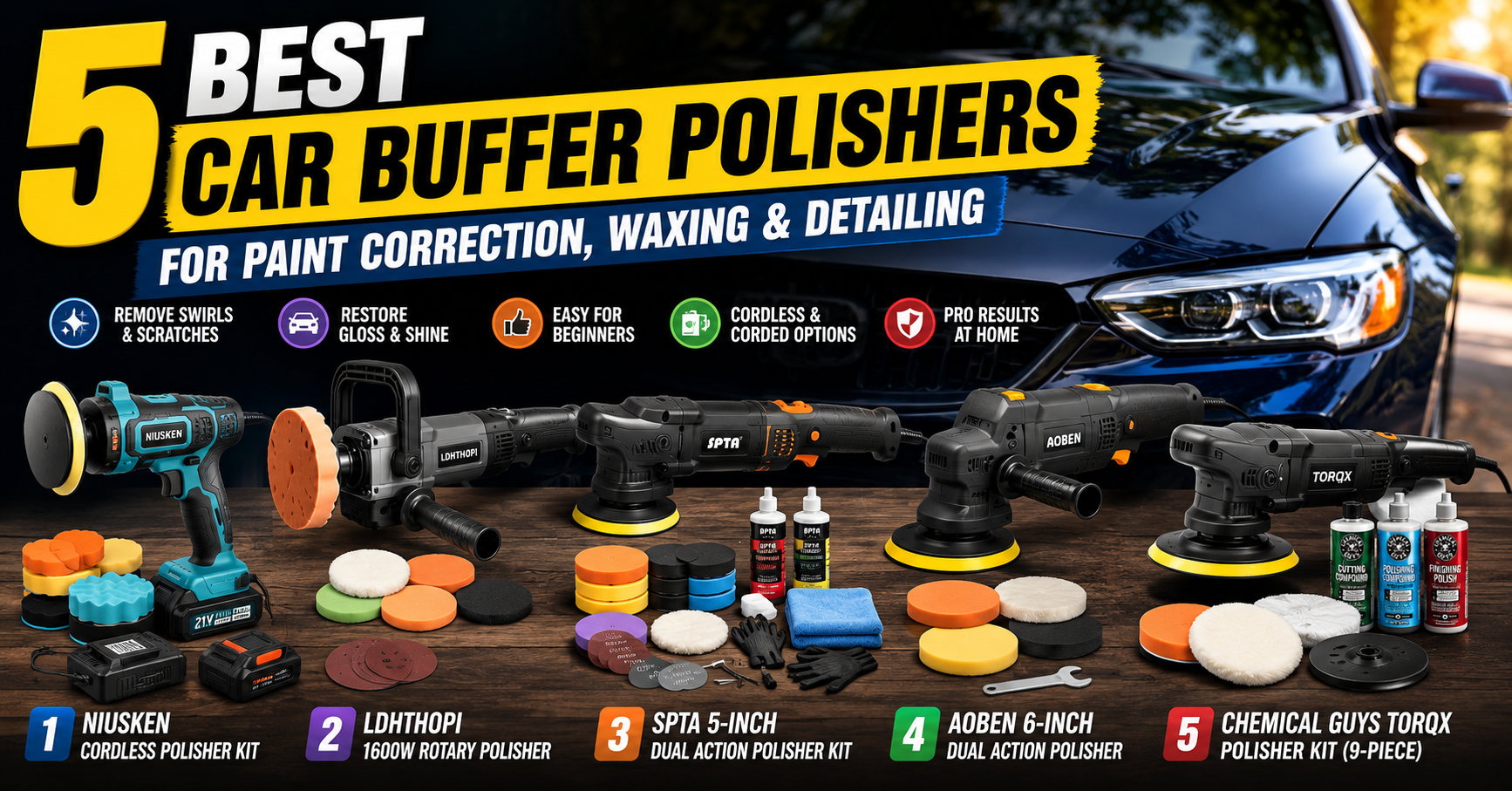
A quality car buffer polisher can transform faded, swirled, or neglected paint, but choosing the correct machine is not always easy. Some polishers are designed for safe, beginner-friendly paint correction, while others prioritize cutting power and require considerably more experience.
The products in this guide cover several different needs. There is a lightweight cordless polisher for quick jobs, a powerful rotary machine for experienced users, two affordable corded dual-action options, and a complete polishing system with pads, compounds, and finishing products.
After comparing their machine type, motor power, speed range, accessories, handling, versatility, and limitations, the Chemical Guys TORQX Random Orbital Polisher Kit is our top overall recommendation. It offers the most approachable combination of paint-correction capability, beginner-friendly operation, and coordinated accessories.
However, it is not automatically the best choice for everyone. The Niusken may be more convenient for mobile work, the LDHTHOPI provides stronger rotary cutting power, and the SPTA package includes significantly more accessories.
Quick Comparison
| Product | Best for | Machine type | Power | Speed range | Main advantage |
|---|---|---|---|---|---|
| Chemical Guys TORQX | Best overall | Dual-action random orbital | 700W | Variable speed | Complete beginner-friendly system |
| Niusken Cordless Polisher | Best cordless option | Dual-action random orbital | Two 21V batteries | 2,800–5,800 RPM | Lightweight and cable-free |
| SPTA 5-Inch Polisher Kit | Best complete accessory kit | Dual-action random orbital | 750W | 2,000–5,200 OPM | Extensive pads, compounds, and tools |
| AOBEN 6-Inch Polisher | Best affordable corded DA | Dual-action random orbital | 700W | 1,000–4,500 RPM | Simple controls and useful pads |
| LDHTHOPI Rotary Polisher | Best for experienced users | Rotary | 1,600W | 1,000–3,500 RPM | Strong cutting and correction power |
How These Products Were Evaluated
This comparison focuses on:
- Machine action
- Motor or battery power
- Speed control
- Ease of handling
- Pad size
- Included accessories
- Suitability for beginners
- Ability to handle larger projects
- Cooling and runtime restrictions
- Value as a complete detailing system
- Potential risks and limitations
This is a specification-based product review created from the supplied product information and current competitor research. The five machines were not tested side by side under controlled laboratory conditions. Actual results will depend on paint hardness, pad choice, polishing liquid, machine technique, defect severity, and surface preparation.
Where Competing Car Polisher Guides Fall Short
Several leading automotive publications provide useful hands-on reviews, but many concentrate primarily on premium dual-action polishers. Car and Driver’s current guide focuses on dual-action machines, while Road & Track emphasizes a smaller group of enthusiast and professional models.
Other guides provide specifications and brief operating instructions but spend less time explaining accessory quality, replacement costs, proprietary battery systems, cooling requirements, or whether an inexpensive package is suitable for full-car correction.
This guide addresses those gaps by comparing:
- Corded and cordless operation
- Dual-action and rotary movement
- Spot correction and full-vehicle polishing
- Machine-only purchases and complete kits
- Beginner safety and experienced-user performance
- Included pads, compounds, sanding discs, batteries, and handles
- Product-specific operating restrictions
Car Buffer vs. Polisher: Is There a Difference?
The terms “buffer” and “polisher” are often used interchangeably, but they can suggest different levels of correction.
A buffer is commonly associated with spreading wax, increasing shine, and maintaining an already healthy finish. A polisher is more often used with abrasive compounds or polishes to reduce swirl marks, oxidation, haze, water-spot etching, and light scratches.
Modern variable-speed machines can usually perform both jobs. The real difference comes from the machine action, pad, polishing liquid, and speed setting.
A soft finishing pad with wax produces a very different result from a cutting pad paired with an abrasive compound, even when both are attached to the same machine.
Dual-Action vs. Rotary Polishers
Understanding machine action is the most important step in choosing a car polisher.
Dual-action random orbital polisher
A dual-action machine combines rotation with an orbital movement. Because the pad is not continuously driving through one fixed circular path, heat and friction are distributed across a wider area.
This generally makes a dual-action polisher more forgiving for beginners. It can still cause damage when used incorrectly, but it is less likely to overheat one small area than a direct-drive rotary machine.
Dual-action machines are ideal for:
- Swirl-mark removal
- Light scratches
- Mild oxidation
- Paint enhancement
- Wax and sealant application
- Regular DIY detailing
- First-time machine polishing
Road & Track recommends a dual-action design for inexperienced users and advises keeping the machine moving with controlled, overlapping passes rather than applying excessive pressure.
Rotary polisher
A rotary polisher spins the pad directly around a single axis. This concentrated movement provides strong cutting ability and can correct defects faster.
The tradeoff is increased heat and greater responsibility for the operator. Holding a rotary machine over one area, using an aggressive pad, or applying too much pressure can damage clear coat, create holograms, or polish through raised edges.
Rotary polishers are better suited to:
- Experienced detailers
- Severe oxidation
- Heavier paint correction
- Boats and large surfaces
- Sanding-mark refinement
- Users who understand heat management
For most first-time users, a dual-action model is the safer starting point.
1. Chemical Guys TORQX Random Orbital Polisher Kit
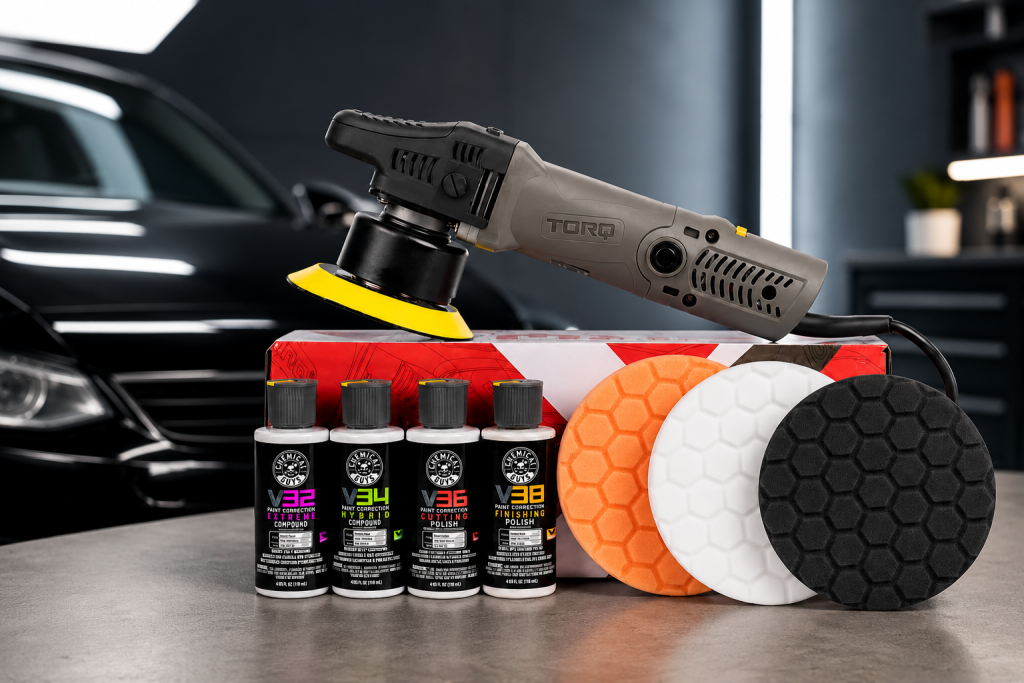
Best overall car buffer polisher
The Chemical Guys TORQX is the most balanced option in this comparison. It combines a manageable dual-action movement, a 700-watt motor, uncomplicated controls, and a coordinated collection of pads, compounds, and finishing products.
Instead of buying a machine and then researching compatible accessories separately, buyers receive the main products required to begin correcting paint.
That convenience is particularly valuable for beginners. Selecting an unsuitable pad or polishing liquid can reduce performance and make the learning process unnecessarily confusing.
Key features
- 700-watt motor
- Short-throw dual-action orbital movement
- Variable-speed operation
- Nine-piece polishing system
- Cutting, polishing, and finishing pads
- Compound and finishing polish included
- Ergonomic body
- Suitable for cars, trucks, SUVs, motorcycles, and RVs
- Can be used on compatible paint, headlights, wheels, and clear plastic
Paint-correction capability
The TORQX is designed for light-to-moderate correction rather than aggressive body-shop work. With the correct pad and compound combination, it can improve:
- Swirl marks
- Fine scratches
- Oxidation
- Surface haze
- Dull clear coat
- Light water-spot etching
- Reduced paint clarity
The dual-action mechanism makes it easier to maintain control across flat panels, doors, hoods, and trunk lids.
Road & Track found the TORQX approachable, well-balanced, and easy to control, although it also noted that the included starter pads may eventually be worth upgrading.
Ease of use
Simple controls make the TORQX suitable for drivers who have never used a machine polisher.
The user can start at a low setting to spread the product, increase the speed for working passes, and lower it again before lifting the pad from the panel.
Because the kit includes several stages of paint-care products, users can move from correction to refinement without mixing unrelated systems.
Potential limitations
The TORQX is corded, so mobility depends on outlet access and extension-cord placement. A cord can drag against the vehicle if it is not carefully managed.
Its short orbital movement also means correction may take longer than with a premium long-throw polisher. However, the smaller movement offers better control on curved panels and compact sections.
Deep scratches, peeling clear coat, exposed primer, and paint chips are beyond the capabilities of this or any ordinary polisher.
Pros
- Beginner-friendly dual-action movement
- Complete system with pads and liquids
- Suitable for multiple correction stages
- Comfortable and controllable
- Useful for light scratches, swirls, and oxidation
- No battery charging interruptions
- Good balance between safety and performance
Cons
- Cord limits mobility
- Starter pads may wear faster than premium replacements
- Not intended for very heavy professional correction
- Additional small pads may be needed for narrow areas
- Higher initial cost than basic machine-only options
Who should buy it?
Choose the Chemical Guys TORQX when you want a coordinated starter system rather than a bare machine.
It is especially suitable for:
- First-time machine polishers
- Weekend detailing enthusiasts
- Owners correcting one or two vehicles
- Drivers who want pads and products in one package
- Users who value control more than maximum cutting speed
Verdict
The TORQX is the best overall choice because it removes much of the guesswork involved in starting machine polishing. It provides enough correction ability for common defects without immediately placing a beginner behind a highly aggressive rotary tool.
2. Niusken Cordless Car Buffer Polisher Kit
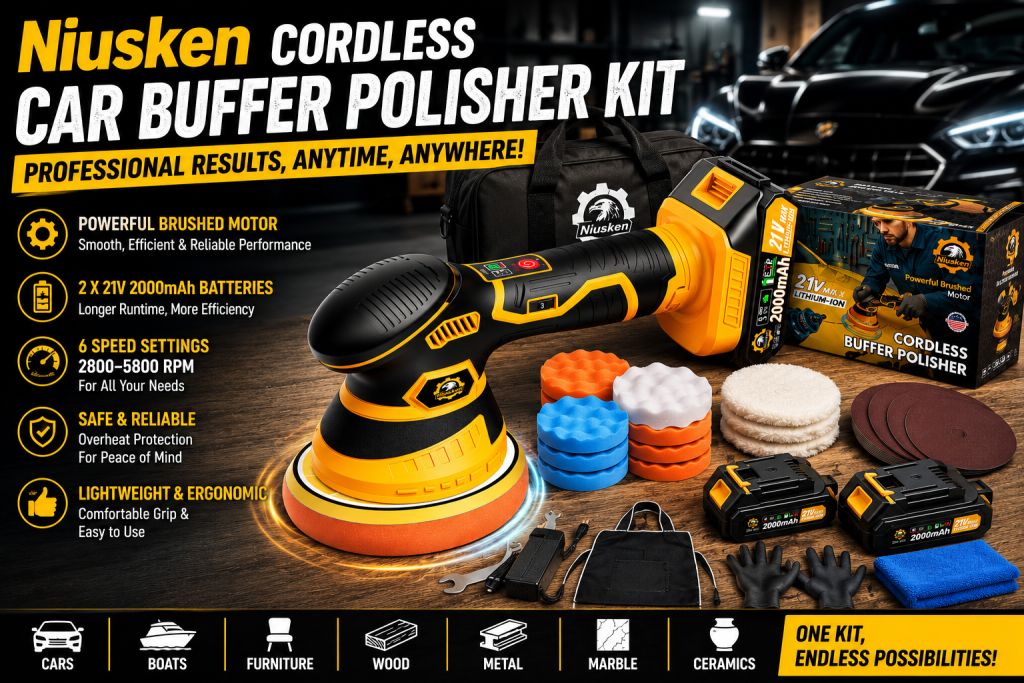
Best cordless car polisher
The Niusken Cordless Car Buffer Polisher is designed for convenience, mobility, and quick detailing jobs.
It weighs approximately 3.3 pounds and operates from two included 21V 2,000mAh batteries. Without a cable trailing across the floor or rubbing against body panels, the user can move freely around a vehicle.
The lightweight body is particularly useful for vertical doors, bumpers, pillars, and areas where a larger corded machine may feel awkward.
Key features
- Cordless dual-action design
- Two 21V 2,000mAh batteries
- Fast charger
- Six speed settings
- 2,800–5,800 RPM range
- 8mm random orbital movement
- LED speed and battery display
- Approximately 3.3-pound body
- 5-inch backing plate
- Multiple sponge pads and bonnets
- Wool pads and sanding discs
- Overheating protection
Cordless convenience
The ability to work away from an outlet is the main reason to choose the Niusken.
It can be useful for:
- Apartment parking areas
- Outdoor detailing
- Mobile detailers
- Quick wax application
- Spot correction
- Door-handle scratches
- Small panels
- Motorcycles
- Boats and recreational equipment
Two batteries improve practicality because one can be charged while the other is used.
However, this battery system is proprietary. It is not compatible with DeWalt batteries or other common third-party tool platforms. That matters because replacement options may be more limited than with a polisher that belongs to a large established battery ecosystem.
LED display and speed control
The LED screen displays the selected speed and remaining battery level. This is a valuable feature on a cordless tool because it helps the user anticipate when a battery change will be required.
Lower settings can be used for spreading wax and applying finishing products. Higher settings are better suited to working polish or addressing light defects.
Accessory package
The kit includes:
- Two 5-inch flat sponge pads
- Two 6-inch flat sponge pads
- Two 5-inch wave sponge pads
- Two wool pads
- Two microfiber bonnets
- Two non-woven bonnets
- Six sanding discs
This is a generous collection, although more accessories do not automatically produce better paint correction. Each pad should be matched carefully to the intended product and surface.
The sanding discs should not be used casually on automotive paint. Wet sanding removes paint material quickly and should be attempted only by users who understand paint thickness, grit progression, and sanding-mark refinement.
Runtime and overheating
The machine includes overheating protection and may stop after extended high-speed operation. The supplied information indicates that continuous high-speed use exceeding approximately 20 minutes may trigger a temporary shutdown.
That makes the Niusken better suited to shorter sections and maintenance work than uninterrupted full-car correction.
A current competitor guide similarly positions this model as a practical cordless option for touch-ups and smaller jobs rather than demanding whole-vehicle paint correction.
Pros
- Lightweight and easy to maneuver
- No cord to drag against the paint
- Two batteries included
- LED battery and speed display
- Wide selection of accessories
- Useful for mobile detailing
- Suitable for spot correction and waxing
Cons
- Proprietary batteries
- Limited continuous runtime
- Overheating protection may interrupt long sessions
- Less suitable for aggressive full-car correction
- Accessory quality may not match premium professional pads
- Sanding discs could be misused by inexperienced owners
Who should buy it?
Choose the Niusken when mobility and low weight are more important than continuous corded power.
It is best for:
- Quick detailing sessions
- Wax and sealant application
- Small-area correction
- Outdoor or mobile use
- Users without convenient outlet access
- Drivers who find heavier machines tiring
Verdict
The Niusken is the most convenient polisher in this comparison. It is not the strongest option for restoring an entire severely neglected vehicle, but it can be highly practical for regular maintenance and smaller corrections.
3. SPTA 5-Inch Dual Action Random Orbital Polisher Kit
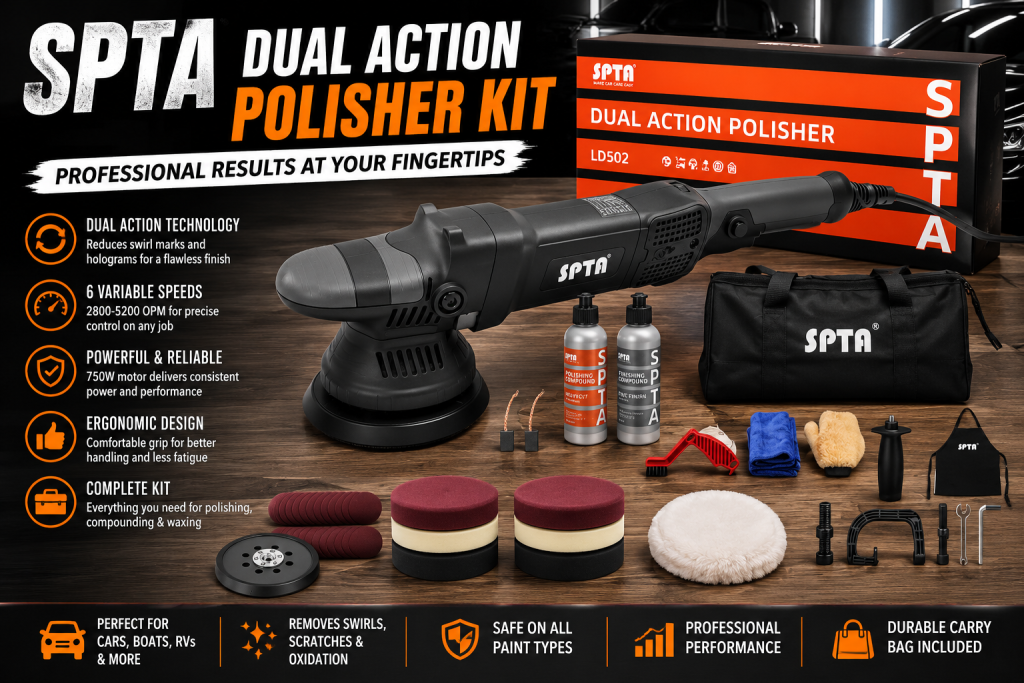
Best complete accessory package
The SPTA kit is designed for buyers who want more than a basic polisher and a few foam pads.
Its 750-watt dual-action machine operates from approximately 2,000 to 5,200 orbits per minute. The package includes polishing compounds, foam pads, wool pads, sanding discs, towels, gloves, an apron, replacement carbon brushes, tools, and a storage bag.
The supplied machine specifications are also reflected in SPTA’s current product information, which describes a 750-watt dual-action unit with constant-speed electronics.
Key features
- 750-watt motor
- 110V corded operation
- Six variable speed settings
- 2,000–5,200 OPM range
- Soft-start function
- Constant-speed electronics
- Detachable side handle
- D-shaped handle
- 5-inch backing plate
- Foam and wool pads
- Coarse and fine compounds
- Sanding discs
- Replacement carbon brushes
- Storage bag and detailing accessories
Why the accessory package matters
Machine polishing requires more than the tool itself. At minimum, the user needs:
- Appropriate pads
- Compound or polish
- Microfiber towels
- A clean working surface
- A method for cleaning pads
- Paint protection for the final stage
The SPTA package includes many of these components. This can make it appealing to someone assembling a home-detailing collection from scratch.
The replacement carbon brushes are also useful because they provide a service item that is often purchased separately.
Speed control
The broad operating range supports several stages:
- Low speed for spreading wax or sealant
- Moderate speed for finishing polish
- Medium-high speed for regular correction
- Higher speed for oxidation and visible defects
Constant-speed electronics are intended to help the machine maintain more consistent movement under changing load. The soft-start function also makes initial product spreading easier to control.
Handles and ergonomics
The kit includes both a side handle and a D-shaped handle.
A side handle can improve control along vertical panels and lower doors. A D-handle may feel more natural on hoods, roofs, and broad horizontal surfaces.
Users can experiment with both configurations rather than being locked into one grip style.
Accessory quantity vs. accessory quality
The SPTA kit wins for quantity, but buyers should not assume every included pad is ideal for every task.
Foam density, pad condition, compound abrasiveness, paint hardness, and polishing technique all affect the final result. The large number of accessories creates flexibility, but it also creates a learning requirement.
Users should label or separate cutting, polishing, and finishing pads to avoid cross-contamination.
Sanding-disc warning
The inclusion of sanding discs expands the kit’s versatility for wood and metal projects, but sanding automotive clear coat is an advanced process.
Do not use the discs on a vehicle simply because they are included. Incorrect grit selection or excessive sanding can remove clear coat, expose color, and create damage that cannot be corrected with ordinary polishing.
Pros
- Extensive collection of accessories
- Dual-action movement is suitable for DIY users
- Soft-start operation
- Constant-speed electronics
- Two handle configurations
- Coarse and fine compounds included
- Storage bag included
- Useful for automotive and workshop projects
Cons
- Large kit may overwhelm complete beginners
- Included sanding discs require caution
- Corded design limits unrestricted movement
- Pad quality may vary across the assortment
- Users must learn which pad and liquid combinations are appropriate
- More accessories require more storage and organization
Who should buy it?
Choose the SPTA when you want a broad detailing and workshop package rather than the simplest beginner system.
It is suitable for:
- DIY enthusiasts building a full kit
- Owners working on several vehicles
- Users who also polish wood or metal
- Buyers who want compounds and accessories included
- Detailers who prefer multiple handle options
Verdict
The SPTA delivers the most extensive package in this comparison. It offers strong value for an organized user who is willing to learn proper pad and product selection.
4. AOBEN 6-Inch Dual Action Car Buffer Polisher
Best affordable corded dual-action polisher
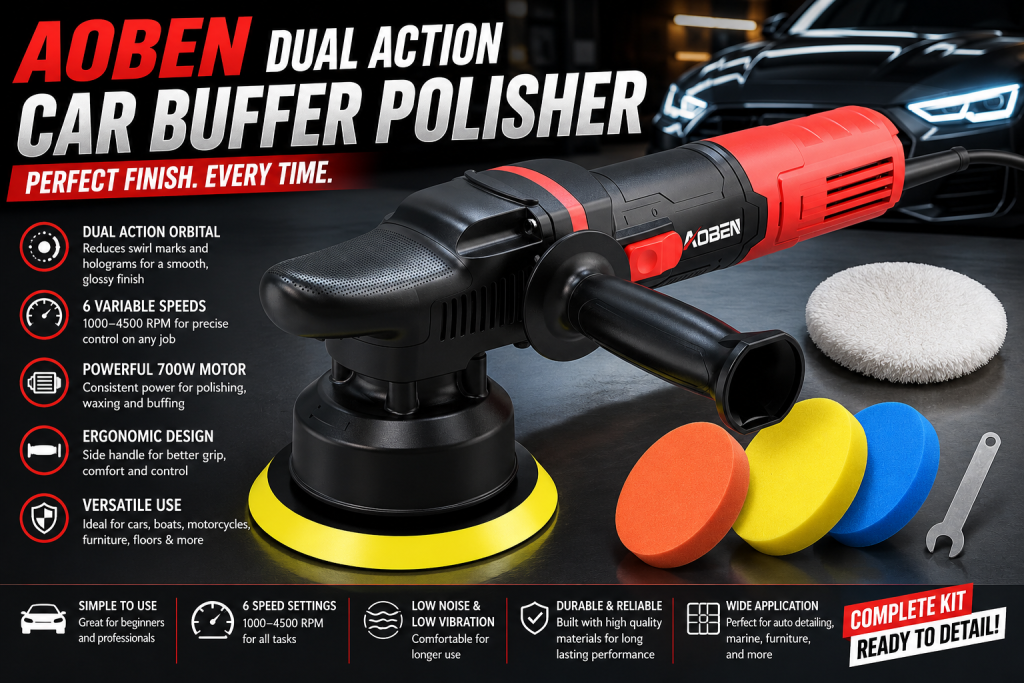
The AOBEN is a straightforward 700-watt dual-action polisher for drivers who want corded consistency without purchasing a large premium kit.
It has six speed settings covering approximately 1,000 to 4,500 RPM and includes three foam pads, one synthetic wool pad, a 6-inch backing disc, a wrench, and two handle positions.
The current product listing describes the same 700-watt motor, variable-speed range, and dual-action movement found in the supplied file.
Key features
- 700-watt motor
- 120V corded power
- Six variable speed settings
- 1,000–4,500 RPM
- Dual-action random orbital movement
- Side handle
- Top handle
- Three foam pads
- Synthetic wool pad
- 6-inch backing disc
- 6.5-inch oversized polishing pads
- Approximately 5.29-pound weight
Oversized pad design
The included foam pads measure approximately 6.5 inches, making them slightly larger than the 6-inch backing plate.
This creates a small protective margin around the edge of the plate. That can help reduce the chance of the hard backing edge contacting paint during normal operation.
However, the user must still keep the pad flat and controlled. An oversized pad cannot compensate for careless technique.
Motor and speed range
Lower speeds are appropriate for spreading wax or sealant. Medium settings can be used for paint cleaning and polishing, while higher speeds support more active correction.
The supplied product information notes that the machine may stop if excessive pressure is applied at the lower settings. This should not necessarily be treated as a lack of power.
Excess pressure is usually counterproductive with a free-spinning dual-action polisher because it can reduce pad rotation, increase heat, and slow correction.
Ergonomics
The side handle can be attached on either side, while the top handle offers another grip position.
This flexibility is useful for left-handed users and for switching between vertical and horizontal panels.
At approximately 5.29 pounds, the AOBEN is noticeably heavier than the Niusken cordless model. The added weight may improve stability on flat panels but can create fatigue during extended work on doors and lower body sections.
Included accessories
The package includes fewer accessories than the SPTA and TORQX systems.
It provides enough pads to begin experimenting, but users will still need:
- Compound or polish
- Microfiber towels
- Pad cleaner
- Wax, sealant, or coating
- Additional pads for full-vehicle work
One pad of each type is rarely enough for correcting an entire vehicle. Pads become saturated with residue and may need cleaning or replacement during a long session.
Pros
- Beginner-friendly dual-action movement
- Consistent corded power
- Useful variable-speed range
- Side and top handles
- Oversized pads help shield the backing plate
- Suitable for polishing and waxing
- Simpler package than large professional-style kits
Cons
- Heavier than lightweight cordless machines
- Compounds and finishing products are not included
- Limited pad quantity
- Cord management is required
- May stall when excessive pressure is used at low speeds
- Large pad is less suitable for narrow or complex areas
Who should buy it?
Choose the AOBEN when you already own detailing liquids and want an affordable corded dual-action machine.
It is a practical fit for:
- Occasional home detailing
- Wax application
- Light paint correction
- Larger, flatter panels
- Users who prefer simple accessories
- Buyers who do not need cordless mobility
Verdict
The AOBEN offers an uncomplicated entry into machine polishing. It lacks the coordinated chemicals of the TORQX and the huge accessory selection of the SPTA, but its basic design may appeal to users who want to select their own pads and polishing products.
5. LDHTHOPI 1600W Rotary Buffer Polisher
Best for experienced users and stronger correction
The LDHTHOPI stands apart from the other four machines because it is a rotary polisher.
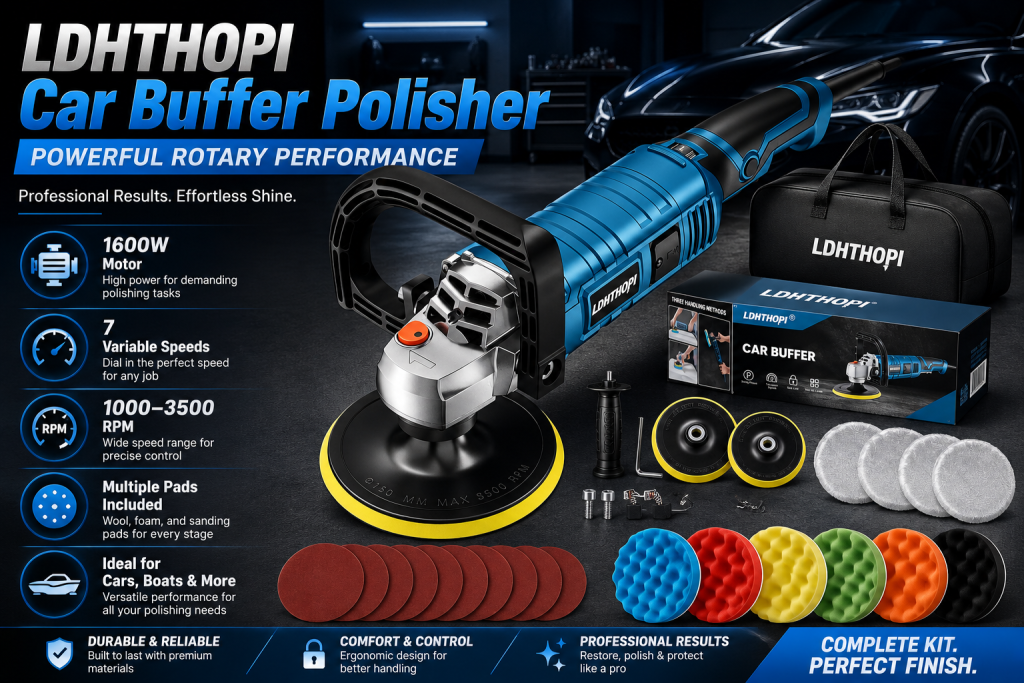
Its 1,600-watt motor, 6-inch and 7-inch pad compatibility, and 1,000–3,500 RPM range provide stronger direct cutting action than a free-spinning dual-action machine.
The current product listing confirms the 1,600-watt motor and seven adjustable speeds.
Key features
- 1,600-watt motor
- Rotary movement
- Seven variable speed settings
- 1,000–3,500 RPM range
- 6-inch and 7-inch capability
- D-handle
- Side handle
- Direct-grip operation
- Seven pad varieties
- Suitable for vehicles, boats, metal, wood, marble, floors, and furniture
Correction power
A rotary machine can remove defects quickly because the pad is directly driven rather than relying on a free-spinning orbital action.
It may be effective for:
- Heavy oxidation
- Sanding-mark refinement
- Severe neglected finishes
- Large boat surfaces
- Strong compound work
- Professional or advanced detailing
However, speed does not equal safety.
The concentrated rotation can create heat quickly, especially on:
- Panel edges
- Raised body lines
- Thin paint
- Plastic bumpers
- Repainted areas
- Small curved sections
Pad selection
The package includes several pad colors and materials intended for different levels of correction.
According to the supplied product information:
- Wool, orange, and black pads are intended for stronger correction
- Yellow and red pads support polishing and gloss enhancement
- Green and blue pads are intended for lighter defects and refinement
Pad colors are not universal across the detailing industry. A black pad from one manufacturer may not perform like a black pad from another.
Always judge a pad by its stated function, foam density, and material rather than its color alone.
Handle configurations
The LDHTHOPI can be operated using:
- Direct grip
- D-handle
- Side handle
These options help users adapt the tool to broad panels, vertical surfaces, and workshop projects.
The additional control is particularly important with a rotary machine because it can pull against the operator when the pad is not held flat.
Cooling requirement
The supplied instructions recommend limiting an operating session to approximately 15 minutes, followed by a five-minute cooling period.
This is a significant ownership consideration. It means the motor should not be expected to perform uninterrupted correction across an entire vehicle.
Users should divide the job into panels, inspect progress, clean pads, and allow the tool to cool between sessions.
Pros
- Powerful 1,600-watt motor
- Strong correction potential
- Seven speed settings
- Multiple handle configurations
- Several pad types included
- Useful for boats and workshop surfaces
- Can address heavier defects faster than many entry-level DA tools
Cons
- Not recommended as a first polishing machine
- Greater risk of overheating paint
- Can create holograms
- Requires careful pad control
- Limited continuous working period
- Larger pads are difficult to use in tight areas
- Strong motor may be excessive for routine wax application
Who should buy it?
Choose the LDHTHOPI when you already understand machine polishing and need more direct cutting power.
It is better suited to:
- Experienced DIY detailers
- Boat owners
- Workshop users
- Severe oxidation
- Larger correction projects
- Users comfortable managing heat and machine movement
Verdict
The LDHTHOPI provides the strongest correction potential of the five products, but it also demands the most skill.
Beginners should generally choose one of the dual-action machines unless they can practice under experienced supervision.
Which Car Polisher Should You Choose?
Choose the Chemical Guys TORQX if:
- You are buying your first proper polishing kit
- You want pads and polishing liquids included
- You need a balance of safety and correction
- You plan to correct an entire vehicle
- You prefer a coordinated product system
Choose the Niusken cordless polisher if:
- You work away from electrical outlets
- You need a lightweight machine
- You primarily wax or perform spot correction
- You value cable-free movement
- You are comfortable using proprietary batteries
Choose the SPTA kit if:
- You want the largest accessory package
- You need compounds, pads, towels, and tools
- You also work on wood or metal
- You enjoy experimenting with multiple pad combinations
- You need replacement brushes and a storage bag
Choose the AOBEN if:
- You want an affordable corded dual-action machine
- You already own polishing compounds
- You prefer a simple kit
- You mainly work on broad exterior panels
- You want consistent power without battery charging
Choose the LDHTHOPI if:
- You have previous machine-polishing experience
- You need stronger rotary correction
- You work on boats or heavily oxidized surfaces
- You understand heat management
- You are willing to follow cooling intervals
Car Polisher Buying Guide
1. Consider your experience level
A first-time user should usually start with a dual-action random orbital machine.
Rotary machines can correct paint faster but provide less protection from operator error.
2. Choose between cordless and corded power
Cordless advantages
- Greater mobility
- No cable contacting the paint
- Easier outdoor use
- Better for mobile detailing
- Convenient for quick jobs
Cordless disadvantages
- Limited runtime
- Battery charging interruptions
- Added battery replacement costs
- Possible proprietary battery restrictions
- Potential reduction in performance as the battery drains
Corded advantages
- Continuous power
- Better for full-car correction
- No battery replacement expense
- Consistent output during long jobs
Corded disadvantages
- Outlet access required
- Extension cord may be necessary
- Cord can drag against paint
- Less convenient outdoors
3. Understand pad size
A 5-inch pad is generally easier to control on curved panels and smaller vehicles. A 6-inch or 7-inch pad covers more surface but may struggle around mirrors, bumpers, pillars, and tight body lines.
Larger pads also create more resistance, so motor performance and technique become increasingly important.
4. Do not judge by wattage alone
A higher wattage figure does not automatically mean that a machine will be smoother, safer, or more effective.
Performance also depends on:
- Torque delivery
- Electronic speed control
- Pad rotation
- Orbital throw
- Machine balance
- Vibration
- Pad and compound choice
- Pressure and arm speed
5. Check what is actually included
A low-priced bare tool may require several additional purchases.
You may need:
- Backing plate
- Cutting pads
- Polishing pads
- Finishing pads
- Compound
- Finishing polish
- Microfiber towels
- Pad brush
- Masking tape
- Extension cord
- Paint protection
Compare the complete setup cost rather than looking only at the machine price.
6. Look at cooling and runtime restrictions
Some machines include thermal protection or recommended cooling intervals.
These limits directly affect whether the polisher is appropriate for:
- A single scratch
- One panel
- A full vehicle
- Several customer vehicles
- Professional daily use
7. Consider replacement parts
Check whether replacement pads, backing plates, carbon brushes, batteries, and chargers are readily available.
A machine is less useful when a worn or damaged part cannot be replaced.
How to Use a Car Polisher Safely
Step 1: Wash the vehicle
Remove dirt, dust, road film, and loose contamination. Running a pad over a dirty surface can create additional scratches.
Step 2: Decontaminate the paint
Use an appropriate iron remover and detailing clay when bonded contamination remains after washing.
The paint should feel clean before correction begins.
Step 3: Inspect the defects
Determine whether the paint has:
- Swirls
- Oxidation
- Water-spot etching
- Paint transfer
- Fine scratches
- Deep scratches
- Peeling clear coat
A polisher cannot replace missing paint or repair clear-coat failure.
Step 4: Mask sensitive areas
Protect:
- Textured plastic
- Rubber trim
- Badges
- Sharp edges
- Raised body lines
- Panel gaps
Polish residue can stain textured plastic, and paint is often thinner around sharp edges.
Step 5: Begin with the least aggressive combination
Start with a polishing pad and mild polish.
Use a stronger compound or cutting pad only when the test section does not provide sufficient correction.
Step 6: Prime the pad
Apply enough product to lubricate the pad face without soaking it.
A completely dry pad can create excessive friction during the first working pass.
Step 7: Spread the product at low speed
Place the pad flat against the paint before turning on the machine.
Spread the product across a small section at low speed.
Step 8: Work in overlapping passes
Increase to the appropriate polishing speed and move slowly across the section.
Use overlapping horizontal and vertical passes to create consistent coverage.
Step 9: Avoid excessive pressure
The pad must continue moving effectively. Heavy pressure can stall a dual-action pad or create dangerous heat with a rotary machine.
Road & Track similarly advises allowing the machine’s weight to contribute rather than forcing the pad into the surface.
Step 10: Inspect the results
Wipe away residue with a clean microfiber towel and inspect the area under direct lighting.
Do not continue polishing automatically. Stop when the desired correction has been achieved.
Step 11: Clean or replace the pad
A saturated pad loses cutting performance and holds spent residue.
Clean pads regularly and use several pads when correcting an entire vehicle.
Step 12: Protect the paint
Polishing may remove existing wax or sealant. Apply fresh protection after the correction process.
Common Car Polishing Mistakes
Using a rotary polisher without practice
A rotary tool can damage paint quickly. Practice on a spare panel before working on a valuable vehicle.
Polishing dirty paint
Even small particles can become trapped between the pad and paint.
Using one pad for the entire vehicle
The pad will collect residue, removed paint material, and contamination.
Applying too much compound
Excess product can clog the pad, reduce correction, create dust, and make residue difficult to remove.
Tilting the pad
Keep the pad as flat as possible. Tilting concentrates pressure on a smaller area.
Remaining on one spot
Keep the machine moving to control heat.
Polishing in direct sunlight
Hot panels can dry polishing liquids too quickly and increase surface temperature.
Assuming every scratch can be removed
A scratch that exposes primer, metal, or plastic requires repair rather than additional polishing.
Using sanding discs without training
Sanding is not an ordinary cleaning step. It removes paint material intentionally and can cause permanent damage.
Frequently Asked Questions
What is the best car polisher for beginners?
The Chemical Guys TORQX is the best beginner option in this comparison because it combines dual-action movement with the pads and liquids needed for several polishing stages.
The AOBEN is another practical choice for users who already own detailing products.
Is a cordless car polisher powerful enough?
A cordless polisher can be powerful enough for waxing, spot correction, and light polishing. Battery runtime and heat limits may make it less convenient for intensive full-car correction.
Can a car polisher remove deep scratches?
No. A polisher can improve scratches located within the clear coat. It cannot replace missing color coat, primer, or metal.
Is a rotary or dual-action polisher better?
A dual-action polisher is generally better for beginners, routine detailing, and controlled paint correction.
A rotary machine is faster and more aggressive but requires greater skill.
Can I use a car polisher to apply wax?
Yes. Use a soft finishing pad and a low speed. Wax application requires less speed and pressure than paint correction.
How many pads are needed to polish a car?
The number depends on vehicle size and paint condition, but relying on one pad is not ideal. Several clean pads make it easier to maintain consistent performance.
What speed should I use?
There is no universal setting for every machine.
In general:
- Low speed for spreading product
- Low-to-medium speed for wax
- Medium speed for finishing polish
- Medium-to-high speed for correction
Follow the machine, pad, and polishing-product instructions.
Can I polish headlights with these machines?
Some dual-action polishers can be used on compatible clear plastic with an appropriate pad and plastic polish. Avoid excessive heat and protect surrounding paint and trim.
How often should a car be polished?
Polishing should be performed when correction is necessary, not automatically after every wash.
Frequent aggressive polishing removes clear-coat material. Regular washing and paint protection can reduce the need for repeated correction.
Should I wax after polishing?
Yes. Wax, sealant, or another suitable protectant should generally be applied after polishing to protect the corrected surface.
Final Verdict
The Chemical Guys TORQX Random Orbital Polisher Kit is the best overall option for most drivers. Its dual-action movement, manageable power, included pads, and coordinated polishing products create an easier path into machine paint correction.
The Niusken Cordless Polisher is the best choice for portability, quick waxing, and localized correction. Its low weight and two-battery package are convenient, although proprietary batteries and heat limits reduce its suitability for demanding continuous work.
The SPTA Dual Action Kit offers the broadest collection of accessories. It is ideal for buyers who want a complete workshop-style package and are willing to learn how to use its many pads and products properly.
The AOBEN 6-Inch Polisher is a straightforward, affordable corded option. It is particularly attractive for users who already own compounds, polishes, towels, and paint protection.
The LDHTHOPI Rotary Polisher provides the strongest direct correction potential, but it is not the best starting machine. Its rotary action and powerful motor make it better suited to experienced users, boats, severe oxidation, and larger restoration projects.
For most beginners, the safest decision is a dual-action machine paired with a mild polish and a medium polishing pad. Begin with a small test area, use controlled overlapping passes, and increase aggressiveness only when the paint condition genuinely requires it.