

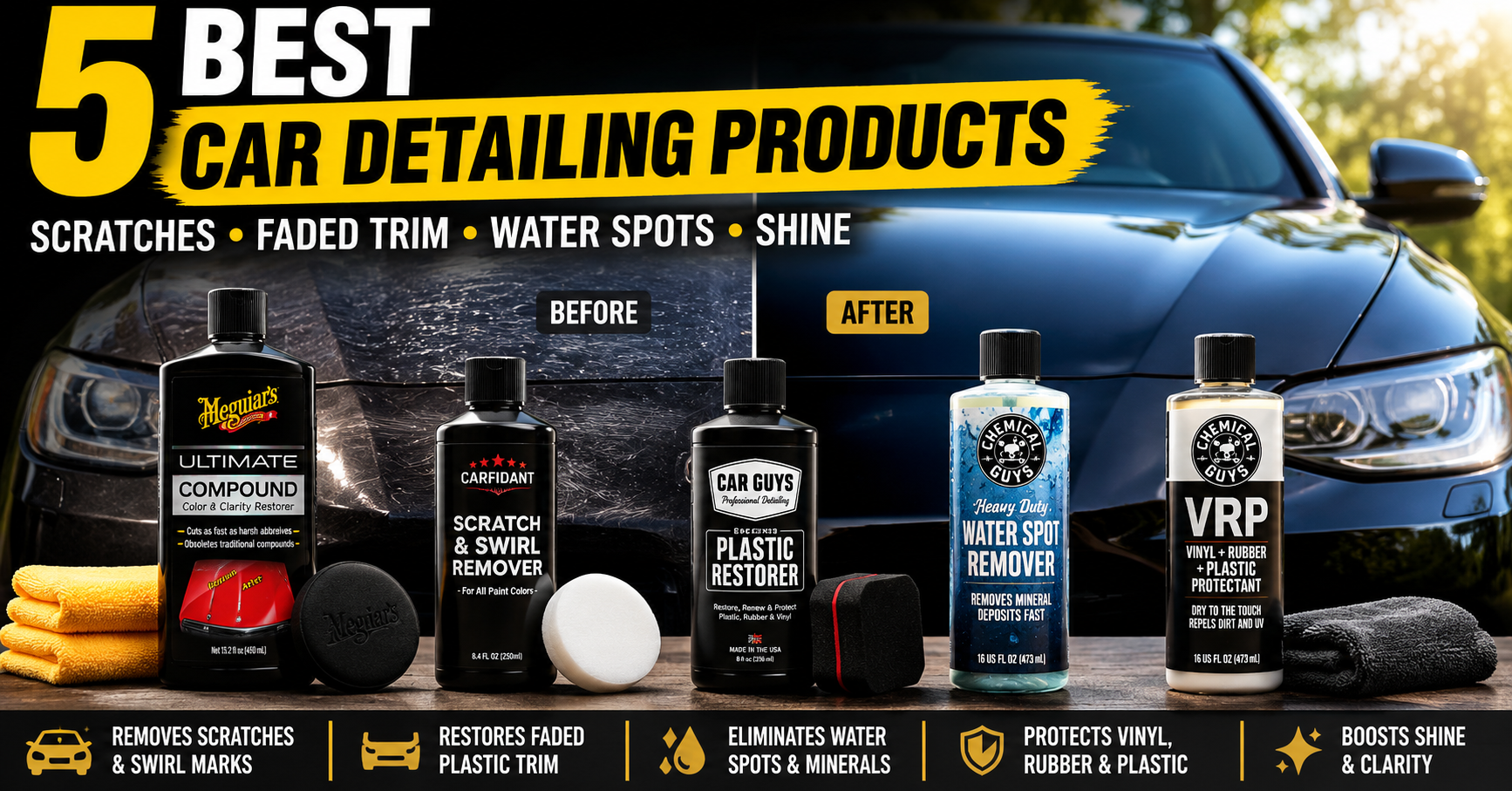
A normal car wash can remove dirt, dust, mud, and road film, but it cannot correct every appearance problem. Swirl marks remain visible under sunlight, faded plastic trim stays gray, mineral deposits cling to windows, and dry rubber may continue looking neglected even after the vehicle is clean.
These problems require targeted detailing products.
This guide reviews five popular automotive appearance products designed for different restoration tasks. They include two paint-correction compounds, one dedicated plastic restorer, one mineral-deposit remover, and one versatile vinyl, rubber, and plastic dressing.
Although these products are frequently grouped under “car detailing supplies,” they are not interchangeable. A scratch remover should not be used as a trim dressing, and a plastic restorer will not level imperfections in automotive clear coat. Choosing the correct formula is essential for achieving a better finish without wasting product or creating additional work.
After comparing their purposes, formulas, application methods, versatility, and limitations, our top overall recommendation for paint correction is Meguiar’s Ultimate Compound. However, each product in this guide earns a recommendation for a particular detailing problem.
Quick Comparison of the Best Car Detailing Products
| Product | Best for | Main surfaces | Application method | Primary benefit |
|---|---|---|---|---|
| Meguiar’s Ultimate Compound | Overall paint correction | Glossy paint and clear coat | Hand or dual-action polisher | Removes light defects and restores clarity |
| Carfidant Scratch and Swirl Remover | Beginner-friendly scratch repair | Clear-coat and painted surfaces | Hand application with included pad | Simple kit for light scratches and swirls |
| CAR GUYS Plastic Restorer | Faded exterior plastic | Plastic, rubber, and vinyl | Foam applicator | Darkens, seals, and renews faded trim |
| Chemical Guys Heavy Duty Water Spot Remover | Hard-water deposits | Paint, glass, chrome, and metal | Hand application | Breaks down mineral stains |
| Chemical Guys VRP Dressing | Multipurpose trim and tire care | Vinyl, rubber, and plastic | Foam or microfiber applicator | Creates a dry satin finish and adds protection |
Our Selection Process
The five products were evaluated according to:
- Intended detailing task
- Surface compatibility
- Ease of application
- Included accessories
- Ability to correct or conceal defects
- Interior and exterior versatility
- Expected finish
- Important limitations
- Suitability for inexperienced users
This article is based on the supplied product information, current manufacturer instructions, and an analysis of competing automotive detailing guides. It does not claim that every product was independently laboratory-tested under identical conditions.
That distinction matters. Results can vary depending on the age of the vehicle, paint hardness, clear-coat condition, climate, surface preparation, applicator, pressure, and amount of product used.
Understanding Correction, Restoration, and Protection
Before selecting a product, it helps to understand the three main functions represented in this guide.
Paint correction
Paint correction products contain abrasives that level a very small amount of the surrounding clear coat. This reduces the difference between a defect and the surrounding finish, making scratches, oxidation, haze, and swirl marks less visible.
A compound does not add missing paint. It works best when the damage is limited to the clear coat.
A professional-style scratch-repair system may include sanding, compounding, polishing, and swirl removal, depending on the severity of the damage. Scratches extending beneath the clear coat may require touch-up paint or repainting rather than additional polishing.
Surface restoration
A trim restorer renews the appearance of plastic, rubber, or vinyl that has become gray, chalky, or dry. It can deepen the color and leave a more uniform finish, but it does not physically rebuild plastic that has cracked, warped, or permanently deteriorated.
Good preparation is particularly important. Old dressing, oil, wax residue, dirt, and traffic film can prevent a restorer from bonding evenly.
Surface protection
A dressing or protectant leaves a finished layer on vinyl, rubber, or plastic. Depending on the formula, it may add shine, reduce dryness, repel dirt, and provide some resistance against environmental exposure.
Protection and cleaning are different processes. A dressing should generally be applied to a clean surface rather than spread over existing grime.
1. Meguiar’s Ultimate Compound Review
Best overall for paint correction
Meguiar’s Ultimate Compound is the strongest all-around option in this roundup for drivers who need to improve dull, scratched, oxidized, or neglected glossy paint.
The formula uses micro-abrasive technology to address light scratches, oxidation, water spots, blemishes, and swirl marks. It is designed to cut quickly while leaving a clearer, glossier finish than many traditional aggressive rubbing compounds.
Meguiar’s states that Ultimate Compound is safe and effective on clear-coat and single-stage glossy paint. It can be applied manually or with a dual-action polisher, giving it more flexibility than products intended only for hand use.
Key features
- 15.2-ounce bottle
- Micro-abrasive paint-correction formula
- Suitable for clear-coat and single-stage paint
- Can be applied by hand
- Compatible with dual-action polishers
- Targets oxidation, swirls, scratches, water spots, and blemishes
- Restores color, gloss, and surface clarity
Performance expectations
Ultimate Compound is most useful for widespread light-to-moderate defects rather than one isolated mark. It can be applied to a small damaged area, but the larger bottle and machine compatibility make it practical for correcting an entire hood, roof, trunk lid, or vehicle.
The formula is more aggressive than a finishing polish. That additional cutting ability helps when ordinary wax or cleaner wax cannot improve the surface. However, users should begin with a small test section and avoid repeatedly polishing the same area without evaluating the results.
A few controlled passes are safer than applying heavy pressure for an extended period.
How to use Meguiar’s Ultimate Compound by hand
- Wash and thoroughly dry the vehicle.
- Move the vehicle into a shaded, well-ventilated location.
- Confirm that the paint is cool.
- Inspect the scratch or oxidation under bright lighting.
- Apply a small amount to a clean foam or microfiber applicator.
- Work on a small section using overlapping motions.
- Apply moderate, controlled pressure.
- Wipe away the residue with a clean microfiber towel.
- Inspect the area before repeating.
- Apply wax, sealant, or another paint protectant after correction.
When using a machine, follow the polisher and pad manufacturer’s instructions. Keep the pad flat and avoid dwelling on panel edges or sharp body lines.
What it can remove
Meguiar’s Ultimate Compound can improve:
- Fine clear-coat scratches
- Automatic-car-wash swirl marks
- Mild oxidation
- Paint transfer
- Cloudy or dull paint
- Light water-spot etching
- General surface haze
What it cannot repair
It cannot replace missing color coat, primer, or metal. A deep scratch that exposes a different color beneath the paint will usually need touch-up paint or professional body repair.
It should also not be treated as a routine weekly cleaner. Compounds remove a small amount of surface material, so they should be used when correction is genuinely needed.
Pros
- Effective for several common paint defects
- Appropriate for localized or larger corrections
- Can be used manually or by machine
- Restores gloss while correcting imperfections
- Suitable for experienced beginners
- Larger bottle offers good coverage
Cons
- Does not include an applicator pad
- More aggressive than a finishing polish
- Requires a separate protective product afterward
- Cannot eliminate deep scratches
- May create uneven results when used carelessly
Who should buy it?
Choose Meguiar’s Ultimate Compound when the vehicle has multiple swirl marks, oxidation, dullness, or light scratches across larger painted areas.
It is the most practical option here for owners who want meaningful paint correction and are willing to spend time working carefully.
Verdict
Meguiar’s Ultimate Compound is our top overall choice because it combines cutting ability, paint compatibility, flexible application, and broad defect removal. It is not a miracle solution for damaged paint, but it can significantly improve clear-coat defects when used correctly.
2. Carfidant Scratch and Swirl Remover Review
Best beginner-friendly scratch-removal kit
The Carfidant Scratch and Swirl Remover is designed for drivers who want a straightforward hand-applied solution without buying a separate applicator.
The 8.4-fluid-ounce bottle comes with a buffer pad. This makes it more convenient for spot correction and smaller detailing jobs than a compound sold by itself.
Carfidant positions the formula as a one-step solution for reducing light scratches, swirl marks, oxidation, water spots, and surface haze. Its instructions and product information emphasize that it is intended for imperfections within the clear coat, not scratches that expose primer or metal.
Key features
- 8.4-fluid-ounce bottle
- Included application pad
- Designed for manual correction
- Compatible with different paint colors
- Targets light scratches, swirls, oxidation, and water spots
- Helps restore gloss and paint clarity
- Compact and beginner-friendly kit
Why beginners may prefer it
The included applicator removes one purchasing decision and makes the kit ready for use after the vehicle has been washed and dried.
The formula is particularly suitable for:
- Door-handle scratches
- Light scuffs
- Isolated swirl marks
- Small areas of paint transfer
- Minor oxidation
- Localized water spots
Unlike a full paint-correction process, this product does not require a machine polisher, multiple pads, or several grades of compound.
That convenience comes with a tradeoff. Hand application can require repeated passes and physical effort, especially when correcting a larger panel.
The fingernail test
Run a clean fingernail gently across the scratch.
When the fingernail glides over the mark without catching, the damage may be shallow enough for a compound to improve it. When the fingernail catches firmly, the scratch may extend too deeply for ordinary polishing.
This is a useful screening method, but it is not a perfect measurement of paint depth. Stop if the scratch reveals primer, bare metal, or an obvious color change.
Carfidant’s instructions similarly warn that scratches felt clearly with a fingernail may require touch-up paint or professional repainting.
How to use Carfidant Scratch and Swirl Remover
- Wash the affected panel.
- Remove any loose contamination.
- Dry the paint completely.
- Place a small amount of compound on the included pad.
- Spread it over the affected area.
- Work in controlled, overlapping motions.
- Wipe the surface with a clean microfiber towel.
- Inspect the result under direct lighting.
- Repeat only when necessary.
- Finish with wax or sealant.
Avoid applying the compound to unpainted plastic and rubber. Masking nearby textured trim can prevent white residue and accidental abrasion.
Pros
- Applicator pad included
- Simple for first-time users
- Good for small, localized defects
- Works on different glossy paint colors
- Compact and easy to store
- Restores gloss while reducing imperfections
Cons
- Smaller bottle than Meguiar’s Ultimate Compound
- Hand correction can require significant effort
- Not intended for deep scratches
- Less practical for correcting an entire vehicle
- A separate microfiber towel and paint protectant are needed
Carfidant vs. Meguiar’s Ultimate Compound
Both products address light scratches, oxidation, water spots, and swirls, but they suit different buyers.
Choose Carfidant when you want:
- An included applicator
- A simple spot-repair kit
- Manual application
- A product for occasional small defects
Choose Meguiar’s Ultimate Compound when you want:
- More product
- Machine compatibility
- Correction across larger panels
- A more flexible addition to a detailing collection
Verdict
Carfidant Scratch and Swirl Remover is the best choice in this group for a beginner who wants to improve a few light scratches without building a complete machine-polishing setup.
Its limits should be respected. It reduces clear-coat imperfections but cannot replace paint that has been removed.
3. CAR GUYS Plastic Restorer Review
Best for faded exterior plastic trim
CAR GUYS Plastic Restorer addresses an entirely different problem from the first two products. It is not a paint compound. It is designed to renew plastic, rubber, and vinyl surfaces that have become faded, gray, dry, or uneven.
The 8-ounce kit includes a foam applicator, making it suitable for bumpers, mirror surrounds, cowl panels, fender trim, door moldings, rubber seals, and selected interior materials.
According to the manufacturer, proper preparation should include removing old dressings, oils, and dirt before application. That preparation helps the restorer contact the actual surface rather than sitting over contamination.
Key features
- 8-ounce bottle
- Foam applicator included
- Suitable for plastic, rubber, and vinyl
- Intended for interior and exterior use
- Water-repelling finish
- Dries rather than remaining oily
- Designed to renew, seal, and protect treated surfaces
Appearance and finish
Many low-cost trim dressings look impressive immediately after application but remain wet, attract dust, or streak after rain.
CAR GUYS Plastic Restorer is intended to produce a richer finish while drying to the touch. That makes it attractive for exterior trim near painted body panels, where oily runoff can create an untidy appearance.
The final look will depend on:
- Condition of the plastic
- Amount of oxidation
- Surface cleanliness
- Number of coats
- Cure time
- Weather exposure
- Previous products applied to the trim
Heavily bleached plastic may absorb the product unevenly during the first application. A second light coat may produce a more consistent finish than one heavy coat.
How to use CAR GUYS Plastic Restorer
- Wash the trim with an appropriate automotive cleaner.
- Remove old dressing, wax, oil, and road film.
- Rinse away cleaner residue.
- Allow the material to dry fully.
- Apply a small quantity to the included foam pad.
- Spread a thin, even layer over the trim.
- Work the product into textured areas.
- Remove excess from adjacent paint or glass.
- Allow the coating to cure before rain or washing.
- Apply another light coat only when necessary.
Always test the product on an inconspicuous area, particularly on colored plastic, soft-touch interior panels, or unusual finishes.
Best uses
CAR GUYS Plastic Restorer is particularly useful for:
- Chalky black bumper trim
- Gray wheel-arch moldings
- Faded mirror surrounds
- Dry weatherstripping
- Plastic cowl panels
- Textured truck and SUV trim
- Selected vinyl interior panels
Pros
- Dedicated restoration formula
- Included applicator
- Useful inside and outside the vehicle
- Designed to dry without an oily feel
- Helps repel water
- Suitable for multiple non-painted materials
- Can create a longer-lasting appearance than basic shine sprays
Cons
- Surface preparation can take time
- Not a permanent repair for damaged plastic
- Results vary on severely oxidized trim
- Incorrect application may create uneven dark areas
- Should not be used as a paint scratch remover
- An 8-ounce bottle may be limited for vehicles with extensive cladding
CAR GUYS Plastic Restorer vs. Chemical Guys VRP
CAR GUYS Plastic Restorer is the more focused choice for faded or neglected trim. Chemical Guys VRP is the more versatile maintenance dressing for tires, dashboards, door panels, rubber, and plastic.
Choose CAR GUYS when restoration and longer-term appearance are the priorities.
Choose VRP when you prefer a multipurpose bottle for regular detailing and a controlled satin finish.
Verdict
CAR GUYS Plastic Restorer is a strong option for owners of older SUVs, trucks, crossovers, and cars with large amounts of exposed black plastic.
It requires better surface preparation than a quick dressing, but that extra step can produce a darker and more uniform result.
4. Chemical Guys Heavy Duty Water Spot Remover Review
Best for mineral deposits and hard-water stains
Water spots are not always ordinary dirt. When water evaporates, dissolved minerals can remain on paint, glass, chrome, and metal. If those deposits stay on a hot surface, they can become increasingly difficult to remove and may eventually contribute to etching.
Chemical Guys Heavy Duty Water Spot Remover is a thick gel made to break down stubborn mineral stains. Its consistency helps it remain on vertical surfaces longer than a thin spray.
The manufacturer recommends it for paint, glass, polished metal, and other compatible exterior surfaces. The product is intended for deposits that remain after washing rather than for loose dirt that should have been removed during the wash.
Key features
- 16-ounce bottle
- Thick gel consistency
- Targets alkaline mineral deposits
- Suitable for automotive paint and glass
- Can be used on chrome and polished metal
- Clings to vertical panels
- Helps prepare surfaces for wax, sealant, or coating
Deposits vs. etching
It is important to distinguish a mineral deposit from etched damage.
A deposit sits on the surface. A dedicated remover may dissolve or loosen it.
Etching is physical damage in the paint or glass. Once a spot has altered the surface itself, a chemical remover may clean away the mineral residue but leave the visible outline behind. Painted surfaces may then require polishing.
Treating spots early improves the chance of removing them without abrasive correction. Chemical Guys likewise notes that light deposits may respond to chemical removal, while etched paint may require polishing.
How to use Chemical Guys Water Spot Remover
- Wash the vehicle to remove loose dirt.
- Dry the affected surface.
- Work in shade on a cool panel.
- Test the product in a small area.
- Apply a small quantity to a microfiber applicator.
- Gently work it over the mineral deposit.
- Allow only the recommended dwell time.
- Do not let the gel dry on the surface.
- Wipe away the residue.
- Rinse or neutralize the treated area according to the directions.
- Inspect the surface.
- Apply wax or sealant after treatment when appropriate.
Avoid extending the dwell time simply because a stain is severe. Multiple controlled treatments are safer than allowing a chemical product to dry on paint or glass.
Best uses
This water-spot remover is suitable for:
- Sprinkler spots on doors and fenders
- Hard-water residue on windows
- Mineral rings around mirrors
- Deposits on chrome trim
- Water spots on polished metal
- Residue that remains after washing
- Surface preparation before paint protection
Pros
- Purpose-built for mineral deposits
- Thick consistency improves control
- Works on several exterior materials
- Useful before waxing or sealing
- Can reduce the need for abrasive polishing
- Suitable for cars, trucks, boats, and RV surfaces when compatible
Cons
- Will not repair severe etching
- Requires careful dwell-time control
- Must not be allowed to dry
- Surface testing is important
- Not a replacement for ordinary washing
- A separate polish may still be needed
Verdict
Chemical Guys Heavy Duty Water Spot Remover is the most specialized product in this roundup.
It is a sensible first step when visible spots remain after washing. Removing mineral deposits chemically before reaching for an abrasive compound follows the principle of using the least aggressive effective method.
5. Chemical Guys VRP Vinyl, Rubber and Plastic Dressing Review
Best multipurpose dressing
Chemical Guys VRP is designed for vinyl, rubber, and plastic, which explains its name. It can be used on tires, dashboards, door panels, exterior trim, bumpers, weatherstripping, and engine-bay plastics.
The formula creates a rich satin-to-gloss appearance depending on how much is applied and how thoroughly the surface is buffed. Chemical Guys describes it as a dry-to-the-touch protectant that helps reduce a greasy feel and dust attraction.
The manufacturer recommends cleaning the surface first, applying a few drops or sprays to an applicator, spreading it evenly, buffing away excess, and waiting before adding another layer.
Key features
- 16-ounce bottle
- Suitable for vinyl, rubber, and plastic
- Interior and exterior compatibility
- Works on tires and trim
- Dry-to-the-touch finish
- Helps resist fading and cracking
- Can be layered for additional shine
- Applied with foam or microfiber
Finish control
VRP offers more finish control than a one-step aerosol tire shine.
For a natural satin finish:
- Use a small amount
- Apply one thin layer
- Work it thoroughly into the surface
- Buff away excess with a clean towel
For a darker or glossier finish:
- Allow the first layer to settle
- Apply a second light coat
- Remove uneven residue
- Avoid overloading textured areas
Using too much product can create streaking, sling from tires, or leave an artificially glossy interior. Thin coats are generally easier to control.
How to use Chemical Guys VRP
- Clean the material with an appropriate interior or all-purpose cleaner.
- Allow it to dry.
- Shake the bottle.
- Apply a few drops to a foam or microfiber applicator.
- Spread a thin coat across the surface.
- Work the dressing into textured material.
- Buff away excess with a microfiber towel.
- Wait approximately five to ten minutes.
- Add another layer only when a richer finish is desired.
Do not apply dressing to steering wheels, pedals, gear selectors, floor mats, tire tread, or any surface where added slickness could create a safety risk.
Best uses
VRP works especially well for:
- Tire sidewalls
- Dashboard plastics
- Door panels
- Rubber seals
- Exterior bumper trim
- Engine-bay plastics
- Mirror surrounds
- Routine trim maintenance
Pros
- Highly versatile
- Suitable for interiors and exteriors
- Dry finish is less greasy than many dressings
- Can produce satin or richer shine
- Useful on tires, trim, rubber, and vinyl
- Straightforward application
- Large enough for repeated maintenance
Cons
- Does not correct paint scratches
- Not a substitute for deep plastic restoration
- Excess application can cause streaking or tire sling
- Surface must be cleaned first
- Should not be applied to control surfaces
- Durability depends on weather and washing frequency
Verdict
Chemical Guys VRP is the best multipurpose product in this guide. It is especially useful for drivers who want one bottle for tires, dashboards, rubber seals, exterior trim, and other maintenance jobs.
It may not restore severely bleached plastic as deeply as a dedicated trim restorer, but its versatility makes it easy to use regularly.
Which Product Should You Choose?
The correct choice depends on the defect rather than the brand.
Choose Meguiar’s Ultimate Compound when:
- Several painted panels look dull
- Swirls are visible in direct sunlight
- The paint has light oxidation
- You want hand and machine compatibility
- You need more correction than a finishing polish provides
Choose Carfidant Scratch and Swirl Remover when:
- You have one or two localized scratches
- You prefer manual application
- You need an included applicator
- You are new to paint correction
- The marks appear limited to the clear coat
Choose CAR GUYS Plastic Restorer when:
- Exterior trim has become gray or chalky
- Basic dressings fade too quickly
- You want a dedicated restoration product
- The vehicle has large plastic bumpers or cladding
- You can spend time cleaning the trim before application
Choose Chemical Guys Water Spot Remover when:
- Mineral spots remain after washing
- Sprinkler water has dried on paint or glass
- Windows have cloudy hard-water marks
- You want to try chemical removal before polishing
- You are preparing paint for wax or sealant
Choose Chemical Guys VRP when:
- You want one dressing for several materials
- Tires and trim need routine maintenance
- You prefer a satin, dry-feeling finish
- The dashboard looks dry or faded
- You regularly detail both interior and exterior surfaces
Recommended Order for a Complete Exterior Restoration
Using these products in the wrong order can undo earlier work. A practical sequence is:
Step 1: Wash the vehicle
Remove loose dirt, road film, and contamination before rubbing any surface. Working compound over dirty paint can drag particles across the clear coat and create new marks.
Step 2: Inspect the paint
Use sunlight or a detailing light to identify:
- Swirl marks
- Surface scratches
- Paint transfer
- Oxidation
- Mineral deposits
- Deep chips
- Exposed primer or metal
Do not assume every visible mark requires compound.
Step 3: Treat mineral deposits
Use Chemical Guys Heavy Duty Water Spot Remover on compatible surfaces when deposits remain after washing.
Removing mineral contamination first allows you to determine whether the remaining mark is true etching that requires polishing.
Step 4: Correct the paint
Choose Meguiar’s Ultimate Compound for larger or more demanding correction. Use Carfidant for smaller beginner-friendly spot repairs.
Always begin with a test area.
Step 5: Protect the corrected paint
Compounding can remove existing wax or sealant. Apply fresh protection after correction.
A wax, paint sealant, or compatible ceramic product can help reduce contamination and make later maintenance easier. Chemical Guys also recommends adding protection after water-spot treatment to reduce future mineral bonding and etching.
Step 6: Clean plastic, rubber, and vinyl
Remove old dressing and residue before applying a restoration or protection product.
Step 7: Restore severely faded trim
Apply CAR GUYS Plastic Restorer to dry, properly prepared trim.
Step 8: Dress and maintain other surfaces
Use Chemical Guys VRP on tires, rubber seals, dashboards, and plastic surfaces that need routine finishing rather than intensive restoration.
Common Car Detailing Mistakes to Avoid
Trying to polish a deep scratch indefinitely
More pressure and more passes cannot replace missing paint. Excessive polishing can thin the remaining clear coat and enlarge the repair area.
Applying products in direct sun
Hot surfaces can cause compounds, dressings, and water-spot removers to dry too quickly, making them difficult to control.
Using one towel for every task
Mineral-removal residue, compound, dressing, and general dirt should not be mixed on the same towel. Use separate clean towels for different products.
Applying trim dressing over dirt
The surface may look darker temporarily, but the finish can become blotchy and lose durability.
Using compound on matte paint
Abrasive compounds are designed to increase gloss. They can create a shiny patch on matte or satin finishes. Meguiar’s clear-coat-safe products are specified for glossy finishes rather than matte or satin paint.
Allowing water-spot remover to dry
Chemical mineral removers should be wiped away and neutralized within the instructed working time.
Applying tire dressing to the tread
Dress only the sidewall. Product on the tread may reduce traction.
Skipping paint protection
Corrected paint may look excellent immediately, but it is left without the wax or sealant that may have been removed during compounding.
Frequently Asked Questions
Do car scratch removers really work?
Yes, but only on suitable defects. They can reduce or remove fine scratches, paint transfer, oxidation, and swirl marks located within the clear coat.
They cannot replace missing paint or repair metal damage.
Can Meguiar’s Ultimate Compound remove deep scratches?
It can reduce the contrast around some scratches, but it is not intended to rebuild paint below the clear coat. Scratches exposing primer or metal usually need touch-up paint or professional repair.
Is Carfidant safe for black cars?
The product is marketed for different paint colors, including dark finishes. However, black paint reveals haze, residue, and uneven polishing more easily than lighter colors. Use a clean applicator, work in small areas, and inspect under strong lighting.
Is a scratch remover the same as wax?
No. A scratch remover contains abrasives or polishing agents that correct the surface. Wax primarily adds gloss and protection.
Wax may temporarily hide extremely fine marks, but it does not provide the same correction as compound.
Should I wax after using a scratch remover?
Yes. Compounding or polishing can remove existing protection, so applying wax or sealant afterward is generally recommended.
Can CAR GUYS Plastic Restorer be used inside a car?
It is designed for compatible interior and exterior plastic, rubber, and vinyl. Test it on an inconspicuous area first and avoid screens, clear gauge covers, leather, fabric, steering wheels, pedals, and other control surfaces.
Is Chemical Guys VRP greasy?
It is designed to dry to the touch when applied in thin layers and buffed properly. Using too much product or failing to remove excess may still leave a slick or overly glossy surface.
Can Chemical Guys VRP be used on tires?
Yes, it can be applied to clean tire sidewalls. Keep it away from the tread, brakes, wheels, and driving surfaces.
Will water-spot remover damage clear coat?
A compatible product used according to its directions is intended to remove deposits without aggressive abrasion. The safest approach is to work on cool, clean paint, test a small section, limit dwell time, and never let the formula dry.
Why are water spots still visible after treatment?
The mineral deposit may have etched the surface. Once the residue is removed, polishing may be required to level the remaining paint defect.
Can I use these five products during one detailing session?
Yes, but they should be used only where needed and in the correct order. Wash first, remove mineral deposits, correct paint, apply paint protection, clean trim, and then apply restorers or dressings.
Final Verdict
No single product in this roundup can solve every cosmetic problem on a vehicle.
Meguiar’s Ultimate Compound is the best overall option for drivers who need real correction on dull, swirled, or lightly scratched glossy paint. Its larger bottle and compatibility with both hand and machine application make it the most capable paint product in the group.
Carfidant Scratch and Swirl Remover is the easier starting point for beginners who want a compact kit for localized imperfections.
CAR GUYS Plastic Restorer is the better choice for neglected exterior trim that needs deeper renewal rather than a temporary shine.
Chemical Guys Heavy Duty Water Spot Remover fills an important gap by targeting mineral deposits before abrasive polishing becomes necessary.
Finally, Chemical Guys VRP is the most versatile maintenance product for tires, dashboards, rubber, vinyl, and plastic.
The key is accurate diagnosis. Use a compound for correctable paint defects, a mineral remover for hard-water deposits, a restorer for faded plastic, and a dressing for ongoing protection and appearance.
When each product is matched to the correct surface and applied patiently, these five detailing supplies can help restore a cleaner, glossier, and more consistently maintained vehicle without requiring a complete professional detailing setup.