

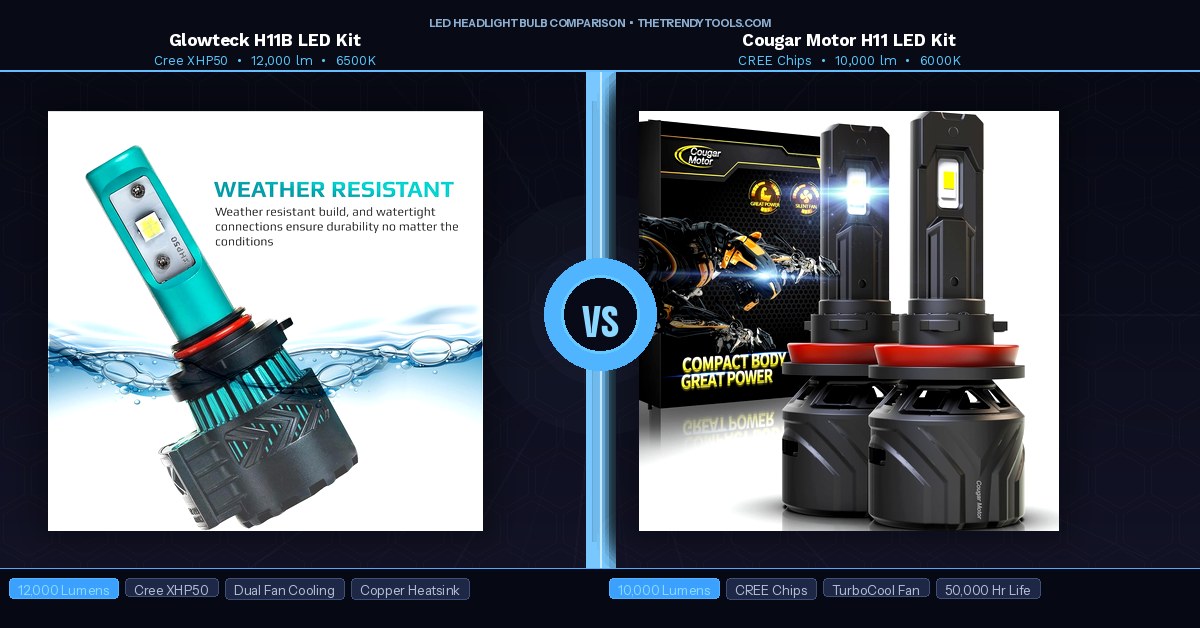
Upgrading your vehicle’s headlights from stock halogen bulbs to LED is one of the best bang-for-your-buck improvements you can make as a car owner. LEDs offer dramatically better brightness, longer lifespans, lower power draw, and a cleaner, more modern light output — all without requiring you to rewire your vehicle or visit a professional shop.
But with so many LED conversion kits on the market, choosing the right one can feel overwhelming. Two products that regularly appear at the top of buyer shortlists are the Cougar Motor H11 LED Headlight Bulbs and the Glowteck H11B LED Headlight Conversion Kit. Both promise significant upgrades over halogen, both use high-grade LED chips, and both are designed for straightforward DIY installation. But they differ in meaningful ways — and understanding those differences will help you make the right call for your specific vehicle and driving needs.
In this comprehensive comparison, we’ll break down both kits across every important dimension: light output, chip technology, cooling systems, beam pattern, compatibility, ease of installation, and long-term value. Let’s get into it.
Quick Side-by-Side Specs Comparison
| Feature | Cougar Motor H11 LED Kit | Glowteck H11B LED Kit |
|---|---|---|
| LED Chip | CREE (Top tier) | Cree XHP50 |
| Lumens (per pair) | 10,000 lm | 12,000 lm |
| Wattage (per pair) | 60W | 68W |
| Color Temperature | 6000K Cool White | 6500K Cool White |
| Lifespan | 50,000 hours | 40,000 hours |
| Cooling System | 7,000 RPM TurboCool fan + aluminum housing | AirFLUX dual fan + copper heatsink + aviation aluminum |
| Beam Pattern | No dark spots, no foggy light | Adjustable for reflector or projector housing, anti-glare |
| CanBUS Compatibility | CanBUS-ready (built-in) | Free CanBUS anti-flicker decoder included |
| Install Time | Under 20 minutes | Under 20 minutes |
| Waterproof | Yes | Yes |
| Voltage | 12V | Not specified (standard automotive) |
| Weight | 25.2g | Not specified |
| Best For | Reliable everyday upgrade, long lifespan | Maximum brightness, advanced cooling, projector/reflector flex |
LED Chip Technology: CREE vs Cree XHP50
The LED chip is the engine of any headlight conversion kit — it determines how efficiently electrical power is converted into visible light, and it has a direct impact on brightness, color accuracy, and long-term reliability. Both products use CREE chips, but there’s an important distinction between them.
Cougar Motor H11: CREE Chips
The Cougar Motor H11 uses top-tier CREE LED chips — a well-respected name in high-performance LED technology. CREE has built its reputation on producing chips with exceptional luminous efficacy (lumens per watt), consistent color temperature, and long operational lifespans. The Cougar Motor’s CREE chips deliver 10,000 lumens per pair at 60W — a highly efficient 166 lumens per watt ratio that represents excellent conversion efficiency for an automotive LED application.
CREE’s manufacturing quality control is stringent, which means the chips used in the Cougar Motor kit are consistent across units. You won’t see significant variation in brightness or color temperature from one bulb to the next, which matters for a headlight application where mismatched beams are immediately noticeable and distracting to oncoming drivers.
Glowteck H11B: Cree XHP50
The Glowteck H11B takes the chip specification one step further with the Cree XHP50 — a specific, named chip family from CREE that sits at the higher end of the automotive LED performance spectrum. The XHP50 is a high-density chip designed to pack more light output into a compact die, which allows it to achieve higher raw lumen figures without proportionally scaling up power consumption.
The result is 12,000 lumens per pair at 68W — a 20% increase in brightness over the Cougar Motor with only a 13% increase in power draw. The XHP50’s efficiency advantage is real and measurable. For drivers who specifically want the most light output possible from their H11B upgrade, the Glowteck’s chip technology delivers a meaningful edge.
Chip Winner: Glowteck H11B — The Cree XHP50 specification is more precise, more powerful, and delivers better lumen-per-watt performance. The Cougar Motor’s CREE chips are excellent, but the XHP50 is a more advanced chip generation.
Brightness and Light Output
Brightness is the number that most buyers focus on first — and for good reason. The whole point of an LED headlight upgrade is to see more of the road at night. Let’s put the numbers in context.
A typical halogen H11 bulb produces approximately 1,000–1,500 lumens. The Cougar Motor H11 delivers 10,000 lumens per pair (5,000 per bulb) — roughly 6–7x brighter than stock halogen. That’s a genuinely dramatic improvement that transforms nighttime driving visibility.
The Glowteck H11B delivers 12,000 lumens per pair (6,000 per bulb) — approximately 8x brighter than halogen and 20% brighter than the Cougar Motor. In real-world driving terms, that 2,000-lumen difference translates to a noticeably wider and longer illuminated zone in front of the vehicle, particularly at highway speeds where light distance matters most.
It’s worth noting, however, that raw lumen output is only half the story. A bulb that produces 12,000 lumens but scatters light in all directions is less useful than a 10,000-lumen bulb with a precisely focused beam pattern. We’ll cover beam quality separately — but from a pure output standpoint, the Glowteck holds the advantage.
Brightness Winner: Glowteck H11B — 12,000 vs 10,000 lumens is a clear and meaningful difference in real-world night driving performance.
Color Temperature: 6000K vs 6500K
Color temperature in LED headlights is measured in Kelvin (K) and describes the color appearance of the light output. Both products fall in the cool white range, but there’s a 500K difference between them that produces a subtly different visual character.
The Cougar Motor H11 at 6000K produces a crisp, clean cool white light with a very slight blue tint that many drivers associate with the premium OEM look of modern European luxury vehicles. At 6000K, the light is bright and white without crossing into the distracting blue-purple territory that higher Kelvin ratings can produce. It’s a widely preferred color temperature for everyday driving because it’s both visually impressive and functionally effective at illuminating road surfaces and signs.
The Glowteck H11B at 6500K pushes slightly further into the cool white spectrum. The 500K difference is subtle — you won’t confuse either of these for a warm yellow halogen or a deep blue HID — but the Glowteck’s output has a fractionally crisper, more intense white character that some drivers prefer for its modern aesthetic and high-contrast illumination of road markings and signage.
Neither temperature is objectively better. Drivers who prioritize the sharpest, most modern-looking beam will prefer the 6500K Glowteck. Drivers who want a clean white without any hint of blue will likely prefer the 6000K Cougar Motor.
Color Temperature: Personal Preference — Both are in the ideal cool white range. Choose 6000K (Cougar Motor) for a classic clean white; 6500K (Glowteck) for a slightly crisper, more intense white output.
Cooling Systems: Keeping Heat Under Control
LED chips generate heat — and heat is the primary enemy of LED longevity and consistent performance. A bulb that runs too hot will degrade faster, shift in color temperature over time, and ultimately fail sooner than its rated lifespan suggests. The cooling system is therefore one of the most critical engineering elements in any LED headlight kit.
Cougar Motor H11: TurboCool Fan System
The Cougar Motor H11 uses a whole aluminum housing combined with a 7,000 RPM TurboCool fan. The aluminum housing acts as a passive heatsink, drawing heat away from the LED chip through conduction. The TurboCool fan then actively moves air across the housing to accelerate heat dissipation through convection.
At 7,000 RPM, the fan moves significant airflow and keeps chip temperatures well within safe operating ranges even in demanding conditions. The all-aluminum construction also means that the housing itself is an efficient thermal conductor — heat doesn’t pool around the chip but instead spreads across the entire housing surface area and dissipates into the surrounding air.
Glowteck H11B: AirFLUX Dual Cooling with Copper Heatsink
The Glowteck H11B takes cooling engineering to a higher level with its AirFLUX dual cooling system. This combines a copper core and copper thermal heatsink with aviation-grade aluminum coating and a dual Japanese ball bearing cooling fan. The multi-element approach addresses heat dissipation through several simultaneous mechanisms.
Copper is a significantly better thermal conductor than aluminum — copper conducts heat approximately twice as efficiently. By using copper at the core where chip temperatures are highest, the Glowteck ensures that heat is rapidly pulled away from the LED chip before it can build up to damaging levels. The aviation aluminum coating then provides a large surface area for that heat to radiate away from the unit entirely.
The dual Japanese ball bearing fan adds both redundancy (two fans rather than one) and quality (Japanese ball bearings are among the most reliable and long-lasting fan components available). This cooling combination is notably more sophisticated than the single-fan aluminum system used by the Cougar Motor.
Cooling Winner: Glowteck H11B — The copper core, aviation aluminum, and dual Japanese ball bearing fan system is a more advanced and more effective thermal management solution than the single TurboCool fan design.
Beam Pattern and Road Coverage
A headlight’s beam pattern — how the light is distributed on the road ahead — is arguably more important than raw lumen output. A poorly designed beam can blind oncoming drivers, create dark spots in your field of view, or scatter light upward uselessly into the sky. Both products address beam quality, but with different approaches.
Cougar Motor H11: Optimized No-Dark-Spot Beam
The Cougar Motor H11 is engineered to produce a clean, consistent beam with no dark spots and no foggy scatter. The optical design ensures that the light is directed efficiently toward the road surface rather than dissipated in off-axis directions. For drivers coming from halogen bulbs, the step up in beam quality is immediately apparent — the Cougar Motor produces a sharper cutoff line at the top of the beam, better side illumination of road edges, and more even light distribution across the full beam width.
Glowteck H11B: Adjustable Beam for Reflector and Projector Housings
The Glowteck H11B adds an important practical feature: adjustable beam pattern compatibility with both reflector and projector headlight housings. This matters because H11 and H11B bulbs are used in both housing types across different vehicle makes and models, and an LED chip positioned incorrectly within a given housing type will produce a poor beam regardless of its raw output.
The Glowteck’s adjustable design allows the LED chip to be oriented correctly for your specific housing, ensuring the beam is properly formed whether your headlights use a reflector bowl or a projector lens. Combined with the anti-glare body design and no-dark-spot beam spread, this adjustability makes the Glowteck a more universally precise optical performer across a wider range of vehicle applications.
Beam Pattern Winner: Glowteck H11B — The adjustable reflector/projector compatibility gives it a meaningful real-world advantage in beam quality across different vehicle types.
CanBUS Compatibility and Error Codes
Modern vehicles use a CanBUS (Controller Area Network Bus) system that monitors electrical components — including headlight bulbs — for proper function. When you replace a halogen bulb with an LED, the lower power draw of the LED can trick the CanBUS system into reporting a bulb-out error, triggering dashboard warning lights and sometimes causing the headlights to flash or malfunction.
Both kits address this, but in different ways.
The Cougar Motor H11 is CanBUS-ready with built-in compatibility — the kit is designed to present the correct electrical load to the vehicle’s computer system so that no error codes are triggered. For most vehicles, this means a completely error-free installation with no additional components required.
The Glowteck H11B includes a free CanBUS anti-flicker resistor decoder as a separate component that ships with the kit. This approach is actually more flexible — the external decoder can be precisely tuned to your vehicle’s specific CanBUS system, making it compatible with a wider range of vehicles including some with more sensitive or stringent error detection systems. The free inclusion of this decoder also removes the cost barrier that sometimes makes CanBUS-compatible upgrades more expensive.
CanBUS Winner: Tie — The Cougar Motor’s built-in compatibility is more convenient; the Glowteck’s included external decoder is potentially more universally compatible. Both approaches effectively solve the error code problem for the vast majority of vehicles.
Lifespan: 50,000 vs 40,000 Hours
This is the one category where the Cougar Motor H11 holds a clear advantage. Its rated lifespan of 50,000 hours exceeds the Glowteck H11B’s 40,000 hours by 25%. In practical terms, both lifespans are extraordinarily long — the average driver would need decades of normal use to approach either figure. But the higher rating does suggest that the Cougar Motor’s more conservative operating parameters (lower wattage, slightly lower lumens) result in less thermal and electrical stress on the components over time.
It’s worth noting that the Glowteck’s more powerful cooling system (copper core, dual fans) may compensate for its higher wattage operation and help it maintain performance closer to its rated lifespan in real-world conditions. But on paper, the Cougar Motor’s 50,000-hour rating represents a longer expected service life.
Lifespan Winner: Cougar Motor H11 — 50,000 hours vs 40,000 hours is a meaningful gap that gives the Cougar Motor a longer theoretical service life.
Installation Experience
Both kits are designed for DIY installation without professional help, and both promise completion in under 20 minutes. This is achievable for most vehicles — the H11 and H11B form factors are among the most common headlight connector types used by major automakers, and the plug-and-play design means no splicing, soldering, or rewiring is required.
The Cougar Motor H11 is noted for its straightforward installation. The CanBUS compatibility is built in, so there are no additional components to install on most vehicles. The compact housing fits cleanly into standard headlight bays, and the single-fan design keeps the bulb’s footprint manageable.
The Glowteck H11B installation is equally straightforward for the bulbs themselves, but if your vehicle requires the CanBUS decoder, that adds one extra connection step. For most users this is a simple plug-in procedure, but it’s worth factoring in if you’re planning a very quick swap. The adjustable beam feature also requires a brief orientation step to confirm correct positioning for your housing type.
For both kits, some vehicles with tight engine bays or complex headlight assemblies may require more time or, in rare cases, professional assistance to access the headlight socket.
Installation Winner: Cougar Motor H11 (slight edge) — The fully integrated CanBUS compatibility means fewer components and a cleaner installation for most vehicles.
Vehicle Compatibility
The H11 connector is used across an extremely wide range of vehicles from virtually every major manufacturer. The Cougar Motor H11 kit is compatible with any vehicle using H11, H8, or H9 base connectors — which covers a significant portion of passenger cars, SUVs, and trucks on the road today.
The Glowteck H11B is specifically designed for the H11B connector, which is a close cousin of the H11 but features a slightly different locking tab orientation. H11B is used most prominently in vehicles like the Honda Accord, Honda Pilot, Jeep Wrangler, and select other models. The Glowteck’s compatibility list includes Chrysler 200/300, Dodge Ram, Tahoe, Mazda, Silverado, GMC, Acura Integra, Honda, Jeep Cherokee, and Toyota Tundra, among others.
Before purchasing either kit, verifying your vehicle’s specific connector type (H11 vs H11B) is essential — the two connectors look similar but are not interchangeable. The Glowteck’s fitment tool (available at point of purchase) helps ensure you order the correct variant for your vehicle.
Compatibility: Verify Before Buying — H11 (Cougar Motor) and H11B (Glowteck) are different connector types. Check your vehicle’s headlight socket specification before ordering either kit.
Who Should Buy the Cougar Motor H11?
The Cougar Motor H11 is the right choice if:
- Your vehicle uses H11, H8, or H9 headlight connectors (not H11B).
- You want a proven, reliable LED upgrade with a long 50,000-hour rated lifespan.
- You prefer a clean 6000K cool white color temperature without any blue tint.
- You want built-in CanBUS compatibility without installing an external decoder component.
- You’re looking for a solid, trusted upgrade from a well-established LED headlight brand.
- Long-term durability and component longevity are your top priorities over maximum brightness.
Who Should Buy the Glowteck H11B?
The Glowteck H11B is the right choice if:
- Your vehicle uses the H11B connector specifically (common in Honda, Jeep, Silverado, and Tundra applications).
- Maximum raw brightness (12,000 lumens) is your primary goal.
- You want the most advanced cooling system available — copper core, dual fans, aviation aluminum — for sustained high-performance operation.
- Your vehicle has both reflector and projector housing options and you need beam adjustability.
- You drive frequently at highway speeds or in rural areas with minimal street lighting where maximum beam distance matters.
- You appreciate premium chip technology (Cree XHP50) and the most efficient lumen-per-watt output in the H11B category.
Value for Money
Both kits are positioned in the competitive mid-range of the LED headlight conversion market — above budget no-name kits, below premium OEM-equivalent replacements. The Cougar Motor H11 delivers excellent value for its 10,000-lumen output, 50,000-hour lifespan, and plug-and-play simplicity. It’s a genuinely capable upgrade that will satisfy the vast majority of drivers making their first LED headlight switch.
The Glowteck H11B delivers more brightness, more sophisticated cooling, and more beam flexibility — but the H11B connector limits its audience to specific vehicle models. For drivers with H11B-equipped vehicles, the Glowteck represents outstanding value given its XHP50 chip technology and advanced thermal management. The free CanBUS decoder inclusion also adds real dollar value to the package.
Value Winner: Context-dependent — For H11 vehicles, the Cougar Motor delivers exceptional value. For H11B vehicles, the Glowteck is the stronger overall package and worth every cent of the premium.
Final Verdict: Cougar Motor H11 vs Glowteck H11B
These two LED headlight conversion kits are excellent products that solve the same problem — upgrading dim halogen headlights to modern, powerful, long-lasting LEDs — but they serve different vehicles and different driver priorities.
The Cougar Motor H11 wins on lifespan (50,000 hours), connector breadth (H11/H8/H9), and installation simplicity. It’s the ideal choice for drivers who want a dependable, clean, bright upgrade with minimal fuss and maximum longevity.
The Glowteck H11B wins on brightness (12,000 lm), chip technology (XHP50), cooling engineering (copper + dual fans), and beam flexibility (reflector/projector adjustability). It’s the ideal choice for H11B vehicle owners who want the most capable, highest-output LED conversion kit available.
Our recommendation: First, confirm whether your vehicle uses H11 or H11B. If it’s H11 — the Cougar Motor is your pick. If it’s H11B — the Glowteck is the superior upgrade. Either way, you’re making a meaningful, lasting improvement to your nighttime driving safety and visibility.
Frequently Asked Questions
What is the difference between H11 and H11B bulbs?
H11 and H11B are very similar connector types but have a different locking tab orientation. H11B has the tab rotated approximately 45 degrees compared to H11, making the two connectors non-interchangeable. Always check your vehicle owner’s manual or use a fitment tool to confirm which connector your headlight housing uses before purchasing.
Will these LED kits cause error codes on my dashboard?
The Cougar Motor H11 is built with CanBUS-ready circuitry that prevents error codes in most vehicles. The Glowteck H11B includes a free CanBUS anti-flicker decoder that handles this for vehicles with sensitive error detection systems. In rare cases with highly sensitive CanBUS systems, additional load resistors may be needed.
Are LED headlight conversions street legal?
LED headlight conversion kits occupy a legal gray area in many jurisdictions. Regulations vary by country and state — some require DOT-certified replacement bulbs, while others are more permissive. Check your local regulations before installing any aftermarket headlight kit.
Do I need a professional to install these bulbs?
Most vehicles with accessible headlight housings can be serviced by a confident DIYer in under 20 minutes. However, some vehicles — particularly those where the headlight housing requires significant disassembly to access — may benefit from professional installation. Consult your vehicle’s service manual if you’re unsure.
Which LED headlight kit is better for highway driving?
For highway driving where beam distance matters most, the Glowteck H11B’s 12,000-lumen output and Cree XHP50 chip give it an edge. More lumens combined with the adjustable beam pattern means you’ll see further down the road at speed — a meaningful safety advantage on unlit rural highways.
How long will these LED bulbs actually last?
The Cougar Motor H11 is rated at 50,000 hours; the Glowteck H11B at 40,000 hours. At 2 hours of nighttime driving per day, the Cougar Motor would last approximately 68 years and the Glowteck approximately 54 years — both far exceeding the practical service life of any vehicle. Real-world lifespan is more likely to be determined by mechanical shock, moisture intrusion, or vehicle end-of-life than by chip wear-out.