

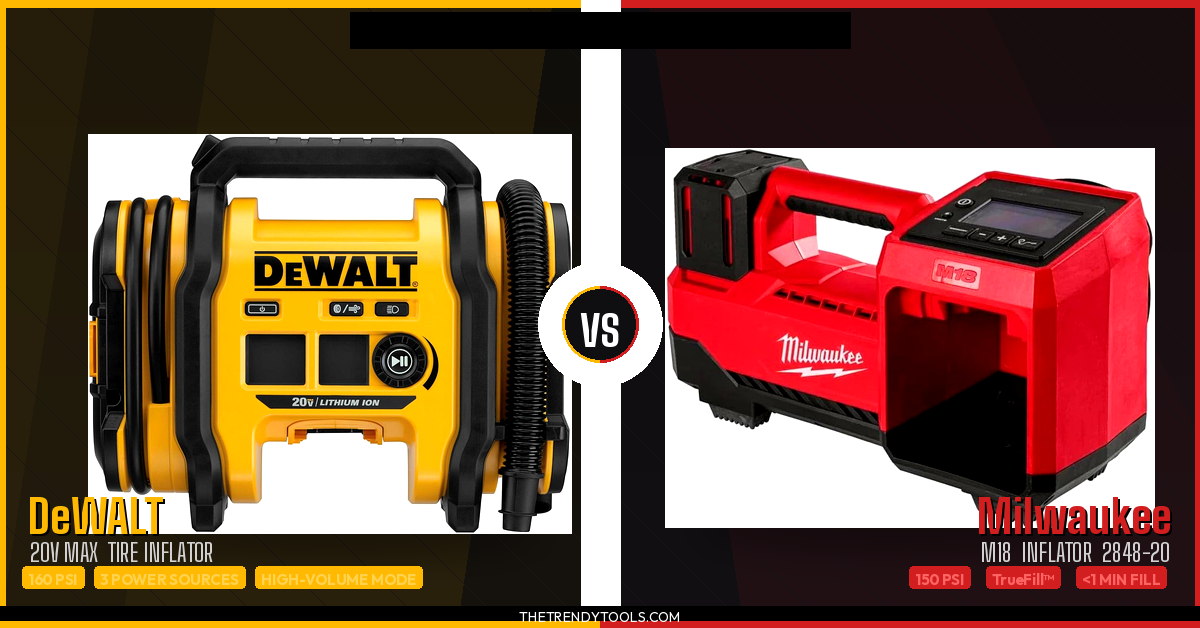
A flat tire on a dark roadside, a low trailer tire before a weekend haul, a deflated air mattress at a campsite — these are the moments when a quality portable inflator stops being a convenience and becomes a necessity. Two of the most talked-about cordless inflators in the professional and prosumer market right now are the DEWALT 20V MAX Tire Inflator (DCC020IB) and the Milwaukee M18 Inflator (2848-20). Both are built by industry titans, both run on their respective 18/20V battery platforms, and both promise to handle your inflation needs with accuracy and reliability.
But they take meaningfully different approaches to the job — and depending on your specific needs, one may suit you far better than the other. In this in-depth comparison, we’ll put the DEWALT and Milwaukee inflators side by side across every key category: power sources, inflation speed, pressure accuracy, versatility, design, and real-world user experiences. By the end, you’ll know exactly which one deserves a spot in your garage, truck bed, or tool bag.
📋 Table of Contents
- Quick Overview: Meet the Contenders
- Side-by-Side Specifications
- Power Sources & Portability
- Inflation Speed & Performance
- Pressure Accuracy & Auto Shutoff
- Versatility: What Can They Inflate?
- Hose, Chuck & Accessories
- Display, Controls & Usability
- Build Quality, Design & Portability
- Battery Compatibility & Runtime
- Real-World User Experiences
- Price & Value for Money
- Pros & Cons Summary
- Who Should Buy Which?
- Final Verdict
Quick Overview: Meet the Contenders
The DEWALT DCC020IB is DEWALT’s flagship portable inflator, engineered with remarkable versatility at its core. Its defining trait is its ability to run on three completely different power sources — a 20V MAX battery, a 12V DC car outlet, or a standard 110V AC wall outlet. Beyond tires, it also handles large inflatables like air mattresses and rafts through a dedicated high-volume hose and deflation port. It’s a tool built for people who want one inflator that can do almost everything, anywhere.
The Milwaukee 2848-20 takes a different philosophy: pure speed and precision for tire inflation. Milwaukee bills it as the fastest 18V cordless tire inflator available, and backs that claim up with a high-efficiency motor that can top off a 33-inch light truck tire in under a minute. Its standout feature is TrueFill™ Technology — an intelligent pressure management system that actively monitors and verifies tire pressure during inflation to deliver pinpoint accuracy. It’s the tool for someone whose primary concern is inflating tires quickly and correctly, every single time.
Two great tools, two distinct priorities. Let’s dig into the details.
Side-by-Side Specifications
| Specification | DEWALT DCC020IB | Milwaukee 2848-20 |
|---|---|---|
| Battery Platform | 20V MAX | M18 (18V) |
| Max PSI | 160 PSI | 150 PSI |
| Power Sources | 20V battery / 12V DC / 110V AC | M18 battery only |
| Inflation Speed | Moderate | Industry-leading (33″ LT tire <1 min) |
| Pressure Technology | Digital gauge + auto shutoff | TrueFill™ Technology + auto shutoff |
| PSI Memory Slots | None | 4 presets |
| Hose Length | High-pressure rubber hose (shorter) | 36 inches |
| Chuck Type | Threaded chuck | All-brass Schrader chuck |
| High-Volume Mode | ✅ Yes (mattresses, rafts) | ❌ No |
| Deflation Mode | ✅ Yes | ❌ No |
| LED Light | ✅ Yes (onboard) | ❌ No |
| Cooling System | Standard (10 min max above 100 PSI) | Internal cooling fan (20+ min runtime) |
| Anti-Vibration Feet | ✅ Heavy-duty rubber feet | ✅ Anti-vibration feet |
| Weight | ~7.2 lbs (bare) | ~6.0 lbs (bare) |
| Battery Included | No (tool only) | No (tool only) |
| Warranty | 3-year limited | 5-year limited |
| Best For | Versatility, multi-surface inflation | Speed, tire-focused precision |
Power Sources & Portability
This is arguably the most significant differentiator between the two inflators — and it’s one the DEWALT wins decisively.
DEWALT DCC020IB
The DEWALT’s three-source power system is genuinely impressive engineering. You can run it on a 20V MAX lithium-ion battery for true cordless freedom, plug it into a 12V DC car outlet via the included cord for roadside use without needing a charged battery, or connect it to a standard 110V AC household outlet for unlimited runtime in a garage or shop setting. This tri-source flexibility means the DEWALT inflator is never stranded. Dead battery? Use the car outlet. No car? Use the wall. It’s the inflator that always has a backup plan.
The 12V DC car cord is stored in a small compartment on the side of the unit, and the AC adapter (sold separately) plugs into the same external power connector. For people who use their inflator in varied environments — on a construction site one day, at a campsite the next, and in a home garage the weekend after — this versatility is genuinely hard to beat.
Milwaukee 2848-20
The Milwaukee is a battery-only inflator. It runs exclusively on M18 batteries, with no 12V DC or AC power option. For Milwaukee users with a well-stocked battery inventory, this is rarely a problem — you simply grab a charged M18 battery and go. The trade-off is that if your batteries are all depleted and you don’t have access to a charger or power outlet, you’re stuck. For roadside emergencies specifically, the DEWALT’s 12V DC option provides a meaningful safety net that the Milwaukee simply doesn’t offer.
That said, the Milwaukee’s battery-only design keeps the tool simpler, lighter, and more compact — there are no cord compartments, no extra connectors, and no compromise in performance to accommodate multiple power modes.
Inflation Speed & Performance
If speed is your top priority, the Milwaukee wins this category without much debate — and it isn’t particularly close.
Milwaukee 2848-20
Milwaukee’s headline claim for the 2848-20 is that it can top off a 33-inch light truck tire in under one minute — and independent testing consistently backs this up. The secret is a larger internal motor that runs at a lower operating frequency (producing the notably lower-pitched sound users comment on) while moving significantly more air volume per cycle. Real-world testing by Pro Tool Reviews found the Milwaukee outpaced competing 18V inflators by a wide margin, and user reports confirm it can handle a full set of four truck tires on a single battery charge under normal conditions.
One Milwaukee user who switched from a Makita inflator described the difference as “night and day,” noting that his Makita would overheat and shut down before finishing four high-pressure truck tires, while the Milwaukee powered through all four in just a few minutes without showing any signs of strain. The built-in internal cooling system is central to this sustained performance — it allows the Milwaukee to operate continuously for over 20 minutes without thermal shutdown, which is significantly better than many competitors.
DEWALT DCC020IB
The DEWALT is not slow, but users consistently describe it as moderate in speed compared to the Milwaukee. Where the DEWALT does perform strongly is in its high-volume inflation mode — using the separate high-volume hose, it can inflate large items like air mattresses and camping rafts much faster than a tire-only inflator ever could. For tasks beyond tire inflation, the DEWALT’s output is genuinely impressive. It’s also worth noting that at higher pressures (above 100 PSI), DEWALT recommends limiting continuous operation to 10 minutes before allowing cooling — a limitation that the Milwaukee’s integrated fan largely avoids.
Pressure Accuracy & Auto Shutoff
Both inflators feature digital pressure gauges and automatic shutoff when the target PSI is reached, but they achieve accuracy in meaningfully different ways.
Milwaukee 2848-20 — TrueFill™ Technology
Milwaukee’s TrueFill™ Technology is the standout feature in this category. Rather than simply shutting off when a pressure sensor triggers, TrueFill actively manages the entire inflation process in three steps: it first waits for the pressure to stabilize after connecting the chuck (preventing false readings from dynamic pressure), then checks the actual system pressure, and finally fills until the verified target is reached. This three-phase approach results in significantly more accurate final pressure readings.
Pro Tool Reviews testing found the Milwaukee hit target PSI numbers more accurately than competitors — by as much as 2 PSI in direct comparisons using a reference manual gauge. For applications where precision matters — race tires, road bikes, commercial vehicles — this level of accuracy is genuinely meaningful. The 4-slot PSI memory enhances everyday usability further: save your car’s recommended pressure, your truck’s recommended pressure, your bike tires, and your trailer tires, then cycle through them with a single button press.
DEWALT DCC020IB
The DEWALT’s digital gauge and auto-shutoff system work reliably and user reviews consistently praise its accuracy — one reviewer noted that readings from the DEWALT were virtually identical to those from a dedicated precision Jaco tire gauge. The auto-shutoff prevents overinflation effectively, and the digital display is easy to read. What the DEWALT lacks compared to Milwaukee is the TrueFill stabilization step and the PSI memory presets — you’ll need to manually enter your target pressure each time you use it. For most users this is a minor inconvenience, but for fleet operators or anyone regularly inflating multiple vehicles to different pressures, the Milwaukee’s memory slots save meaningful time.
Versatility: What Can They Inflate?
This is a category where the DEWALT pulls decisively ahead.
DEWALT DCC020IB
The DEWALT was engineered with two completely distinct inflation modes. The high-pressure mode (using the standard hose) handles tires, sports balls, bicycle tubes, and any application requiring precise pressure control up to 160 PSI. The separate high-volume mode (using a second, larger hose) is designed for fast inflation of large items — air mattresses, inflatable kayaks, camp furniture, pool floats, and air rafts. There’s also a dedicated deflation port, meaning you can quickly deflate items when breaking camp or packing up without needing to manually press the valve. This combination of high-pressure, high-volume, and deflation capability in a single tool is genuinely rare and makes the DEWALT an exceptional multi-purpose inflator for camping, outdoor activities, and household use beyond just tires.
Milwaukee 2848-20
The Milwaukee is optimized squarely for tire inflation and similar medium-duty applications. It includes a Schrader chuck for standard tire valves, a Presta chuck adapter for road bikes and performance tires, an inflation needle for sports balls, and a general inflator nozzle for smaller items. What it doesn’t have is a high-volume mode for large inflatables or a dedicated deflation port. If you need to inflate a camping air mattress or a large inflatable pool toy, the Milwaukee will technically work through the standard hose, but it will be slow and inefficient at that task compared to a high-volume mode. The Milwaukee is purpose-built for tires, and it excels there — just don’t expect it to double as a camping gear inflator.
Hose, Chuck & Accessories
DEWALT DCC020IB
The DEWALT comes with a high-pressure rubber hose (durable and kink-resistant) and a separate high-volume hose for large inflatables. The threaded chuck provides a secure, airtight connection to tire valve stems. Onboard accessory storage keeps the included tapered nozzle, Presta valve adapter, and inflator needle organized and always at hand. The design means you’re unlikely to lose accessories in the back of a truck or garage, which is a practical win for real-world use.
Milwaukee 2848-20
The Milwaukee’s standout hose specification is its generous 36-inch length, which provides noticeably more reach than many competitors — particularly useful when inflating tires that are hard to get close to, or when setting the inflator on the ground while reaching the inboard rear tires of a truck. The all-brass Schrader chuck is a premium detail: brass is more durable and corrosion-resistant than plastic alternatives and maintains thread integrity through thousands of connection cycles. The on-board hose and nozzle wrap keeps everything neatly stored on the tool. One minor criticism noted in testing is that the Schrader chuck’s thread engagement causes a small amount of air loss when disconnecting — a tradeoff of the secure threaded design.
Display, Controls & Usability
DEWALT DCC020IB
The DEWALT features a clear backlit digital display showing current and target pressure readings. Controls are straightforward — up and down buttons to set target pressure, and separate mode buttons for high-pressure, high-volume, and deflation modes. The onboard LED light (integrated into the top grab handle) serves double duty: it illuminates the workspace during nighttime inflation and functions as a carry light when transporting the unit. Overall the interface is intuitive enough that most users can operate it without consulting the manual.
Milwaukee 2848-20
The Milwaukee’s interface is similarly clean, with a backlit LCD screen, plus and minus buttons for setting pressure, a memory button to cycle through stored PSI presets, a units button to switch between PSI, kPa, and Bar, and a dedicated inflate trigger button to begin the cycle. The addition of a units selector (PSI/kPa/Bar) is a thoughtful feature not found on many competitors and extends the tool’s usability to international users and industrial applications. The 4-slot memory preset system is the Milwaukee’s biggest usability advantage — once programmed with your commonly used pressures, inflating any tire becomes a two-button operation.
Build Quality, Design & Portability
Both inflators feel solidly built with no cheap plastics or flimsy components — these are professional-grade tools from premium brands, and that quality is evident in hand.
The DEWALT (at approximately 7.2 lbs bare) is the heavier of the two, which is partly attributable to its dual-hose system, multi-power-source electronics, and overall larger footprint. Its yellow-and-black DEWALT aesthetic is instantly recognizable. The heavy-duty rubber feet do an excellent job of preventing the unit from “walking” across garage floors during operation, and the top carry handle makes transport comfortable. It’s a larger tool that feels like it belongs in a workshop or truck bed rather than a glove compartment.
The Milwaukee (at approximately 6 lbs) is slightly lighter and more compact, with a cleaner, more streamlined profile given its single-hose design. Its anti-vibration feet keep it stable during use, and the 36-inch hose gives you plenty of reach without needing to reposition the unit. Both tools are sturdy, but the Milwaukee feels slightly more purpose-designed for grab-and-go tire inflation scenarios.
Battery Compatibility & Runtime
DEWALT DCC020IB
The DEWALT is compatible with the entire 20V MAX battery lineup, from 1.5Ah all the way up to 9.0Ah high-capacity packs. Larger batteries provide more continuous runtime before needing a recharge. The tool is also compatible with DEWALT FLEXVOLT 60V MAX batteries in 20V mode. Critically, for situations where no charged battery is available, the 12V DC and 110V AC power options mean the tool remains operational — a runtime safety net that no battery-only inflator can match.
Milwaukee 2848-20
The Milwaukee runs exclusively on M18 batteries across the full RedLithium lineup. Real-world user data suggests that inflating three 275/70R18 truck tires from 55 to 70 PSI consumed a 3.0Ah battery from 100% down to about 25% — meaning a single 5Ah or 8Ah battery should comfortably handle multiple vehicles between charges. For context, the Milwaukee’s higher CFM output means it achieves more inflation per unit of battery energy than slower inflators, partially offsetting its battery-only limitation. The Milwaukee tool is battery-only, but its efficiency means you use less battery charge per tire than you might expect.
Real-World User Experiences
DEWALT DCC020IB — What Users Say
DEWALT users consistently praise the inflator’s build quality, calling it solid and well-made with nothing feeling cheap or flimsy. The accuracy of the digital gauge earns high marks — multiple reviewers report readings within 1 PSI of dedicated precision gauges. Users particularly appreciate the tri-power versatility, the high-volume mode for camping gear, and the onboard LED for nighttime use. The consensus is that this is a supremely well-rounded inflator that handles far more than just tires. The only consistent criticisms are that it’s on the slower side for tire inflation and is bulkier than competing inflators focused purely on tire use.
Milwaukee 2848-20 — What Users Say
Milwaukee users are effusive about one thing above all others: speed. Reviewers who switched from other brands — including users with Makita and Ryobi inflators that overheated and shut down on truck tires — report that the Milwaukee completes the same jobs in a fraction of the time without any signs of thermal stress. The TrueFill accuracy system earns consistent praise from users who note it hits target pressures more reliably than older inflators. Off-road and overlanding communities have embraced the Milwaukee particularly enthusiastically — users report inflating five full-size truck tires by 20 PSI in about 15 minutes. The most common minor criticism is that the Schrader chuck loses a small amount of air upon disconnection.
Price & Value for Money
As bare tools, both inflators sit in a similar price bracket, with the Milwaukee typically priced slightly higher reflecting its speed-focused engineering and TrueFill technology. Both are sold as tool-only units — battery and charger are not included with either.
The DEWALT offers exceptional value for users who need multi-mode inflation (tires and large inflatables) or who don’t want to be limited to a single power source. If you buy the DEWALT, you’re essentially buying a tire inflator, a camping gear inflator, and a deflation tool in one package — hard to beat for versatility per dollar spent.
The Milwaukee’s higher price is easier to justify if tire inflation speed and precision are your primary use case, or if you’re already heavily invested in the M18 ecosystem and want the fastest, most accurate tire inflator available for that platform. Both tools represent strong value within their respective strengths.
Pros & Cons Summary
⚡ DEWALT DCC020IB
✅ Pros
- Three power sources — 20V battery, 12V DC, 110V AC
- High-volume mode for mattresses, rafts, pool toys
- Dedicated deflation port for quick pack-down
- 160 PSI max — slightly higher than Milwaukee
- Onboard LED light for nighttime use
- Highly accurate digital pressure gauge
- Heavy-duty rubber feet prevent walking
- Compatible with entire 20V MAX & FLEXVOLT ecosystem
- 3-year limited warranty
❌ Cons
- Slower tire inflation vs Milwaukee
- Heavier at ~7.2 lbs
- No PSI memory presets
- 10-min max above 100 PSI without cooling break
- No internal cooling fan
🔴 Milwaukee 2848-20
✅ Pros
- Fastest 18V tire inflator — 33″ LT tire in under 1 min
- TrueFill™ Technology for pinpoint PSI accuracy
- 4-slot PSI memory presets for quick setup
- Internal cooling fan — 20+ min continuous runtime
- 36-inch hose for maximum reach
- Premium all-brass Schrader chuck
- PSI/kPa/Bar unit selection
- Lighter and more compact design
- 5-year limited warranty
❌ Cons
- Battery only — no 12V DC or AC power option
- No high-volume mode for large inflatables
- No deflation mode
- No onboard LED light
- Small air loss when disconnecting Schrader chuck
Who Should Buy Which?
🟡 Choose the DEWALT DCC020IB if you:
- Want one inflator that handles tires and large inflatables like air mattresses, kayaks, and pool toys
- Need the peace of mind of three power sources — especially the 12V DC option for roadside emergencies
- Are already invested in the DEWALT 20V MAX tool ecosystem
- Camp, travel, or do outdoor activities where an inflator needs to do more than just tires
- Want a workshop/garage inflator that can run from the wall without burning through batteries
🔴 Choose the Milwaukee 2848-20 if you:
- Prioritize raw inflation speed — especially for truck, SUV, or light truck tires
- Inflate multiple vehicles regularly and need PSI memory presets to speed up the process
- Are already in the Milwaukee M18 ecosystem with plenty of charged batteries
- Are in fleet maintenance, landscaping, or overlanding/off-road where fast tire re-inflation is critical
- Demand the most accurate PSI readings available from a cordless inflator
Final Verdict
🏆 Our Verdict
This is one of those comparisons where neither tool wins outright — they’re built for different people with different priorities, and both are genuinely excellent at what they set out to do.
The DEWALT DCC020IB is the better choice for versatility and flexibility. Three power sources, high-volume mode, deflation capability, and an LED light make it the more complete all-round inflator — especially for anyone who needs it to handle more than just vehicle tires. If you want one tool to cover every inflation scenario you might encounter, the DEWALT is your answer.
The Milwaukee 2848-20 is the better choice for speed, precision, and sustained performance at tire inflation specifically. Its TrueFill™ Technology, 4-slot PSI memory, internal cooling fan, and class-leading fill speed make it the top choice for anyone who inflates tires frequently and wants the fastest, most accurate tool available for that job. The 5-year warranty is also a meaningful confidence boost.
DEWALT DCC020IB
★★★★★
4.6 / 5.0 — Best for Versatility
Milwaukee 2848-20
★★★★★
4.8 / 5.0 — Best for Speed & Precision
Already own one of these inflators? Tell us how it’s been serving you — drop your thoughts in the comments below!