

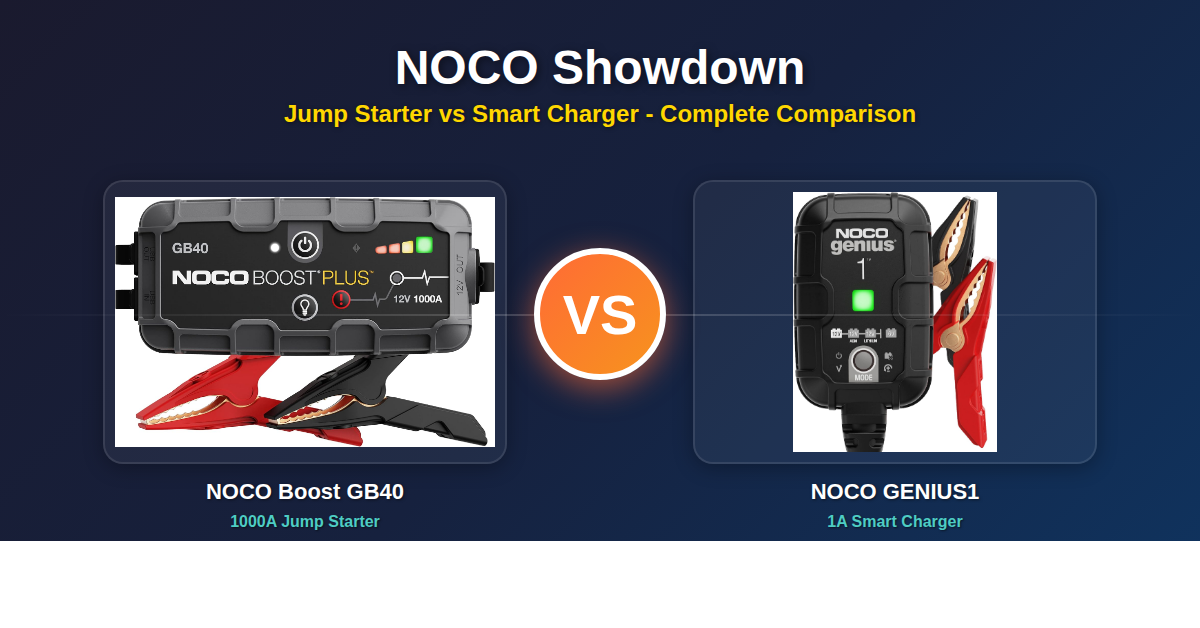
When your car battery fails, you need a reliable solution fast. NOCO, a trusted name in battery charging technology, offers two popular products that serve very different purposes: the Boost GB40 1000A Jump Starter and the GENIUS1 1A Smart Battery Charger. While both products come from the same manufacturer and both deal with battery problems, they approach the issue from completely different angles. Understanding the differences between these two products is essential for choosing the right tool for your specific needs.
In this comprehensive comparison, we will dive deep into every aspect of these two NOCO products, examining their features, performance, use cases, advantages, and limitations. Whether you need an emergency jump starter to keep in your glove box or a smart charger to maintain your seasonal vehicles, this guide will help you make an informed decision about which NOCO product—or whether you need both—belongs in your automotive toolkit.
Understanding the Fundamental Difference
Before we compare specific features, it is crucial to understand that the NOCO Boost GB40 and NOCO GENIUS1 serve fundamentally different purposes, even though both address battery-related problems.
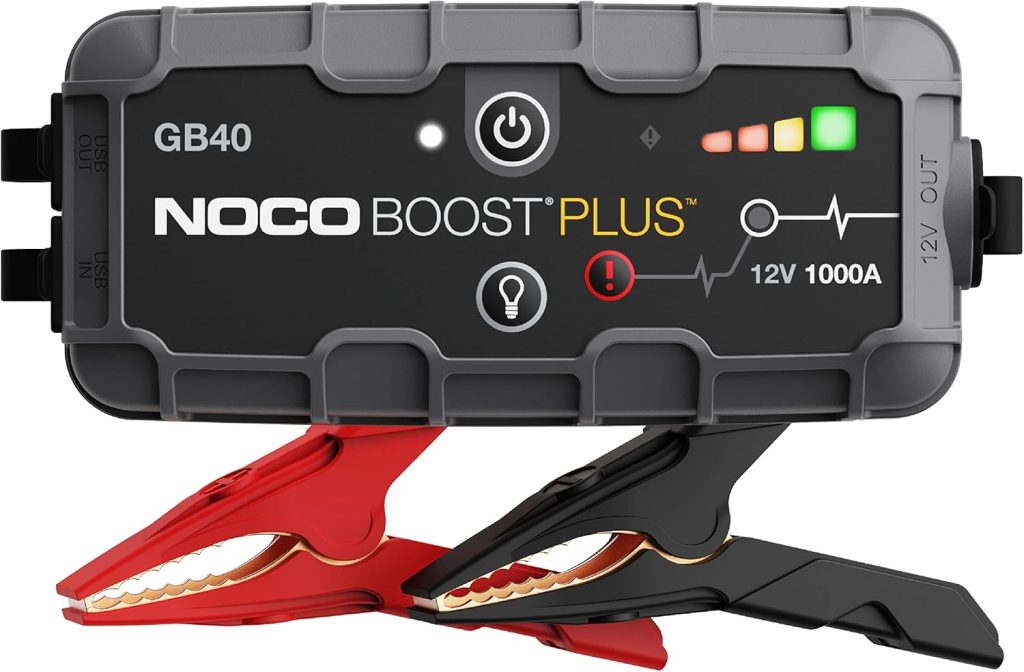
NOCO Boost GB40: The Emergency Jump Starter
The GB40 is a portable lithium-ion jump starter designed for emergency situations when your battery is too weak to start your engine. Think of it as a portable battery pack that delivers a massive surge of power—up to 1000 amps—to crank your engine when your car battery cannot. It is designed for immediate action, providing quick relief when you are stranded with a dead battery.
The GB40 does not recharge your car battery in the traditional sense. Instead, it provides enough temporary power to start your engine, after which your vehicle’s alternator takes over to recharge the car battery. It is the modern, portable alternative to traditional jumper cables and needing another vehicle for a jump start.
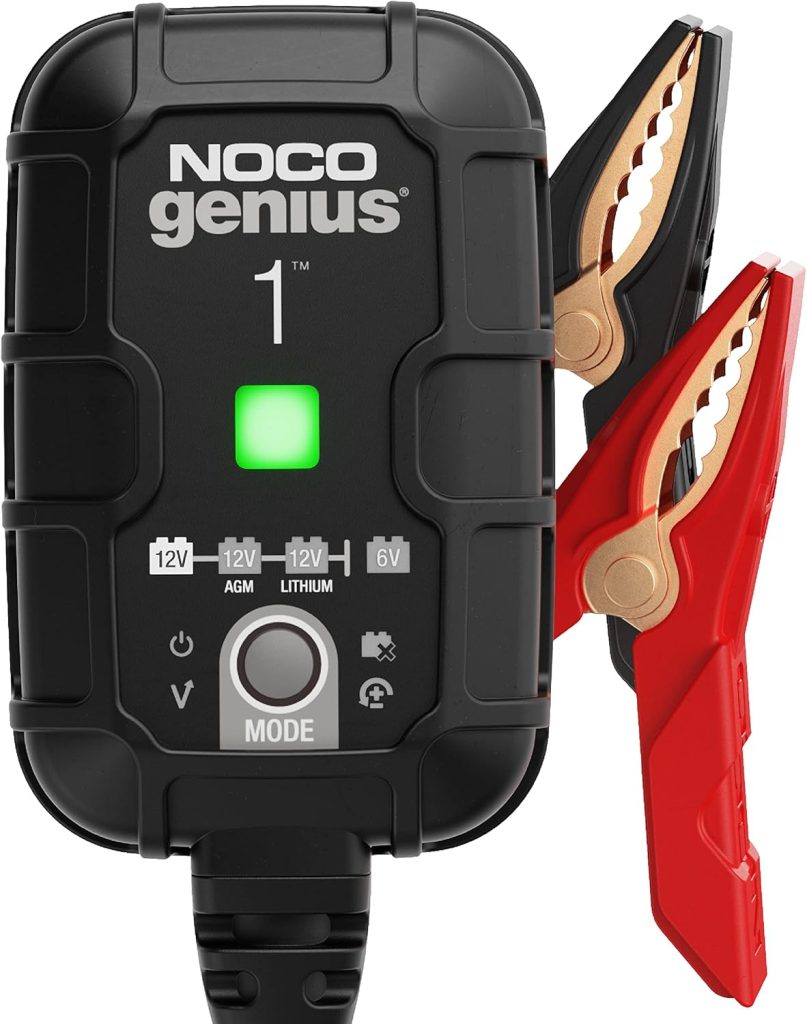
NOCO GENIUS1: The Smart Battery Charger
The GENIUS1, on the other hand, is a battery charger and maintainer designed to actually restore charge to depleted batteries over time. It delivers a slow, steady 1-amp charge that gradually brings a dead or weak battery back to full capacity. It is not designed for emergency situations where you need to start your car immediately. Instead, it is a patient, methodical tool that takes hours or even days to fully charge a depleted battery.
The GENIUS1 also serves as a battery maintainer, meaning you can leave it connected to your battery indefinitely to keep it at optimal charge during storage or infrequent use. It is the tool you use when you have time and want to properly restore and maintain your battery’s health.
The Core Question: Jump Start or Recharge?
The fundamental question when choosing between these products is simple: Do you need to jump start your car right now, or do you need to recharge your battery over time? If you are stranded and need to get moving within minutes, the GB40 is your answer. If your battery is weak and you have hours or days to properly recharge it, the GENIUS1 is the better choice. Understanding this distinction is the key to making the right purchase decision.
Detailed Feature Comparison
Now let us examine how these two products compare across various important factors.
Power Output and Performance
The power output difference between these two devices is dramatic and reflects their different purposes.
The NOCO Boost GB40 delivers an impressive 1000 amps of peak power. This massive current surge is what allows it to crank engines that the dead car battery cannot turn. The GB40 can start gasoline engines up to 6.0 liters and diesel engines up to 3.0 liters, making it suitable for most passenger vehicles, trucks, SUVs, motorcycles, boats, and ATVs. According to NOCO, the GB40 can deliver up to 20 jump starts on a single charge, though real-world performance varies based on battery condition and engine size.
The NOCO GENIUS1, in stark contrast, delivers only 1 amp of charging current. This is one one-thousandth of the GB40’s peak output. While this seems weak, it is intentional. The 1-amp output provides a slow, gentle charge that is healthier for the battery and reduces the risk of overheating or damage. However, this low current means charging takes considerable time. Based on real user experiences, charging a completely dead battery can take 36 hours or more when disconnected from the vehicle, and potentially up to two weeks if you encounter complications or if the battery remains connected to the car with parasitic drains.
Winner for immediate power: GB40. Winner for patient, gentle charging: GENIUS1.
Portability and Size
Portability is a significant differentiator between these products.
The NOCO Boost GB40 is remarkably compact, weighing just 2.5 pounds and measuring small enough to fit comfortably in a glove box, center console, or under a seat. Its compact size is one of its greatest advantages—you can keep it in your vehicle at all times without sacrificing cargo space. The rubberized, IP65-rated housing protects it from water, dust, and impacts, making it suitable for the harsh environment inside a vehicle trunk or emergency kit. Users consistently praise its palm-sized design, with one reviewer noting it is “smaller than most mobile phones.”
The NOCO GENIUS1 is also compact, being 35 percent smaller than its predecessor, the G750. However, it is designed as a stationary charger that plugs directly into a wall outlet. While small, it is not meant to be carried in your vehicle. Instead, it lives in your garage, workshop, or wherever you store vehicles that need periodic charging. The 110-inch DC cable provides good reach to your battery, but the unit itself must remain plugged into AC power (120-240VAC) to function.
Winner for portability: GB40 by a wide margin.
Ease of Use
User-friendliness varies significantly between these two products.
The NOCO Boost GB40 is designed for simplicity in emergency situations. The UltraSafe Technology includes spark-proof connections and reverse polarity protection, meaning you can connect it incorrectly without causing damage or sparks—critical features when you are stressed and in a hurry. Simply connect the clamps to your battery (positive to positive, negative to negative), and the unit automatically detects the connection and prepares to deliver power. Press the button, start your engine, and you are back on the road. The integrated LED indicators show charge status and connection status clearly.
The NOCO GENIUS1 has a more complex learning curve, as evidenced by detailed user reviews. One reviewer spent two weeks figuring out the optimal charging process, noting that “the instruction manual is weak to say the least.” The single-button interface provides minimal feedback—a slowly blinking light “like a heartbeat” that provides limited information about charging status. The Force Mode feature, designed to charge completely dead batteries, did not work as expected for some users, with the charger switching to 6V mode instead of charging the 12V battery.
Multiple users discovered through trial and error that the GENIUS1 works best when the battery is disconnected from the vehicle, as the 1-amp output cannot overcome parasitic drains from the car’s electrical system. While the GENIUS1 offers sophisticated features like temperature compensation and desulfation mode, accessing and understanding these features requires patience and experimentation.
Winner for ease of use: GB40, particularly in emergency situations.
Charging Speed and Time Requirements
The time required to get your vehicle running varies dramatically between these products.
With the NOCO Boost GB40, you can start your car in literally seconds. User reviews confirm that after connecting the GB40 to a dead battery, the dashboard “came to life immediately,” and the engine started on the second attempt within seconds. Even if your battery is completely dead, you can be driving within one to two minutes of connecting the GB40. This speed is invaluable in emergency situations, bad weather, or when you are in an unsafe location.
The NOCO GENIUS1 requires extraordinary patience. Charging a completely dead battery takes approximately 36 hours when properly disconnected from the vehicle, according to verified user experience. If you attempt to charge while the battery remains connected to the car, the process can extend to two weeks or may not complete at all due to parasitic drains. Even a partially depleted battery will take 8 to 12 hours to fully recharge at the 1-amp rate.
This difference is not a flaw—it is by design. The GB40 provides immediate relief but does not actually recharge your battery. The GENIUS1 provides a complete, healthy recharge but requires time you may not have in an emergency.
Winner for speed: GB40 without question. Winner for complete battery restoration: GENIUS1, if you have the time.
Battery Compatibility
Both products work with 12-volt batteries, but the GENIUS1 offers broader compatibility.
The NOCO Boost GB40 is designed exclusively for 12-volt lead-acid batteries in vehicles. It works with all types of 12V lead-acid batteries including flooded, AGM, and gel cell varieties. The 1000-amp output is calibrated for jump-starting gasoline engines up to 6.0 liters and diesel engines up to 3.0 liters, covering virtually all passenger vehicles, light trucks, motorcycles, boats, ATVs, and similar equipment.
The NOCO GENIUS1 works with both 6-volt and 12-volt batteries, and it supports both lead-acid and lithium-ion (LiFePO4) battery chemistries. This makes it compatible with a wider range of applications including vintage vehicles with 6V systems, motorcycles, lawn equipment, golf carts, marine batteries, deep-cycle batteries, and modern lithium-ion battery systems. The integrated thermal sensor adjusts charging parameters based on battery chemistry and ambient temperature, ensuring optimal charging for each battery type.
Winner for compatibility: GENIUS1, with its support for multiple voltages and chemistries.
Additional Features and Functionality
Beyond their primary functions, both products offer useful secondary features.
The NOCO Boost GB40 includes a built-in USB-C power bank that can charge smartphones, tablets, and other devices. This adds value for emergency preparedness—the GB40 can provide phone charging when you need to call for help. The integrated 100-lumen LED flashlight with seven light modes (including SOS and strobe) is genuinely useful for nighttime emergencies, roadside repairs, or signaling for help. The flashlight is bright enough to illuminate work areas and visible enough for emergency signaling.
The GB40 recharges itself in approximately three hours via USB-C, making it quick to prepare for the next emergency. Remarkably, the GB40 can retain 50 percent of its charge after sitting unused in a vehicle trunk for 18 months, as confirmed by real user experience. This long-term charge retention means it is ready when you need it, even after long periods of storage.
The NOCO GENIUS1 focuses entirely on charging functions but does so with sophistication. Its integrated thermal sensor dynamically adjusts charging based on ambient temperature, preventing overcharging in hot weather and undercharging in cold conditions. The precision pulse charging automatically detects and reverses battery sulfation and acid stratification—conditions that reduce battery capacity and lifespan. This desulfation feature can actually restore aged batteries to better performance, potentially saving you from having to replace them.
The GENIUS1 can be left connected to your battery indefinitely without risk of overcharging, making it ideal for maintaining seasonal vehicles like motorcycles, boats, classic cars, or RVs during winter storage. The Force Mode allows it to charge batteries as low as zero volts—though user experiences suggest this feature can be temperamental and may not work reliably on all completely dead batteries.
Winner for emergency features: GB40. Winner for sophisticated battery maintenance: GENIUS1.
Build Quality and Durability
Both products are engineered in the USA by NOCO and feature robust construction, though they face different environmental challenges.
The NOCO Boost GB40 features an IP65-rated enclosure with rubberized over-molding, making it resistant to water, dust, and impacts. This rugged construction is essential for a device that may spend years bouncing around in a trunk or glove box, exposed to temperature extremes, humidity, and rough handling. The high-conductivity clamps are designed for maximum energy transfer and secure connections. User reviews confirm the GB40’s toughness, with units functioning perfectly after more than a year of trunk storage.
The NOCO GENIUS1, being a stationary charger, does not require the same level of environmental protection. However, it is still well-built with quality materials and connections. The direct wall plug-in design eliminates the power brick common in many chargers, reducing potential failure points. The 110-inch DC cable is long enough to reach batteries in most garage situations without requiring extension cords.
Winner: GB40 for physical durability requirements, though both are well-constructed for their intended environments.
Safety Features
Safety is paramount when working with batteries, and both products include important protections.
The NOCO Boost GB40’s UltraSafe Technology is its standout safety feature. The spark-proof connections mean you will not create sparks when connecting to the battery—crucial since batteries can emit explosive hydrogen gas. The reverse polarity protection prevents damage if you accidentally connect positive to negative and vice versa. These features make the GB40 essentially foolproof, allowing even inexperienced users to safely jump-start vehicles without risk of sparks, explosions, or electrical damage.
The NOCO GENIUS1 includes overcharge protection that prevents damage from extended connection times. You can leave it connected for weeks or months without harming the battery. The integrated thermal sensor helps prevent overheating during charging, and the automatic monitoring system adjusts charging parameters to maintain battery health. However, user reviews suggest that the GENIUS1 can be finicky with completely dead batteries, sometimes refusing to charge or switching to incorrect voltage modes, which requires troubleshooting and manual intervention.
Winner: GB40 for foolproof safety features, particularly for inexperienced users.
Real-World Use Cases: Which Product for Which Situation?
Understanding when to use each product helps clarify their value propositions.
When the NOCO Boost GB40 is the Right Choice
Emergency Roadside Situations: When you are stranded with a dead battery in a parking lot, on the roadside, or anywhere you need to get moving immediately, the GB40 is invaluable. One user reported that the GB40 eliminated the need for AAA roadside assistance, which previously required nearly three-hour waits. The ability to jump-start yourself in under a minute is worth the investment for anyone who values time and independence.
Remote or Rural Locations: If you frequently travel in areas with limited cell service or where help is far away, having the GB40 means you are not dependent on finding another vehicle or waiting for rescue services.
Multiple Vehicle Households: The GB40 can jump-start up to 20 vehicles on a single charge, making it ideal for families with multiple cars or for helping neighbors and friends. You become the person who can help others rather than needing to ask for jumps.
Cold Weather Climates: In winter, batteries lose capacity and vehicles are harder to start. Having the GB40 ready in your glove box provides peace of mind during the months when battery failures are most common.
Vehicles with Parasitic Drains: Some vehicles have electrical systems that slowly drain batteries when parked. Rather than trying to diagnose and fix the drain, the GB40 lets you quickly start the vehicle whenever needed.
Emergency Preparedness Kits: Beyond vehicle use, the GB40’s USB power bank and LED flashlight make it a valuable component of home or vehicle emergency kits for power outages, natural disasters, or other emergencies.
When the NOCO GENIUS1 is the Right Choice
Seasonal Vehicle Storage: For motorcycles, boats, RVs, classic cars, or convertibles stored during winter or off-season, the GENIUS1 keeps batteries maintained and ready. Simply connect it when you park the vehicle for the season and leave it connected until spring. The indefinite connection capability means your battery will be fully charged and healthy when you are ready to use the vehicle again.
Battery Recovery and Restoration: If you have a weak or sulfated battery that still has life left, the GENIUS1’s desulfation mode can potentially restore performance and extend the battery’s lifespan, saving you the cost of replacement.
Infrequently Used Vehicles: Second cars, spare vehicles, or equipment used only occasionally benefit from the GENIUS1’s maintenance charging. Rather than discovering a dead battery every time you need the vehicle, the GENIUS1 keeps it ready to go.
Workshop or Fleet Maintenance: For mechanics, fleet managers, or equipment rental operations, the GENIUS1 provides an affordable way to maintain multiple batteries. At its price point (less than the cost of a steak dinner, as one user noted), you can have multiple units maintaining different batteries simultaneously.
Lawn and Garden Equipment: Riding mowers, tractors, and other seasonal lawn equipment benefit from off-season maintenance charging to prevent battery degradation during months of storage.
Deep-Cycle Battery Applications: Marine batteries, solar system batteries, and other deep-cycle applications benefit from the GENIUS1’s smart charging algorithms that optimize performance for these specific battery types.
Budget-Conscious Battery Maintenance: If you cannot afford frequent battery replacements, the GENIUS1 helps maximize the lifespan of your existing batteries through proper maintenance and desulfation, providing excellent long-term value.
When You Need Both Products
Many automotive enthusiasts and practical vehicle owners benefit from having both products in their toolkit. The GB40 handles emergencies and immediate jump-start needs, while the GENIUS1 maintains battery health over time. Together, they provide comprehensive battery management—emergency relief and long-term maintenance. For someone who owns multiple vehicles, stores a motorcycle or boat seasonally, and wants emergency preparedness, investing in both products creates a complete battery care system.
Cost Analysis and Value Proposition
Price is always a consideration, but value depends on how you use the product.
The NOCO Boost GB40 typically retails for 100 to 125 dollars, though prices vary with sales and promotions. For this investment, you get immediate roadside assistance capability that can save you from towing fees (often 100 to 200 dollars), AAA membership costs, or the time and inconvenience of waiting for help. One jump start essentially pays for the device. The long charge retention means it is ready after years of storage, providing value even if you rarely need it.
The NOCO GENIUS1 typically costs 30 to 40 dollars, making it remarkably affordable. As one user noted, it costs less than a steak dinner. For this modest investment, you get sophisticated charging technology that can maintain multiple batteries over years of use. If it extends the life of even one battery by a year or two, it pays for itself several times over, since replacement batteries cost 100 to 300 dollars depending on type and vehicle.
Both products include warranties—one year for the GB40 and three years for the GENIUS1—providing additional value and peace of mind.
From a value perspective, both products deliver excellent returns on investment for their intended purposes. The GB40 is worth every penny for emergency preparedness, while the GENIUS1 is an almost absurdly good value for battery maintenance given its low price and sophisticated features.
Customer Experience and Reliability
Real user experiences provide valuable insights into how these products perform in the real world.
The NOCO Boost GB40 enjoys overwhelmingly positive reviews, with users praising its reliability, compact size, and foolproof operation. The user review we examined gave it top marks after successfully jump-starting a Honda Accord that had been sitting with a dead battery. The GB40 worked immediately despite having sat unused for 18 months in the trunk, demonstrating exceptional charge retention and reliability. Users appreciate that it eliminates dependence on strangers for jumps and AAA for roadside assistance. The overall rating of 4.6 stars reflects high customer satisfaction.
The NOCO GENIUS1 has a more complex user experience profile. While it ultimately works and delivers results, the learning curve can be steep. The user review we examined rated it five stars but noted that it took two weeks of trial and error to successfully charge a completely dead battery in a 2000 Lexus RX300. Key discoveries included the need to disconnect the battery from the vehicle for successful charging, the 36-hour charge time for a completely dead battery, and the fact that Force Mode did not work as expected. The weak instruction manual and minimal status indicators frustrated some users initially.
However, once users understand how to properly use the GENIUS1, satisfaction is high. It successfully charged the battery, the car started and ran normally, and the low price point made the learning curve acceptable. Users appreciate that for “just-in-case money,” they get reliable long-term charging capability.
The key takeaway is that the GB40 delivers a superior out-of-box experience with minimal learning required, while the GENIUS1 rewards patience and experimentation with excellent long-term value.
Limitations and Considerations
No product is perfect, and understanding limitations helps set appropriate expectations.
NOCO Boost GB40 Limitations
The GB40 does not actually recharge your car battery. It only provides enough power to start the engine, after which the alternator must recharge the battery. If your alternator is failing or your battery is severely degraded, the GB40 will start the car but the battery will die again once you turn off the engine. It treats the symptom (dead battery) but not the underlying cause.
The GB40 requires periodic recharging itself. While it holds charge remarkably well, you should recharge it every 3 to 6 months if stored unused to ensure it is ready in emergencies. If you forget to maintain its charge, it will not help when you need it.
At 2.5 pounds and palm-sized, the GB40 is small enough to steal. If you leave it visible in your vehicle, it could be an attractive target for thieves. Store it out of sight for security.
NOCO GENIUS1 Limitations
The 1-amp output is painfully slow. If you need your vehicle today or tomorrow, the GENIUS1 is not the solution. It requires days of charging time for completely dead batteries, and you must have a place to safely charge the battery during this extended period.
For best results, you need to disconnect the battery from the vehicle, which requires basic mechanical knowledge and tools. Many modern vehicles have complex electrical systems that lose settings when the battery is disconnected, requiring reprogramming after reconnection.
The user interface and instructions are admittedly weak. Be prepared to do research, watch videos, or experiment to fully understand optimal usage. This is not ideal for non-technical users who just want to plug it in and have it work.
The Force Mode for charging completely dead batteries can be unreliable, sometimes switching to 6V mode incorrectly or refusing to charge. You may need patience and troubleshooting to successfully charge extremely depleted batteries.
The Verdict: Which Should You Choose?
After this comprehensive comparison, the answer depends entirely on your specific needs and situation.
Choose the NOCO Boost GB40 if:
You need emergency jump-start capability and want independence from roadside assistance or helpful strangers. You value the convenience of immediate solutions and want a device you can keep in your vehicle at all times. You frequently travel in remote areas or want emergency preparedness for your family. You need to jump-start multiple vehicles or help others regularly. You want a multi-functional device with power bank and flashlight capabilities. You are willing to pay a premium (100 to 125 dollars) for convenience and peace of mind.
Choose the NOCO GENIUS1 if:
You need to maintain batteries in seasonal or infrequently used vehicles like motorcycles, boats, RVs, or classic cars. You have weak or sulfated batteries you want to restore rather than replace. You have time to properly recharge batteries over days rather than needing immediate results. You are comfortable disconnecting batteries and performing basic maintenance procedures. You want an affordable (30 to 40 dollars) solution for long-term battery health. You appreciate sophisticated charging technology and do not mind a learning curve.
Consider buying both if:
You own multiple vehicles with different needs. You want both emergency capability and long-term maintenance solutions. You store seasonal vehicles but also need roadside emergency protection. You value having comprehensive battery management tools. Your budget allows for both purchases (total investment of 130 to 165 dollars).
Conclusion
The NOCO Boost GB40 and NOCO GENIUS1 are both excellent products that serve distinctly different purposes in the battery care ecosystem. The GB40 excels as an emergency jump starter with its powerful 1000-amp output, compact portability, foolproof UltraSafe Technology, and multi-functional capabilities including USB charging and LED flashlight. It delivers immediate results when you are stranded and need to get moving right now. Real users confirm its reliability, long charge retention, and genuine life-saving value in emergency situations.
The GENIUS1 excels as a patient, methodical battery charger and maintainer with its sophisticated smart charging algorithms, desulfation capabilities, temperature compensation, and indefinite connection safety. It restores battery health over time, maintains seasonal vehicles perfectly, and provides exceptional value at a remarkably low price point. Real users confirm that despite a learning curve and slow charging speed, it successfully charges completely dead batteries and delivers outstanding long-term value.
Neither product is better than the other—they are simply different tools for different jobs. The GB40 is your emergency responder, ready to rescue you in minutes when disaster strikes. The GENIUS1 is your patient mechanic, quietly maintaining your batteries over months and years to prevent problems before they occur.
For most vehicle owners, the ideal solution is recognizing that these products complement rather than compete with each other. The GB40 protects you from the consequences of battery failure, while the GENIUS1 helps prevent battery failure in the first place. Together, they provide comprehensive battery care that combines emergency preparedness with proactive maintenance.
Whichever product you choose—or whether you wisely invest in both—you will be getting engineering quality, proven reliability, and real-world performance from NOCO, a company that has earned its reputation for excellence in battery charging technology. Your batteries, your vehicle, and your peace of mind will all benefit from having the right NOCO tool for your specific needs.