
Summer heat inside a parked car is no small problem. On a hot day, the interior temperature of a vehicle left in direct sunlight can climb to dangerous levels within minutes — scorching your steering wheel, cracking your dashboard, fading your upholstery, and making the first few minutes back inside feel unbearable. A quality windshield sunshade is one of the simplest, most effective tools you can use to combat this.
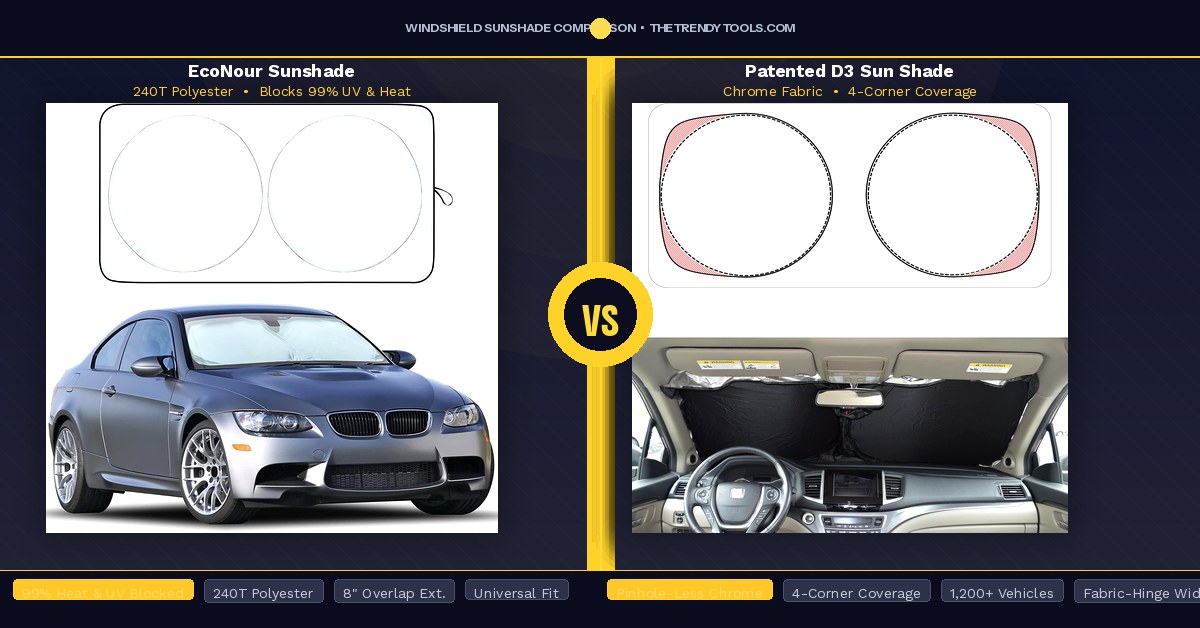
Two products that consistently stand out in this category are the Patented Automotive Windshield Sun Shade (Model D3) and the EcoNour Car Windshield Sunshade. Both promise to block heat and UV rays, both fold for easy storage, and both are designed to fit a wide range of vehicles. But they go about it in meaningfully different ways — and understanding those differences will help you choose the right one for your car, truck, or SUV.
In this in-depth comparison, we’ll break down both products across design, materials, fitment, ease of use, heat protection, durability, and overall value. Let’s get into it.
Quick Side-by-Side Comparison
| Feature | Patented D3 Windshield Sun Shade | EcoNour Car Windshield Sunshade |
|---|---|---|
| Design Type | Foldable with patented support structure | Foldable with overlapping extension panels |
| Corner Coverage | Patented 4-corner coverage | Standard coverage up to 64×32 inches |
| Fabric Material | Pinhole-less chrome plated fabric | 240T polyester |
| Width Adjustability | Fabric-hinge allows compact to truck width | Overlapping design extends up to 8 inches |
| UV/Heat Blocking | Chrome fabric reflects sunlight | Blocks 99% heat and UV rays |
| Vehicle Compatibility | Size chart for 1,200+ vehicles | Universal fit for cars, SUVs, trucks |
| Storage | Stores in door pockets | Folds into included storage pouch |
| Manufacturing | Made in India (in-house) | Not specified |
| Best For | Precise fitment, corner-to-corner coverage | Universal fit, maximum UV blocking |
Design and Construction: Two Different Philosophies
The most important thing to understand about these two sunshades is that they approach the same problem — blocking sunlight through your windshield — from fundamentally different design philosophies. And that philosophy shapes everything from how they fit to how they’re stored.
Patented D3 Sun Shade: Engineering-First Design
The Patented D3 Sun Shade is built around a proprietary support structure that sets it apart from virtually every other windshield shade on the market. Most sunshades are essentially a reflective sheet that you fold and press against your windshield — they cover the flat center portion reasonably well but tend to fall short at the corners, leaving triangular gaps where sunlight streams in unimpeded.
The D3 solves this with a patented structural design that actively covers all four corners of the windshield. This is a meaningful engineering achievement. The corners of a windshield are where the glass curves most sharply, which is precisely why so many sunshades struggle there. The D3’s support structure is designed to conform to those curves and maintain contact across the full glass surface.
The other standout design feature is the fabric-hinge system. The two loop members of the shade are connected by a fabric panel that allows the overall width to be adjusted. Compress it for a compact car’s narrower windshield; extend it for the much wider span of a full-size truck or SUV. This single mechanism gives the D3 a much broader range of fitment options without requiring you to buy multiple sizes.
EcoNour Sunshade: Simplicity and Versatility
EcoNour takes a more streamlined, universally accessible approach. The shade features a classic foldable design with one important upgrade: a reinforced overlapping panel system that can extend up to 8 inches beyond the core shade dimensions. This is EcoNour’s answer to the fitment challenge — rather than a structural frame, it uses overlapping layers that can expand to accommodate wider windshields up to 64 inches wide.
The design is intuitive and quick to deploy. Pop it open, place it against the windshield, and you’re done. No adjustment needed for most vehicles. The overlapping design also means there are no rigid structural components to maintain or break — the whole shade is fabric-based, which contributes to its impressive packability and lightweight feel.
Design Winner: Patented D3 — The patented corner-coverage structure and fabric-hinge adjustability represent a more sophisticated engineering solution. For drivers who want the most precise, gap-free coverage, the D3’s design philosophy delivers more.
Fabric and Materials: What’s Actually Blocking the Sun?
The fabric is the heart of any sunshade — it’s what actually blocks the heat and UV radiation. And the two products take very different material approaches.
Patented D3: Pinhole-Less Chrome Plated Fabric
The D3 uses what the manufacturer describes as pinhole-less chrome plated fabric — and they make a specific, provocative claim about it: every other sunshade on the market uses fabric with micro-pinholes, and the D3 does not.
Micro-pinholes are tiny perforations in the reflective material that, while individually invisible to the naked eye, collectively allow small amounts of UV radiation and light to pass through. The D3’s chrome fabric is engineered to eliminate these pinholes entirely, meaning the reflective barrier is continuous and unbroken across the full surface.
The chrome plating serves a dual purpose: it reflects incoming sunlight away from the vehicle (reducing solar heat gain) and provides a smooth, professional appearance from the outside. The brand manufactures this shade in-house at their own facility in India, which they say allows them to invest the cost savings from cutting out middlemen directly into higher-quality raw materials. Whether you take that claim at face value or not, the pinhole-free manufacturing process represents a genuine differentiator in this product category.
EcoNour: 240T Polyester
EcoNour uses 240T polyester — a thread count designation that indicates a relatively tightly woven fabric. Higher thread counts in polyester generally correlate with greater density, less light transmission, better durability, and improved heat resistance. 240T is a solid mid-range specification that sits above the cheap 190T materials used in many budget sunshades.
EcoNour also makes a bold performance claim: their shade blocks 99% of heat and UV rays. That’s an impressive figure, and 240T polyester is certainly capable of delivering strong UV blocking when used with an appropriate reflective coating on the outer surface. The tightly woven construction helps ensure consistent performance across the full shade area.
The polyester construction also makes the EcoNour particularly durable under repeated folding and unfolding. Fabric-only shades with no rigid structural components tend to hold up well over time since there’s nothing to crack, warp, or break under temperature cycling.
Materials Winner: Patented D3 (on specificity) — The pinhole-less chrome claim is a specific, verifiable differentiator. EcoNour’s 99% heat blocking is compelling but a broadly common marketing claim across this product category. The D3’s material story is more distinctive.
Fitment and Vehicle Compatibility
A sunshade that doesn’t fit properly is worse than no sunshade — it leaves gaps that let light in, slips down while you’re driving away, and provides a false sense of protection. Fitment is arguably the most critical practical consideration when choosing between these two products.
Patented D3: Data-Driven Size Chart for 1,200+ Vehicles
The Patented D3 comes with an extensive size compatibility chart that was built from actual measurements of over 1,200 vehicle windshields. The brand didn’t just create a few generic size categories — they measured real vehicles, analyzed the data, and configured their shade dimensions to deliver the best possible fit across that entire vehicle range.
This data-driven approach to fitment is genuinely impressive and relatively rare in this product category. Most sunshade brands offer a handful of sizes (small, medium, large, XL) and leave it to the customer to figure out which one fits. The D3’s size chart takes the guesswork out of the process by letting you look up your specific year, make, and model to find your recommended configuration.
Combined with the fabric-hinge width adjustment, this means the D3 can be fine-tuned to your specific windshield dimensions rather than forcing you to accept a compromise fit. The brand also offers customer support for fitment issues, promising to resolve any problems if you provide your vehicle details.
EcoNour: Universal Fit with Overlapping Extension
EcoNour takes the universal fit approach. The medium size covers windshields up to 64×32 inches, and the overlapping design can extend up to 8 additional inches in width to accommodate wider glass. Multiple sizes are available, so if the medium doesn’t cover your windshield, there’s likely a larger option that will.
The universal design is a deliberate trade-off: you gain simplicity and ease of purchase (no need to look up your vehicle in a chart), but you may sacrifice the edge-to-edge precision that a vehicle-specific fit provides. For most standard passenger cars and mid-size SUVs, the EcoNour’s coverage will be adequate. For vehicles with unusually large or oddly shaped windshields, the universal approach may leave small gaps.
Fitment Winner: Patented D3 — The 1,200-vehicle measurement database and fabric-hinge adjustability deliver a more precise, customized fit. For drivers who want the most complete coverage possible, the D3’s fitment approach is superior.
Ease of Use and Daily Convenience
The best sunshade is the one you actually use every day — and that means the deployment and storage experience matters enormously. A shade that’s too complicated to set up or too bulky to store will sit in your trunk unused by week two.
Patented D3: Door Pocket Storage
The D3 folds down quickly and is designed specifically to store in your vehicle’s door pockets. This is a thoughtful design choice — door pockets are among the most accessible storage spots in a car, meaning the shade is always within arm’s reach when you park. There’s no hunting around in the trunk or back seat, no special bag to locate, and no fumbling with clips or straps.
Deployment is equally straightforward: pop it out and position it against the windshield. The structural support members spring into shape, and the fabric-hinge allows quick width adjustment if needed. The whole process takes seconds once you’re familiar with the motion.
EcoNour: Included Storage Pouch
EcoNour folds away into a dedicated storage pouch that ships with the shade. The pouch keeps everything organized and protects the fabric from scratches, dust, and damage. It’s a clean, tidy solution, though it does require you to find a spot to store the pouch in your vehicle — glove box, door pocket, under a seat, or in the trunk.
Folding the EcoNour takes only seconds. The fabric-only construction means it collapses easily without resistance, and the lightweight polyester compresses down to a small package. There are no rigid structural parts that need to be aligned or folded in a specific sequence.
Ease of Use Winner: Tie — Both deploy quickly and store conveniently. The D3’s door pocket storage is a clever, vehicle-integrated solution; the EcoNour’s included pouch is a more traditional but equally effective approach. Personal preference will determine which you prefer.
Heat and UV Protection Performance
At the end of the day, the job of a windshield sunshade is to keep your car cooler and protect your interior from UV damage. How do these two products compare on the metrics that actually matter?
Patented D3: Reflective Chrome Surface
The D3’s chrome plated fabric works through reflection — it bounces incoming solar radiation back out through the windshield rather than absorbing it. Reflective sunshades are generally more effective at reducing heat gain than absorptive ones, because reflected energy never enters the vehicle’s thermal environment at all.
The elimination of micro-pinholes means the chrome barrier is truly continuous, with no weak points where radiation can sneak through. The full four-corner coverage further ensures that the reflective layer covers as much glass area as possible, minimizing the unshaded zones where heat typically infiltrates.
EcoNour: 99% Heat and UV Blocking Claim
EcoNour’s stated 99% heat and UV blocking performance is among the strongest claims in this product category. The 240T polyester, when combined with an effective reflective coating, is capable of delivering very high blocking performance across both the infrared (heat) and ultraviolet portions of the solar spectrum.
The 8-inch overlapping extension also contributes to heat protection by ensuring the shade maintains coverage even on windshields that are slightly wider than the core dimensions — a gap at the edge of an otherwise excellent sunshade can allow surprisingly significant heat ingress.
Heat Protection Winner: Effectively Equal — Both products are engineered for serious heat and UV blocking. The D3’s pinhole-less chrome surface and corner-to-corner coverage give it a structural advantage; the EcoNour’s 99% blocking claim represents strong performance in real-world testing. Neither will leave you disappointed.
Durability and Long-Term Value
A windshield sunshade is a product you use almost every day during summer months — and potentially year-round in warm climates. Durability is a legitimate concern, especially for shades that use rigid structural components that can crack, or reflective coatings that can peel and flake over time.
Patented D3
The D3’s in-house manufacturing at the brand’s own India facility means quality control is tightly managed throughout production. The use of higher-quality raw materials (which the brand specifically credits to their vertical manufacturing model and cost savings) is a reassuring indicator of long-term durability. The chrome fabric is designed to maintain its reflective properties without developing pinholes or delamination over time.
The structural support members do introduce some mechanical complexity compared to a purely fabric shade. Over many thousands of fold-and-unfold cycles, these components will see wear. However, the fabric-hinge design distributes stress more evenly than rigid hinge alternatives, which should help extend the useful life of the product.
EcoNour
EcoNour’s 240T polyester construction is inherently durable precisely because it has no rigid structural components to crack or break. The fabric-only design handles repeated folding gracefully, and high-thread-count polyester is known for its resistance to fraying, tearing, and UV degradation over time.
The included storage pouch also protects the shade from surface scratches and contact damage when stored, which helps maintain the reflective coating’s performance over time. For drivers in climates with extremely hot summers, polyester’s heat resistance is an added durability benefit.
Durability Winner: EcoNour (slight edge) — The fabric-only construction’s lack of mechanical components makes it inherently more resilient to long-term wear. But both products are built for durability, and either should last multiple seasons with normal use.
Who Should Buy the Patented D3 Sun Shade?
The Patented D3 is the right choice if:
- You want precise, corner-to-corner windshield coverage with no gaps.
- You drive a vehicle with an unusually large, wide, or steeply curved windshield (trucks, full-size SUVs, minivans) where universal shades often fall short.
- You value patented engineering and a material innovation (pinhole-less chrome) that is genuinely differentiated from the competition.
- You want to use your vehicle’s built-in door pockets for shade storage without an additional pouch or bag.
- Fitment accuracy is your top priority and you’re willing to consult the size chart for your specific vehicle.
The D3 is the choice for the detail-oriented driver who wants the most technically precise fit and isn’t willing to settle for “close enough” when it comes to coverage.
Who Should Buy the EcoNour Windshield Sunshade?
The EcoNour is the better fit if:
- You want a straightforward, no-fuss universal sunshade that works well across a wide range of standard vehicles.
- You prioritize a strong, independently stated heat and UV blocking performance claim (99%).
- You want a purely fabric-based construction with no rigid parts that could crack or break over time.
- You appreciate the organization of a dedicated storage pouch included in the box.
- You own a standard car, compact SUV, or hatchback where universal sizing is accurate enough for excellent coverage.
The EcoNour is the choice for drivers who want a reliable, well-made, easy-to-use sunshade without the need to consult a vehicle compatibility chart or manage a structural frame.
Value for Money
Both products occupy a competitive price point within the mid-range sunshade market. Neither is a budget option, and neither is a premium luxury product — they sit in the practical sweet spot where quality and affordability intersect.
The Patented D3 delivers exceptional value for drivers of larger vehicles (trucks, SUVs, minivans) for whom universal shades have historically been a poor fit. The patented engineering and 1,200+ vehicle size chart represent real development investment that pays off in real-world coverage quality. For compact car owners, the value equation is slightly less compelling since universal shades tend to fit smaller windshields adequately.
The EcoNour delivers excellent value across the board for standard vehicle owners. The 240T polyester, overlapping extension system, included pouch, and strong heat-blocking performance all come together in a package that punches above its price point.
Value Winner: Depends on your vehicle — For trucks and large SUVs, the D3 offers superior value through precise fitment. For standard cars and mid-size crossovers, the EcoNour delivers comparable performance at a user-friendly experience.
Final Verdict
The Patented Automotive Windshield Sun Shade (D3) and the EcoNour Car Windshield Sunshade are both well-designed, effective products that will meaningfully reduce heat buildup in your vehicle. But they serve different driver profiles and different vehicle types.
Choose the Patented D3 if you drive a truck, large SUV, minivan, or crossover and want the most precise, engineered fit available. The patented corner-coverage structure, fabric-hinge adjustability, pinhole-less chrome fabric, and 1,200-vehicle size chart all combine to deliver a level of coverage precision that universal shades simply can’t match. It’s the sunshade for drivers who take fitment seriously.
Choose the EcoNour if you drive a standard passenger car, compact SUV, or hatchback and want a clean, reliable, easy-to-use shade with strong heat and UV protection. The 240T polyester, 99% blocking performance, and included storage pouch make it one of the most complete universal sunshade packages on the market. It’s the sunshade for drivers who want simplicity and performance without the complexity.
Either way, investing in a quality windshield sunshade is one of the smartest, most cost-effective ways to protect your vehicle’s interior — and both of these products are worthy of a spot in your car.
Frequently Asked Questions
Does a windshield sunshade really make a difference in car temperature?
Yes, significantly. Studies have shown that a reflective windshield sunshade can reduce interior car temperatures by 15–30°F compared to a vehicle left in direct sunlight without one. They also protect your dashboard and upholstery from UV-related fading and cracking over time.
Can I use these sunshades in winter too?
Absolutely. In winter, a windshield sunshade can prevent frost and ice from forming on your windshield overnight, reducing your morning warm-up time. Both the D3 and EcoNour can be used year-round for this purpose.
How do I know which size sunshade fits my car?
The Patented D3 offers a detailed size chart based on measurements of 1,200+ vehicles — look up your year, make, and model. For the EcoNour, measure your windshield width and height and compare to the available size options (the medium covers up to 64×32 inches with the 8-inch overlap extension).
Do these sunshades work for rear windows?
Both products are designed specifically for front windshield use. For rear window and side window protection, separate rear and side window sunshades are recommended.
Will these sunshades stick to my windshield?
Neither product uses adhesives or suction cups. Both are held in place by fitting snugly between the windshield and dashboard, relying on their structural dimensions and your closed sun visor flaps for retention. This is standard for foldable windshield sunshades and works reliably in normal conditions.
Which is better for a pickup truck — the D3 or EcoNour?
For a full-size pickup truck with a wide windshield, the Patented D3 is generally the stronger choice. Its fabric-hinge allows it to extend to truck windshield widths, and the 1,200-vehicle size chart helps ensure you select the right configuration. Universal shades like the EcoNour may struggle to cover the full width of a truck windshield even with the 8-inch overlap extension.