

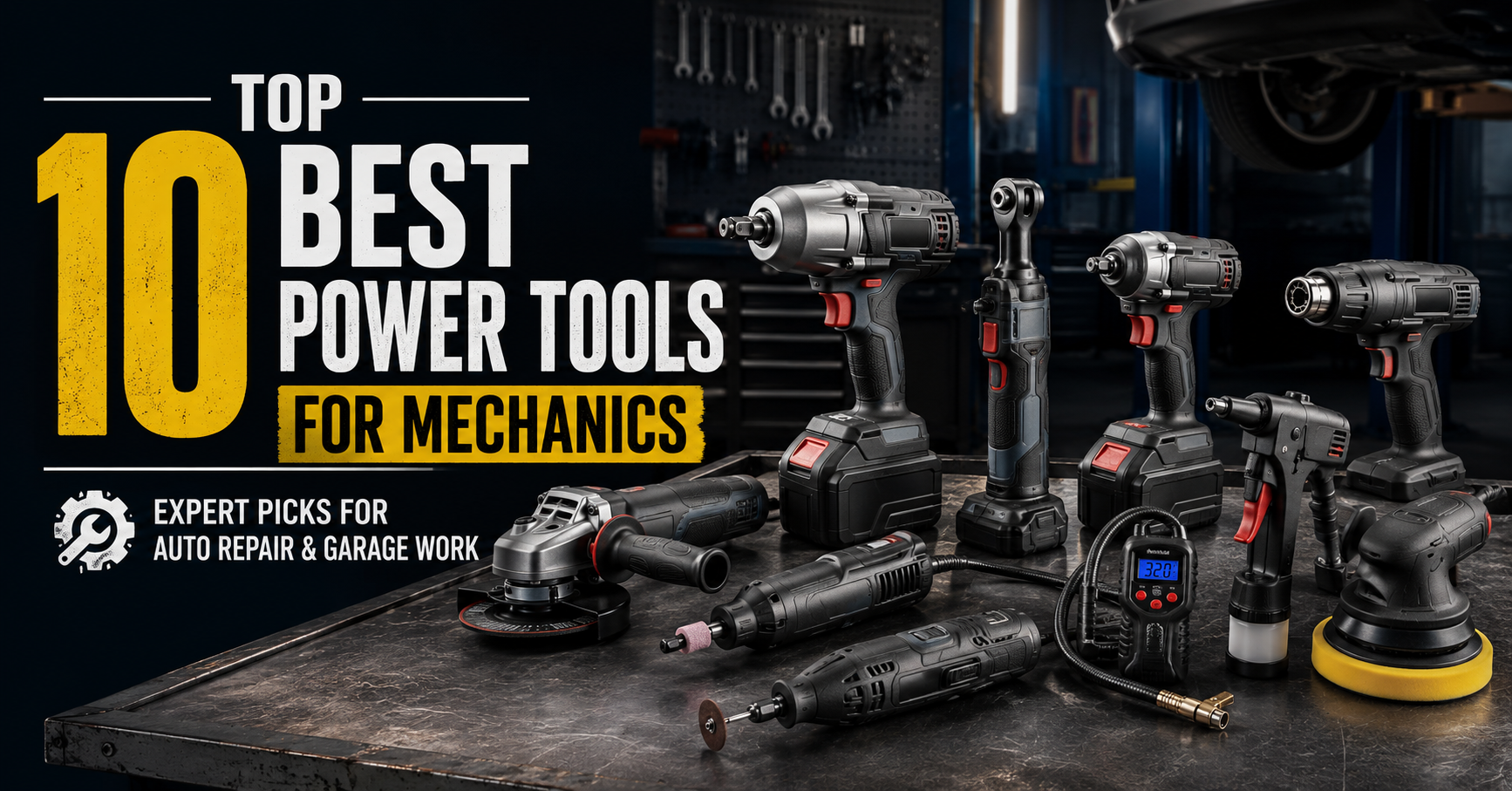
Modern mechanics do not just need strong hands and a full socket set. They need speed, control, torque, portability, and reliable tools that can survive daily use around rust, grease, brake dust, suspension parts, engine bays, and tight underbody spaces. Whether you are a professional auto technician, mobile mechanic, diesel tech, restoration builder, or serious DIY garage owner, choosing the right power tools can make every repair faster and cleaner.
The best power tools for mechanics are not always the biggest or most expensive options. A huge high-torque impact wrench is excellent for lug nuts, axle nuts, crank bolts, and rusted suspension hardware, but it is not the tool you want for delicate trim screws or under-dash work. A cordless ratchet can save your wrist on repetitive fasteners, while a die grinder or rotary tool can make gasket cleanup, rust removal, polishing, and small cutting jobs much easier.
This guide reviews the top 10 power tools every mechanic should consider, with practical explanations of where each tool fits in an automotive workflow. Instead of focusing only on headline torque numbers, this article looks at real shop value: compact size, battery platform, durability, control, comfort, speed settings, and the types of repairs each tool handles best.
Editor’s Note: Prices, kits, batteries, and availability change often. Always confirm the latest package contents before buying, especially when choosing between a bare tool and a kit with batteries and charger.
Quick Comparison: Best Power Tools for Mechanics
| Rank | Tool Type | Top Pick | Best For |
|---|---|---|---|
| 1 | High-Torque Impact Wrench | Milwaukee M18 FUEL 1/2-Inch High Torque Impact Wrench | Lug nuts, axle nuts, suspension bolts, rusted fasteners |
| 2 | Cordless Ratchet | Milwaukee M12 FUEL 3/8-Inch Extended Reach Ratchet | Fastener removal in tight engine bays |
| 3 | Impact Driver | DeWalt 20V MAX XR 1/4-Inch Impact Driver | Interior trim, undertrays, light brackets, small fasteners |
| 4 | Angle Grinder | Makita 18V LXT Brushless 4-1/2-Inch / 5-Inch Grinder | Cutting, grinding, seized exhaust parts, rusted bolts |
| 5 | Die Grinder | Milwaukee M12 FUEL 1/4-Inch Right Angle Die Grinder | Gasket cleanup, deburring, polishing, rust removal |
| 6 | Automotive Polisher | DeWalt 20V MAX Cordless Rotary Polisher | Paint correction, headlight restoration, compounding |
| 7 | Heat Gun | Ryobi 18V ONE+ Cordless Heat Gun | Heat shrink, decals, adhesives, seized parts |
| 8 | Rotary Tool | Dremel 8220 12V Max Cordless Rotary Tool | Precision cutting, polishing, engraving, small detail work |
| 9 | Rivet Tool | Milwaukee M12 Rivet Tool | Body panels, trim repairs, blind rivets, fabrication |
| 10 | Tire Inflator | Milwaukee M12 Compact Inflator | Tire top-offs, mobile service, roadside emergencies |
1. Milwaukee M18 FUEL 1/2-Inch High Torque Impact Wrench
The Milwaukee M18 FUEL 1/2-Inch High Torque Impact Wrench is one of the most useful heavy-duty power tools a mechanic can own. If you regularly deal with rusted lug nuts, axle nuts, suspension bolts, crank pulley bolts, control arm hardware, or truck repair, a high-torque impact wrench should be near the top of your buying list.
This tool is built for situations where ordinary hand tools, breaker bars, and smaller impact wrenches struggle. Its biggest advantage is brute force combined with cordless convenience. Instead of dragging an air hose across the shop or relying on a compressor, you can walk to the vehicle, install the right impact socket, and get to work immediately.
For professional automotive use, the 1/2-inch drive size is the sweet spot for heavy work. It pairs well with impact-rated sockets for wheel service, suspension jobs, drivetrain repairs, and undercar work. The Milwaukee M18 battery platform is also a major benefit because it supports a large range of automotive, construction, and shop tools.
Key Features
- 1/2-inch drive for heavy-duty mechanic work
- High breakaway torque for stubborn and rusted fasteners
- Brushless motor design for better efficiency and durability
- Multiple drive control modes for better fastening control
- Cordless design eliminates the need for an air compressor
- Excellent choice for professional shops, fleet repair, and mobile mechanics
Why Mechanics Like It
The main reason mechanics love this type of impact wrench is time savings. Removing stubborn lug nuts by hand can be slow, physically tiring, and sometimes unsafe when too much leverage is required. A powerful cordless impact wrench can break many fasteners loose in seconds. It also improves workflow when moving from one vehicle to another because you are not tied to an air line.
Best Uses
- Removing and installing lug nuts
- Breaking loose rusted suspension bolts
- Axle nut removal
- Truck and SUV repair
- Crankshaft pulley bolt removal
- Heavy equipment and fleet service
Pros
- Excellent power for difficult automotive fasteners
- Great replacement for many pneumatic impact jobs
- Strong battery platform with many compatible tools
- Ideal for professional and demanding DIY use
Cons
- Heavier than compact or mid-torque impact wrenches
- Can be excessive for small fasteners
- Quality batteries add to the total cost
Verdict: If you want one serious impact wrench for mechanic work, this is the type of tool to buy first. It is not the smallest impact wrench, but for seized, rusted, or high-torque fasteners, it can save huge amounts of time and effort.
2. Milwaukee M12 FUEL 3/8-Inch Extended Reach Ratchet
A cordless ratchet is one of those tools that many mechanics do not fully appreciate until they use one. The Milwaukee M12 FUEL 3/8-Inch Extended Reach Ratchet is designed for repetitive fastening and removal in areas where a large impact wrench will not fit. In engine bays, under dashboards, around intake manifolds, and behind brackets, a cordless ratchet can be a major productivity booster.
The extended reach design gives this tool extra access compared with standard cordless ratchets. That matters in modern vehicles, where fasteners are often buried under wiring, hoses, plastic covers, and tight frame clearances. Instead of loosening a bolt by hand a quarter turn at a time, you can break the fastener loose, then let the ratchet spin it out quickly.
Key Features
- 3/8-inch drive size suitable for common mechanic sockets
- Extended neck for improved access
- Compact head for tight-space work
- Brushless motor design
- Runs on Milwaukee’s compact M12 battery system
- Useful for under-hood and interior repair
Why Mechanics Like It
This is not a replacement for a high-torque impact wrench. Instead, it is a speed tool. Once a bolt is loose, the cordless ratchet removes it quickly without constant manual cranking. It is especially useful for jobs with many small and medium fasteners, such as valve covers, splash shields, brackets, battery trays, interior panels, and engine accessories.
Best Uses
- Engine bay fasteners
- Valve cover bolts
- Alternator and accessory brackets
- Interior and dashboard work
- Underbody shields
- Brake brackets and light suspension hardware
Pros
- Saves significant time on repetitive fasteners
- Excellent access in tight spaces
- Compact battery platform
- Less hand fatigue than manual ratcheting
Cons
- Not meant for breaking extremely tight bolts
- Extended reach may feel longer than necessary in open areas
- Requires impact sockets or quality chrome sockets used properly depending on application
Verdict: For day-to-day auto repair, a cordless ratchet may become one of your most-used power tools. It is not about maximum torque; it is about speed, access, and reducing wrist fatigue.
3. DeWalt 20V MAX XR 1/4-Inch Impact Driver
The DeWalt 20V MAX XR 1/4-Inch Impact Driver is a compact, fast, and versatile tool for lighter mechanic tasks. While impact drivers are more commonly associated with construction and screw driving, they are also very useful in automotive work when paired with the correct adapters and bits.
This tool is ideal for undertrays, splash shields, interior trim, brackets, small bolts, sheet metal screws, license plate hardware, battery hold-downs, and other jobs where speed matters but a full-size impact wrench would be too aggressive. The 1/4-inch hex chuck accepts driver bits, nut drivers, socket adapters, Torx bits, Phillips bits, and many specialty automotive bits.
Key Features
- 1/4-inch hex chuck for fast bit changes
- Compact and lightweight design
- Multiple speed settings for better control
- Brushless motor for efficient performance
- Compatible with DeWalt 20V MAX batteries
- Great for light-duty automotive and shop tasks
Why Mechanics Like It
An impact driver is useful when you need speed more than heavy torque. Many automotive fasteners are small, and using too much power can strip threads, damage plastic clips, or snap bolts. A controlled impact driver helps run fasteners in and out quickly while still being easy to handle with one hand.
Best Uses
- Interior trim screws
- Underbody plastic panels
- Splash shields
- Small brackets
- Battery trays
- Light-duty shop assembly
Pros
- Fast and lightweight
- Excellent for small fasteners
- Easy bit changes
- Useful beyond automotive work
Cons
- Not a replacement for an impact wrench
- Socket adapters can wear if abused
- Can still over-tighten small fasteners if used carelessly
Verdict: The DeWalt 20V MAX XR impact driver is a great supporting tool for mechanics. It is not the right choice for lug nuts, but it shines on smaller automotive jobs where speed and control matter.
4. Makita 18V LXT Brushless 4-1/2-Inch / 5-Inch Cut-Off Angle Grinder
An angle grinder is one of the most important power tools for mechanics who work on rusted vehicles, exhaust systems, fabrication projects, and older cars. The Makita 18V LXT Brushless 4-1/2-Inch / 5-Inch grinder is a strong cordless option for cutting, grinding, cleaning, and surface preparation.
In automotive repair, not every fastener comes off cleanly. Exhaust bolts snap. Brackets rust. Seized hardware rounds off. A grinder gives you a controlled way to cut through metal, remove damaged bolts, clean welds, and shape parts. The 4-1/2-inch to 5-inch wheel size is a practical choice because it balances cutting capacity with manageable tool size.
Key Features
- Brushless motor design
- Compatible with Makita 18V LXT batteries
- Works with common 4-1/2-inch and 5-inch wheels
- Useful for cutting, grinding, and surface prep
- Cordless mobility for shop and field work
- Strong choice for fabrication and rust repair
Why Mechanics Like It
The biggest benefit is freedom. A cordless grinder lets you work under a vehicle, around an exhaust system, or in a junkyard-style environment without searching for an outlet. It is also helpful for quick cuts when setting up a corded grinder would slow the job down.
Best Uses
- Cutting seized exhaust pipes
- Grinding rusted bolts
- Cleaning welds
- Cutting brackets
- Removing damaged hardware
- Light fabrication
Pros
- Very versatile for automotive repair
- Cordless design improves mobility
- Good size for cutting and grinding
- Excellent for rust-belt mechanics
Cons
- Consumes batteries quickly under heavy use
- Requires proper eye, face, and hand protection
- Not as compact as a die grinder for detail work
Verdict: A cordless angle grinder is essential for mechanics who deal with rust, exhaust work, and fabrication. The Makita 18V LXT brushless grinder is a strong choice for users already invested in Makita batteries.
5. Milwaukee M12 FUEL 1/4-Inch Right Angle Die Grinder
The Milwaukee M12 FUEL 1/4-Inch Right Angle Die Grinder is one of the best cordless surface-preparation tools for mechanics. It is designed for jobs where an angle grinder is too large and a rotary tool is too small. This makes it excellent for gasket cleanup, rust removal, deburring, polishing, light grinding, and cleaning tight metal surfaces.
For many years, die grinders were mostly pneumatic tools. Air die grinders are still common in professional shops, but cordless models have become much more attractive because they remove the need for air hoses and compressors. For mobile mechanics, restoration work, and quick shop jobs, cordless freedom is a huge advantage.
Key Features
- 1/4-inch collet for common die grinder accessories
- Right-angle head for better access
- Brushless motor design
- Compact M12 battery platform
- Useful for gasket cleaning, polishing, and deburring
- Great alternative to pneumatic die grinders for many jobs
Why Mechanics Like It
This tool is extremely useful during engine work, brake service, exhaust repair, and restoration projects. When replacing gaskets, cleaning mating surfaces properly is critical. A die grinder with the correct abrasive pad can remove old material faster than hand scraping, but it must be used carefully to avoid damaging aluminum or machined surfaces.
Best Uses
- Cleaning gasket surfaces
- Removing rust from brackets
- Deburring metal edges
- Polishing small parts
- Cleaning brake components
- Surface prep before paint or welding
Pros
- Compact and easy to control
- No air hose required
- Excellent for surface preparation
- Works well in tight automotive spaces
Cons
- Not intended for heavy cutting like an angle grinder
- Accessory choice matters greatly
- Can remove material too quickly if used carelessly
Verdict: For mechanics who do gasket work, rust cleanup, and detail grinding, this is one of the most useful specialty cordless tools available. It fills the gap between a large grinder and a small rotary tool.
6. DeWalt 20V MAX Cordless Rotary Polisher
The DeWalt 20V MAX Cordless Rotary Polisher is a valuable tool for mechanics, detailers, body shop workers, and restoration enthusiasts. While it is not used for mechanical disassembly, it plays an important role in paint correction, headlight restoration, gelcoat work, and refinishing tasks.
A rotary polisher is more aggressive than many dual-action polishers, which makes it effective for compounding and correcting deeper defects. However, that extra power also means it requires skill. Used incorrectly, a rotary polisher can create swirl marks, burn paint, or remove too much clear coat. Used correctly, it can restore shine and clarity to faded or damaged finishes.
Key Features
- Cordless design for easier movement around vehicles
- Brushless motor
- Variable speed control
- Useful for paint correction and headlight restoration
- Compatible with DeWalt 20V MAX batteries
- Good option for mobile detailers and auto shops
Why Mechanics Like It
Many automotive shops do more than mechanical repairs. They restore headlights, clean up customer vehicles, polish painted parts, and handle light body-related tasks. A cordless polisher makes these jobs easier because there is no cord dragging across paint or getting caught under tires.
Best Uses
- Paint correction
- Headlight restoration
- Compounding oxidized paint
- Polishing fiberglass and gelcoat
- Restoration projects
- Detailing work
Pros
- No cord to drag across paint
- Strong polishing performance
- Variable speed for better control
- Great for detailers and restoration mechanics
Cons
- Rotary polishers require practice
- Can damage paint if misused
- Not a must-have for every mechanic
Verdict: If your work includes detailing, restoration, paint correction, or headlight repair, the DeWalt cordless rotary polisher is a highly useful addition to your automotive power tool collection.
7. Ryobi 18V ONE+ Cordless Heat Gun
The Ryobi 18V ONE+ Cordless Heat Gun is a practical and affordable tool for automotive electrical work, adhesive removal, trim work, and light repair tasks. A heat gun is safer and more controlled than using an open flame, especially around wiring, paint, plastic, rubber, fuel lines, and interior panels.
Mechanics often need heat for more than one reason. Heat shrink tubing, wire connectors, decals, badges, window tint, seam sealer, and adhesive-backed trim all benefit from controlled heat. A cordless heat gun is especially convenient because you can grab it quickly without running an extension cord.
Key Features
- Cordless 18V design
- Compatible with Ryobi ONE+ batteries
- Useful for heat shrink and adhesive softening
- Good for mobile and garage use
- More controlled than open flame methods
- Lightweight and easy to store
Why Mechanics Like It
Electrical repairs are one of the best uses for a cordless heat gun. Properly shrinking tubing over a soldered or crimped repair helps protect the connection from moisture and vibration. A heat gun can also soften stubborn decals, loosen adhesive, and help with plastic trim work.
Best Uses
- Shrinking heat tubing
- Softening adhesive
- Removing badges and decals
- Window tint work
- Light plastic forming
- Warming seized areas carefully
Pros
- Affordable and convenient
- Safer than an open flame for many jobs
- Great for wiring and adhesive work
- Useful around the garage and home
Cons
- Battery runtime can be limited
- Not as powerful as many corded heat guns
- Not ideal for large-area heating
Verdict: The Ryobi cordless heat gun is not the most powerful tool on this list, but it is one of the most convenient. For wiring, trim, adhesives, and quick heat jobs, it is a smart addition to a mechanic’s kit.
8. Dremel 8220 12V Max Cordless Rotary Tool
The Dremel 8220 12V Max Cordless Rotary Tool is a precision tool for small cutting, grinding, sanding, engraving, polishing, and detail cleaning. It is not meant to replace a die grinder or angle grinder, but it is excellent for delicate jobs where larger tools are too aggressive.
Mechanics often face small problems that need careful tool control: a stripped screw slot, a small bracket that needs trimming, corrosion in a tight area, a plastic tab that needs shaping, or a small part that needs polishing. A rotary tool gives you that control.
Key Features
- 12V cordless design
- Compatible with many Dremel accessories
- Good for cutting, sanding, grinding, polishing, and engraving
- Compact and easy to maneuver
- Useful for precision repairs
- Great for small metal, plastic, and detail work
Why Mechanics Like It
The biggest strength of a Dremel-style rotary tool is precision. It lets you do small jobs without damaging nearby parts. For interior repairs, motorcycle work, electrical projects, hobby fabrication, and restoration details, it can be extremely useful.
Best Uses
- Cleaning stripped screw heads
- Cutting small brackets
- Engraving parts
- Polishing small components
- Detail sanding
- Plastic trimming
Pros
- Very precise
- Huge accessory selection
- Compact and lightweight
- Good for detail-oriented work
Cons
- Not for heavy grinding or cutting
- Small accessories wear quickly
- Can feel underpowered for thick metal
Verdict: The Dremel 8220 is the best type of tool for small, detailed automotive tasks. Every mechanic may not use it daily, but when a precision job appears, it can be the perfect solution.
9. Milwaukee M12 Rivet Tool
The Milwaukee M12 Rivet Tool is a specialized but extremely helpful tool for mechanics who work on body panels, interior trim, trailers, fabrication, underbody panels, and equipment repair. Blind rivets are common in automotive and light industrial work, and installing them by hand can be tiring when you have more than a few to set.
A cordless rivet tool reduces hand fatigue and improves consistency. Instead of squeezing a manual riveter repeatedly, you place the rivet, pull the trigger, and let the tool do the work. For body shop technicians, trailer repair shops, restoration builders, and fleet mechanics, this can save a lot of time.
Key Features
- Cordless M12 platform
- Designed for blind rivet installation
- Reduces hand fatigue compared with manual riveters
- Useful for steel, aluminum, and stainless rivets depending on size and setup
- Compact enough for automotive work
- Good for body, trim, and fabrication tasks
Why Mechanics Like It
Manual rivet tools are fine for occasional use, but they become tiring on larger jobs. A cordless rivet tool makes the process faster and more consistent. It is especially helpful when working overhead, inside panels, or in awkward positions where hand force is difficult.
Best Uses
- Body panel repair
- Interior trim repair
- Trailer maintenance
- Fabrication projects
- Underbody panels
- Equipment and fleet repair
Pros
- Greatly reduces hand fatigue
- Improves speed on repeated rivets
- Compact cordless design
- Professional finish on rivet jobs
Cons
- More specialized than an impact wrench or ratchet
- Not necessary for every garage
- Requires correct rivet size and material selection
Verdict: If you regularly install rivets, this tool is worth it. It may not be the first power tool a beginner mechanic buys, but for body, trim, trailer, and fabrication work, it is a major upgrade over manual riveters.
10. Milwaukee M12 Compact Inflator
The Milwaukee M12 Compact Inflator is a small but highly practical tool for mechanics, mobile technicians, and vehicle owners. Tire pressure affects safety, tire wear, fuel economy, and handling. Having a compact cordless inflator nearby makes it easy to top off tires after service or handle low-pressure situations on the road.
This tool is especially useful for mobile mechanics and roadside work. Instead of relying on a shop compressor or gas station air pump, you can adjust tire pressure wherever the vehicle is located. It is also handy for motorcycles, trailers, compact equipment, and seasonal tire checks.
Key Features
- Compact cordless design
- Runs on Milwaukee M12 batteries
- Useful for car and light truck tires
- Automatic shut-off features on many modern inflators help prevent overfilling
- Easy to store in a service vehicle or garage
- Great for mobile work and emergency use
Why Mechanics Like It
A tire inflator is not exciting like an impact wrench, but it is used often. After rotating tires, repairing a flat, checking a customer complaint, or preparing a vehicle for delivery, accurate tire pressure matters. A cordless inflator makes the process simple and portable.
Best Uses
- Tire pressure top-offs
- Mobile mechanic service
- Roadside emergencies
- Trailer tires
- Motorcycle tires
- Seasonal pressure checks
Pros
- Compact and portable
- Very useful for routine maintenance
- Good for mobile technicians
- Easy to keep in a vehicle or toolbox
Cons
- Not a replacement for a large shop compressor
- Battery-powered inflators can heat up during extended use
- Best for top-offs rather than continuous heavy inflation
Verdict: The Milwaukee M12 Compact Inflator is a simple tool that solves a common problem. It is an excellent choice for mechanics who want a portable, accurate, and easy-to-store tire inflation solution.
How to Choose the Best Power Tools for Mechanics
Buying automotive power tools is not just about picking the strongest tool available. Mechanics need the right balance of torque, size, control, durability, and battery compatibility. Before you buy, consider how often you will use the tool and what jobs you expect it to handle.
1. Start With Your Most Common Jobs
If you do wheel, brake, and suspension work, start with a strong impact wrench and a cordless ratchet. If you do detailing and restoration, a polisher, rotary tool, and die grinder may be more important. If you work on rusty vehicles, an angle grinder becomes essential.
2. Choose a Battery Platform Carefully
Battery platforms matter because batteries and chargers are expensive. Milwaukee M18 and M12, DeWalt 20V MAX, Makita 18V LXT, and Ryobi ONE+ all have strong ecosystems. If you already own batteries from one brand, it may make sense to stay within that platform unless another tool offers a major advantage.
3. Do Not Ignore Tool Size
Large tools usually provide more power, but mechanics often work in tight spaces. A compact impact, cordless ratchet, right-angle die grinder, or small rotary tool may be more useful than a huge tool that cannot reach the fastener.
4. Look for Control Features
Variable speed triggers, multiple modes, auto shut-off functions, and brake systems can protect fasteners and improve safety. Mechanics regularly move between large bolts, small screws, plastic clips, and delicate parts, so control matters as much as power.
5. Use the Right Accessories
Even the best power tool performs poorly with the wrong accessory. Use impact-rated sockets with impact wrenches, quality abrasive discs with grinders, correct polishing pads with polishers, and proper rivets with rivet tools. Cheap accessories can damage parts, reduce performance, or create safety risks.
Essential Safety Tips for Automotive Power Tools
- Always wear eye protection when using impact tools, grinders, die grinders, and rotary tools.
- Use hearing protection during extended impact or grinding work.
- Wear gloves when handling sharp metal, but avoid loose gloves near spinning tools.
- Use jack stands before working under any vehicle.
- Never use chrome hand sockets on high-torque impact wrenches.
- Keep sparks away from fuel, brake cleaner, solvents, and flammable materials.
- Let grinders and cutting wheels reach full speed before contacting the workpiece.
- Do not over-tighten critical fasteners; always follow final torque specs with a torque wrench.
Best Power Tool Setup for Beginner Mechanics
If you are just starting your mechanic tool collection, you do not need to buy all 10 tools at once. A smart beginner setup would include a high-torque or mid-torque impact wrench, a cordless ratchet, a good work light, and a tire inflator. After that, add an impact driver, angle grinder, and die grinder based on the type of work you do most often.
For most DIY mechanics, the best first power tool is a cordless impact wrench. It immediately helps with wheel removal, brake work, suspension jobs, and general repair. The second most useful tool is usually a cordless ratchet because it speeds up repetitive work. After that, your choices depend on whether you focus more on repair, restoration, fabrication, or detailing.
Best Power Tool Setup for Professional Mechanics
Professional mechanics should think in terms of workflow. A high-torque impact handles the stubborn hardware. A compact impact or impact driver handles lighter fastening. A cordless ratchet handles tight areas. A die grinder and angle grinder handle rust, cutting, and surface prep. A tire inflator, heat gun, rotary tool, and rivet tool cover the specialty jobs that appear throughout the week.
The biggest advantage of a complete cordless setup is mobility. You can move around the vehicle, work outside the bay, help another technician, or handle mobile service without dragging hoses and cords everywhere. This is why cordless automotive power tools have become so popular in modern US repair shops.
Frequently Asked Questions
What is the most important power tool for a mechanic?
For most mechanics, the most important power tool is a cordless 1/2-inch impact wrench. It saves time on lug nuts, suspension bolts, axle nuts, and other stubborn fasteners. A cordless ratchet is usually the second most useful tool because it speeds up smaller fastener removal in tight spaces.
Are cordless tools better than air tools for mechanics?
Cordless tools are better for mobility, convenience, and quick jobs because they do not require an air compressor or hose. Air tools can still be excellent for continuous heavy-duty shop use, but modern cordless tools are powerful enough to replace many pneumatic tools in daily automotive work.
Do mechanics need an impact driver?
An impact driver is not a replacement for an impact wrench, but it is useful for small fasteners, trim screws, undertrays, brackets, and light-duty automotive work. It is also useful around the shop for assembly tasks.
Should I buy Milwaukee, DeWalt, Makita, Ryobi, or Dremel?
Each brand has strengths. Milwaukee is especially strong in automotive cordless tools, ratchets, impacts, and specialty tools. DeWalt has excellent 20V MAX tools and polishers. Makita is known for durable grinders and a strong 18V LXT platform. Ryobi is a good value choice for occasional and DIY use. Dremel remains one of the most popular names for precision rotary tools.
Can I use regular sockets with an impact wrench?
No. Use impact-rated sockets with impact wrenches. Regular chrome sockets can crack or shatter under impact force. Impact sockets are designed to handle the repeated hammering action of impact tools.
Is a cordless ratchet strong enough to remove tight bolts?
A cordless ratchet is mainly a speed tool, not a high-torque breaker. For very tight bolts, break the fastener loose manually or with an impact wrench first, then use the cordless ratchet to remove it quickly.
Is a die grinder or rotary tool better for mechanics?
A die grinder is better for heavier surface preparation, gasket cleanup, deburring, and rust removal. A rotary tool is better for small precision work, light cutting, polishing, and detailed repairs. Many mechanics eventually benefit from owning both.
Final Verdict: What Are the Best Power Tools for Mechanics?
The best power tools for mechanics are the ones that save time without sacrificing control. For heavy-duty repair, the Milwaukee M18 FUEL 1/2-Inch High Torque Impact Wrench is the top choice because it handles stubborn automotive fasteners that smaller tools cannot. For daily under-hood work, the Milwaukee M12 FUEL 3/8-Inch Extended Reach Ratchet is one of the biggest time-savers in any toolbox.
The DeWalt 20V MAX XR Impact Driver is excellent for lighter automotive fastening, while the Makita 18V LXT Angle Grinder is essential for rust, cutting, and fabrication. The Milwaukee M12 FUEL Right Angle Die Grinder is a smart pick for gasket cleanup and surface prep, and the DeWalt cordless rotary polisher is ideal for paint correction and restoration work.
For specialty tasks, the Ryobi cordless heat gun, Dremel 8220 rotary tool, Milwaukee M12 rivet tool, and Milwaukee M12 compact inflator all bring practical value to a mechanic’s workflow. You may not use every one of them on every job, but together they create a complete cordless tool setup for repair, restoration, detailing, fabrication, and mobile service.
If you are building your mechanic power tool collection from scratch, start with the tools that solve your most common problems: impact wrench, cordless ratchet, impact driver, grinder, and inflator. Then add specialty tools as your work demands grow. With the right setup, you can work faster, reduce hand fatigue, and handle more automotive jobs with confidence.